 Add to Chrome
 Add to Firefox
 Add to Edge
Anthropogenic Regional Adaptation in Multimodal Vision-Language Model
Apr 13, 2026
While the field of vision-language (VL) has achieved remarkable success in integrating visual and textual information across multiple languages and domains, there is still no dedicated framework for assessing human-centric alignment in vision-language systems. We offer two contributions to address this gap. First, we introduce Anthropogenic Regional Adaptation: a novel paradigm that aims to optimize model relevance to specific regional contexts while ensuring the retention of global generalization capabilities. Second, we present a simple, but effective adaptation method named Geographical-generalization-made-easy (GG-EZ), which utilizes regional data filtering and model merging. Through comprehensive experiments on 3 VL architectures: large vision-language models, text-to-image diffusion models, and vision-language embedding models, and a case study in Southeast Asia (SEA) regional adaptation, we demonstrate the importance of Anthropogenic Regional Adaptation and the effectiveness of GG-EZ, showing 5-15% gains in cultural relevance metrics across SEA while maintaining over 98% of global performance and even occasionally surpassing it. Our findings establish Anthropogenic Regional Alignment as a foundational paradigm towards applicability of multimodal vision-language models in diverse regions and demonstrate a simple-yet-effective baseline method that optimizes regional value alignment while preserving global generalization.

NusaAksara: A Multimodal and Multilingual Benchmark for Preserving Indonesian Indigenous Scripts
Feb 25, 2025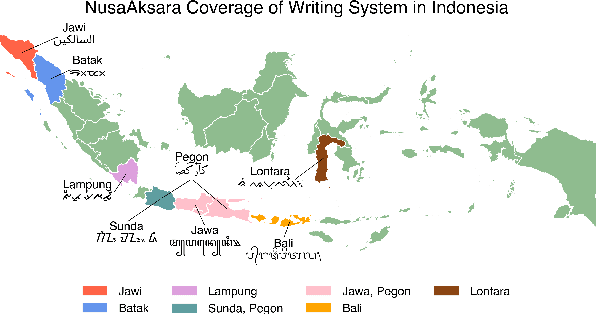
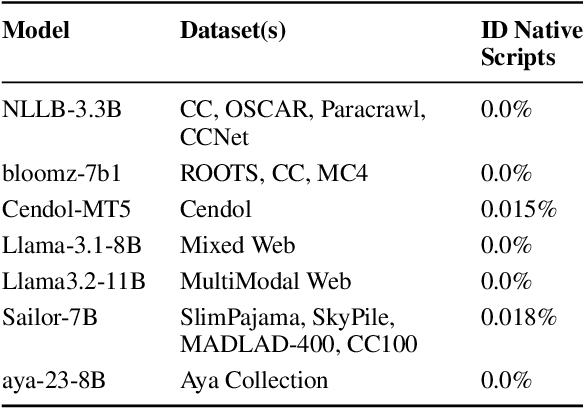
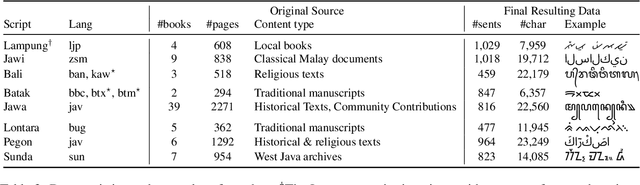
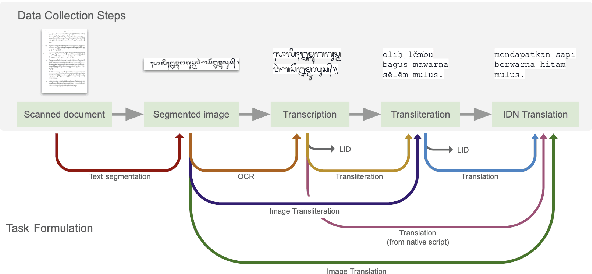
Indonesia is rich in languages and scripts. However, most NLP progress has been made using romanized text. In this paper, we present NusaAksara, a novel public benchmark for Indonesian languages that includes their original scripts. Our benchmark covers both text and image modalities and encompasses diverse tasks such as image segmentation, OCR, transliteration, translation, and language identification. Our data is constructed by human experts through rigorous steps. NusaAksara covers 8 scripts across 7 languages, including low-resource languages not commonly seen in NLP benchmarks. Although unsupported by Unicode, the Lampung script is included in this dataset. We benchmark our data across several models, from LLMs and VLMs such as GPT-4o, Llama 3.2, and Aya 23 to task-specific systems such as PP-OCR and LangID, and show that most NLP technologies cannot handle Indonesia's local scripts, with many achieving near-zero performance.
IndoToxic2024: A Demographically-Enriched Dataset of Hate Speech and Toxicity Types for Indonesian Language
Jun 27, 2024

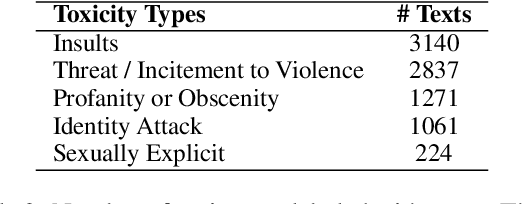
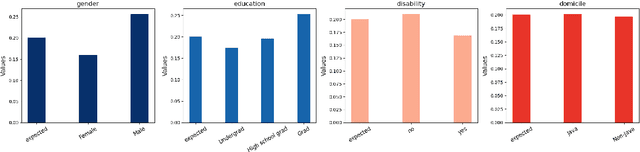
Hate speech poses a significant threat to social harmony. Over the past two years, Indonesia has seen a ten-fold increase in the online hate speech ratio, underscoring the urgent need for effective detection mechanisms. However, progress is hindered by the limited availability of labeled data for Indonesian texts. The condition is even worse for marginalized minorities, such as Shia, LGBTQ, and other ethnic minorities because hate speech is underreported and less understood by detection tools. Furthermore, the lack of accommodation for subjectivity in current datasets compounds this issue. To address this, we introduce IndoToxic2024, a comprehensive Indonesian hate speech and toxicity classification dataset. Comprising 43,692 entries annotated by 19 diverse individuals, the dataset focuses on texts targeting vulnerable groups in Indonesia, specifically during the hottest political event in the country: the presidential election. We establish baselines for seven binary classification tasks, achieving a macro-F1 score of 0.78 with a BERT model (IndoBERTweet) fine-tuned for hate speech classification. Furthermore, we demonstrate how incorporating demographic information can enhance the zero-shot performance of the large language model, gpt-3.5-turbo. However, we also caution that an overemphasis on demographic information can negatively impact the fine-tuned model performance due to data fragmentation.