 Add to Chrome
 Add to Firefox
 Add to Edge
Sparse Gain Radio Map Reconstruction With Geometry Priors and Uncertainty-Guided Measurement Selection
Apr 07, 2026
Radio maps are important for environment-aware wireless communication, network planning, and radio resource optimization. However, dense radio map construction remains challenging when only a limited number of measurements are available, especially in complex urban environments with strong blockages, irregular geometry, and restricted sensing accessibility. Existing methods have explored interpolation, low-rank cartography, deep completion, and channel knowledge map (CKM) construction, but many of these methods insufficiently exploit explicit geometric priors or overlook the value of predictive uncertainty for subsequent sensing. In this paper, we study sparse gain radio map reconstruction from a geometry-aware and active sensing perspective. We first construct \textbf{UrbanRT-RM}, a controllable ray-tracing benchmark with diverse urban layouts, multiple base-station deployments, and multiple sparse sampling modes. We then propose \textbf{GeoUQ-GFNet}, a lightweight network that jointly predicts a dense gain radio map and a spatial uncertainty map from sparse measurements and structured scene priors. The predicted uncertainty is further used to guide active measurement selection under limited sensing budgets. Extensive experiments show that our proposed GeoUQ-GFNet method achieves strong and consistent reconstruction performance across different scenes and transmitter placements generated using UrbanRT-RM. Moreover, uncertainty-guided querying provides more effective reconstruction improvement than non-adaptive sampling under the same additional measurement budget. These results demonstrate the effectiveness of combining geometry-aware learning, uncertainty estimation, and benchmark-driven evaluation for sparse radio map reconstruction in complex urban environments.

Multi-Modal Sensing and Fusion in mmWave Beamforming for Connected Vehicles: A Transformer Based Framework
Feb 14, 2026Millimeter wave (mmWave) communication, utilizing beamforming techniques to address the inherent path loss limitation, is considered as one of the key technologies to support ever increasing high throughput and low latency demands of connected vehicles. However, adopting standard defined beamforming approach in highly dynamic vehicular environments often incurs high beam training overheads and reduction in the available airtime for communications, which is mainly due to exchanging pilot signals and exhaustive beam measurements. To this end, we present a multi-modal sensing and fusion learning framework as a potential alternative solution to reduce such overheads. In this framework, we first extract the representative features from the sensing modalities by modality specific encoders, then, utilize multi-head cross-modal attention to learn dependencies and correlations between different modalities, and subsequently fuse the multimodal features to obtain predicted top-k beams so that the best line-of-sight links can be proactively established. To show the generalizability of the proposed framework, we perform a comprehensive experiment in four different vehicle-to-infrastructure (V2I) and vehicle-to-vehicle (V2V) scenarios from real world multimodal and 60 GHz mmWave wireless sensing data. The experiment reveals that the proposed framework (i) achieves up to 96.72% accuracy on predicting top-15 beams correctly, (ii) incurs roughly 0.77 dB average power loss, and (iii) improves the overall latency and beam searching space overheads by 86.81% and 76.56% respectively for top-15 beams compared to standard defined approach.
* 13 Pages. arXiv admin note: text overlap with arXiv:2509.11112
Multi-Modality Sensing in mmWave Beamforming for Connected Vehicles Using Deep Learning
Apr 08, 2025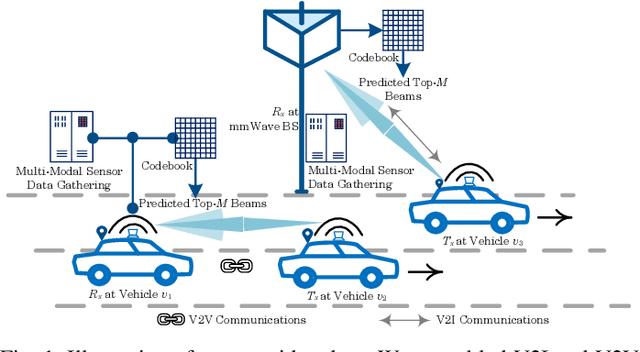
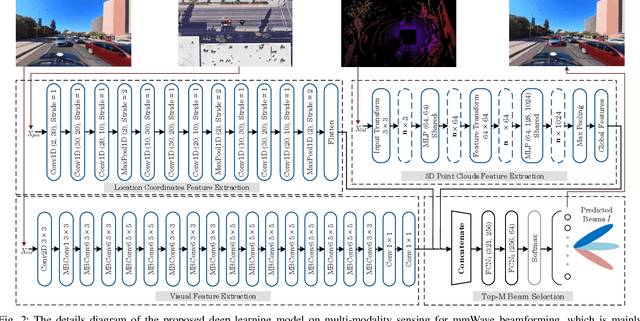
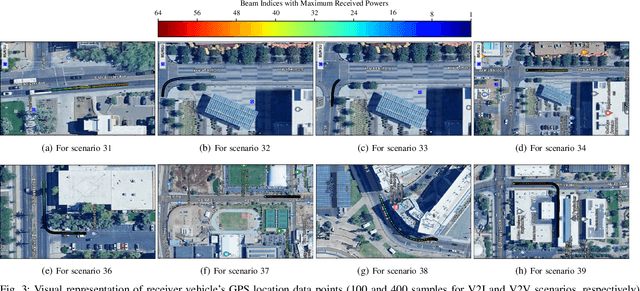
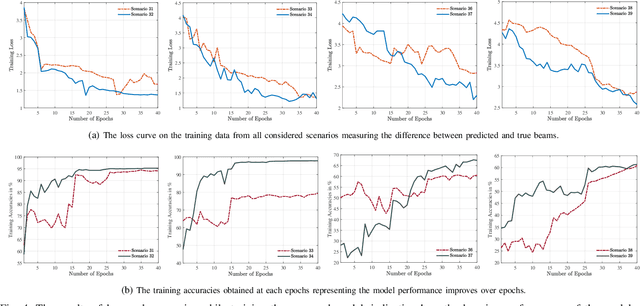
Beamforming techniques are considered as essential parts to compensate severe path losses in millimeter-wave (mmWave) communications. In particular, these techniques adopt large antenna arrays and formulate narrow beams to obtain satisfactory received powers. However, performing accurate beam alignment over narrow beams for efficient link configuration by traditional standard defined beam selection approaches, which mainly rely on channel state information and beam sweeping through exhaustive searching, imposes computational and communications overheads. And, such resulting overheads limit their potential use in vehicle-to-infrastructure (V2I) and vehicle-to-vehicle (V2V) communications involving highly dynamic scenarios. In comparison, utilizing out-of-band contextual information, such as sensing data obtained from sensor devices, provides a better alternative to reduce overheads. This paper presents a deep learning-based solution for utilizing the multi-modality sensing data for predicting the optimal beams having sufficient mmWave received powers so that the best V2I and V2V line-of-sight links can be ensured proactively. The proposed solution has been tested on real-world measured mmWave sensing and communication data, and the results show that it can achieve up to 98.19% accuracies while predicting top-13 beams. Correspondingly, when compared to existing been sweeping approach, the beam sweeping searching space and time overheads are greatly shortened roughly by 79.67% and 91.89%, respectively which confirm a promising solution for beamforming in mmWave enabled communications.
* 15 Pages
Position Aware 60 GHz mmWave Beamforming for V2V Communications Utilizing Deep Learning
Feb 02, 2024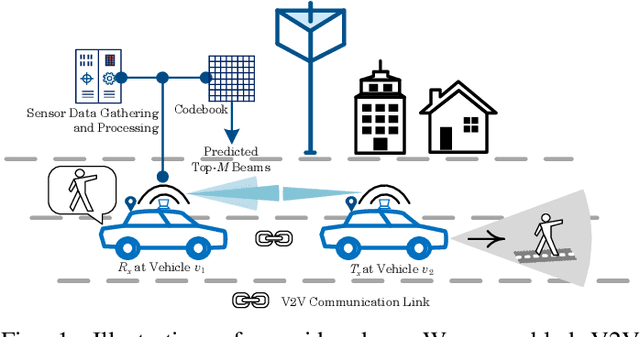
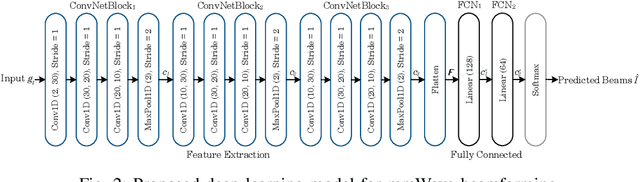
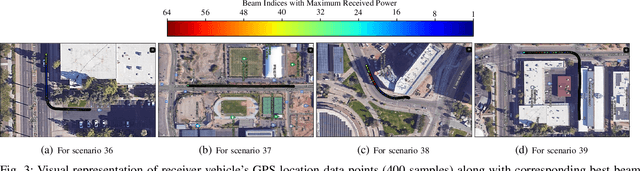
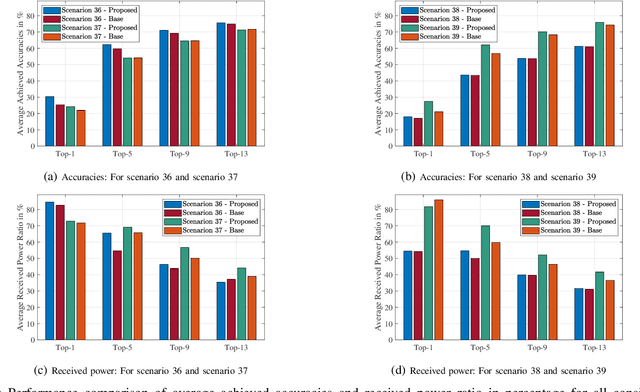
Beamforming techniques are considered as essential parts to compensate the severe path loss in millimeter-wave (mmWave) communications by adopting large antenna arrays and formulating narrow beams to obtain satisfactory received powers. However, performing accurate beam alignment over such narrow beams for efficient link configuration by traditional beam selection approaches, mainly relied on channel state information, typically impose significant latency and computing overheads, which is often infeasible in vehicle-to-vehicle (V2V) communications like highly dynamic scenarios. In contrast, utilizing out-of-band contextual information, such as vehicular position information, is a potential alternative to reduce such overheads. In this context, this paper presents a deep learning-based solution on utilizing the vehicular position information for predicting the optimal beams having sufficient mmWave received powers so that the best V2V line-of-sight links can be ensured proactively. After experimental evaluation of the proposed solution on real-world measured mmWave sensing and communications datasets, the results show that the solution can achieve up to 84.58% of received power of link status on average, which confirm a promising solution for beamforming in mmWave at 60 GHz enabled V2V communications.