 Add to Chrome
 Add to Firefox
 Add to Edge
HiNS: Hierarchical Negative Sampling for More Comprehensive Memory Retrieval Embedding Model
Jan 21, 2026
Memory-augmented language agents rely on embedding models for effective memory retrieval. However, existing training data construction overlooks a critical limitation: the hierarchical difficulty of negative samples and their natural distribution in human-agent interactions. In practice, some negatives are semantically close distractors while others are trivially irrelevant, and natural dialogue exhibits structured proportions of these types. Current approaches using synthetic or uniformly sampled negatives fail to reflect this diversity, limiting embedding models' ability to learn nuanced discrimination essential for robust memory retrieval. In this work, we propose a principled data construction framework HiNS that explicitly models negative sample difficulty tiers and incorporates empirically grounded negative ratios derived from conversational data, enabling the training of embedding models with substantially improved retrieval fidelity and generalization in memory-intensive tasks. Experiments show significant improvements: on LoCoMo, F1/BLEU-1 gains of 3.27%/3.30%(MemoryOS) and 1.95%/1.78% (Mem0); on PERSONAMEM, total score improvements of 1.19% (MemoryOS) and 2.55% (Mem0).

O-Mem: Omni Memory System for Personalized, Long Horizon, Self-Evolving Agents
Nov 18, 2025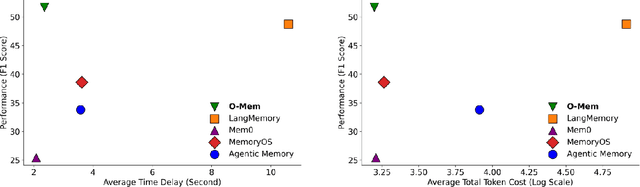
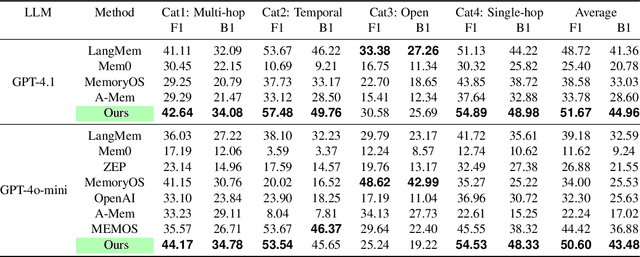
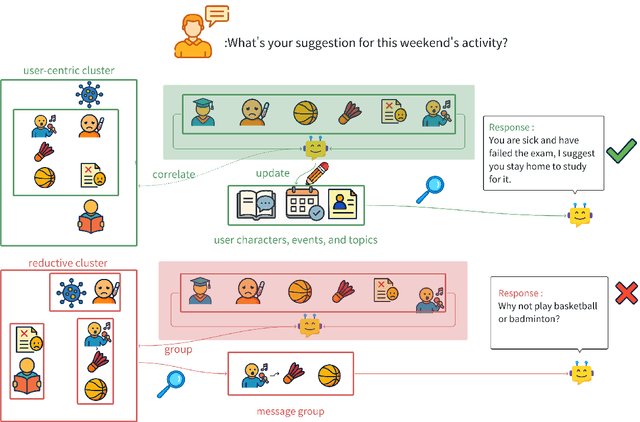

Recent advancements in LLM-powered agents have demonstrated significant potential in generating human-like responses; however, they continue to face challenges in maintaining long-term interactions within complex environments, primarily due to limitations in contextual consistency and dynamic personalization. Existing memory systems often depend on semantic grouping prior to retrieval, which can overlook semantically irrelevant yet critical user information and introduce retrieval noise. In this report, we propose the initial design of O-Mem, a novel memory framework based on active user profiling that dynamically extracts and updates user characteristics and event records from their proactive interactions with agents. O-Mem supports hierarchical retrieval of persona attributes and topic-related context, enabling more adaptive and coherent personalized responses. O-Mem achieves 51.67% on the public LoCoMo benchmark, a nearly 3% improvement upon LangMem,the previous state-of-the-art, and it achieves 62.99% on PERSONAMEM, a 3.5% improvement upon A-Mem,the previous state-of-the-art. O-Mem also boosts token and interaction response time efficiency compared to previous memory frameworks. Our work opens up promising directions for developing efficient and human-like personalized AI assistants in the future.