 Add to Chrome
 Add to Firefox
 Add to Edge
DECKBench: Benchmarking Multi-Agent Frameworks for Academic Slide Generation and Editing
Feb 10, 2026
Automatically generating and iteratively editing academic slide decks requires more than document summarization. It demands faithful content selection, coherent slide organization, layout-aware rendering, and robust multi-turn instruction following. However, existing benchmarks and evaluation protocols do not adequately measure these challenges. To address this gap, we introduce the Deck Edits and Compliance Kit Benchmark (DECKBench), an evaluation framework for multi-agent slide generation and editing. DECKBench is built on a curated dataset of paper to slide pairs augmented with realistic, simulated editing instructions. Our evaluation protocol systematically assesses slide-level and deck-level fidelity, coherence, layout quality, and multi-turn instruction following. We further implement a modular multi-agent baseline system that decomposes the slide generation and editing task into paper parsing and summarization, slide planning, HTML creation, and iterative editing. Experimental results demonstrate that the proposed benchmark highlights strengths, exposes failure modes, and provides actionable insights for improving multi-agent slide generation and editing systems. Overall, this work establishes a standardized foundation for reproducible and comparable evaluation of academic presentation generation and editing. Code and data are publicly available at https://github.com/morgan-heisler/DeckBench .

MEPIC: Memory Efficient Position Independent Caching for LLM Serving
Dec 18, 2025Modern LLM applications such as deep-research assistants, coding agents, and Retrieval-Augmented Generation (RAG) systems, repeatedly process long prompt histories containing shared document or code chunks, creating significant pressure on the Key Value (KV) cache, which must operate within limited memory while sustaining high throughput and low latency. Prefix caching partially alleviates some of these costs by reusing KV cache for previously processed tokens, but limited by strict prefix matching. Position-independent caching (PIC) enables chunk-level reuse at arbitrary positions, but requires selective recomputation and positional-encoding (PE) adjustments. However, because these operations vary across queries, KV for the same chunk diverges across requests. Moreover, without page alignment, chunk KV layouts diverge in memory, preventing page sharing. These issues result in only modest HBM savings even when many requests reuse the same content. We present MEPIC, a memory-efficient PIC system that enables chunk KV reuse across positions, requests, and batches. MEPIC aligns chunk KV to paged storage, shifts recomputation from token- to block-level so only the first block is request-specific, removes positional encodings via Rotary Position Embedding (RoPE) fusion in the attention kernel, and makes remaining blocks fully shareable. These techniques eliminate most duplicate chunk KV in HBM, reducing usage by up to 2x over state-of-the-art PIC at comparable latency and accuracy, and up to 5x for long prompts, without any model changes.
Do LLMs Align with My Task? Evaluating Text-to-SQL via Dataset Alignment
Oct 06, 2025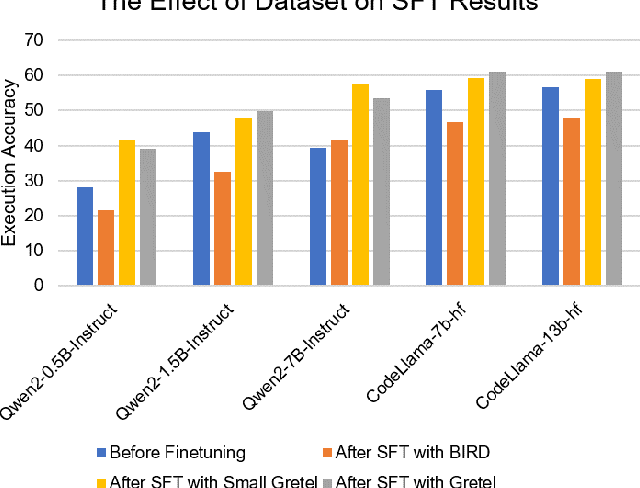
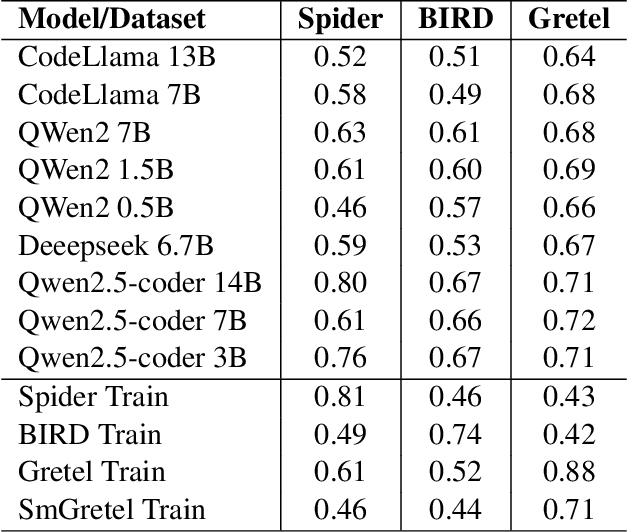
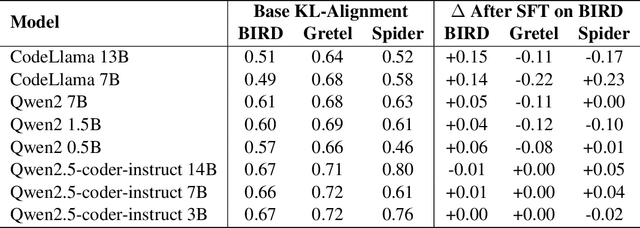
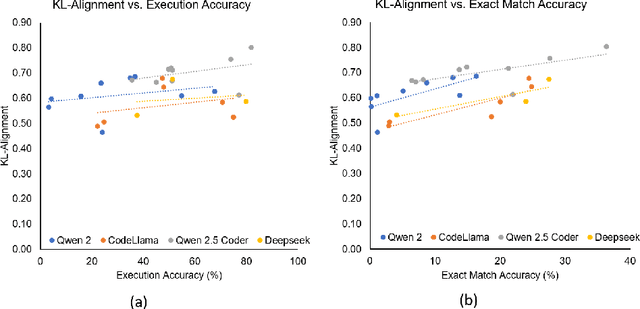
Supervised Fine-Tuning (SFT) is an effective method for adapting Large Language Models (LLMs) on downstream tasks. However, variability in training data can hinder a model's ability to generalize across domains. This paper studies the problem of dataset alignment for Natural Language to SQL (NL2SQL or text to SQL), examining how well SFT training data matches the structural characteristics of target queries and how this alignment impacts model performance. We hypothesize that alignment can be accurately estimated by comparing the distributions of structural SQL features across the training set, target data, and the model's predictions prior to SFT. Through comprehensive experiments on three large cross-domain NL2SQL benchmarks and multiple model families, we show that structural alignment is a strong predictor of fine-tuning success. When alignment is high, SFT yields substantial gains in accuracy and SQL generation quality; when alignment is low, improvements are marginal or absent. These findings highlight the importance of alignment-aware data selection for effective fine-tuning and generalization in NL2SQL tasks.
Enhancing Learned Knowledge in LoRA Adapters Through Efficient Contrastive Decoding on Ascend NPUs
May 20, 2025Huawei Cloud users leverage LoRA (Low-Rank Adaptation) as an efficient and scalable method to fine-tune and customize large language models (LLMs) for application-specific needs. However, tasks that require complex reasoning or deep contextual understanding are often hindered by biases or interference from the base model when using typical decoding methods like greedy or beam search. These biases can lead to generic or task-agnostic responses from the base model instead of leveraging the LoRA-specific adaptations. In this paper, we introduce Contrastive LoRA Decoding (CoLD), a novel decoding framework designed to maximize the use of task-specific knowledge in LoRA-adapted models, resulting in better downstream performance. CoLD uses contrastive decoding by scoring candidate tokens based on the divergence between the probability distributions of a LoRA-adapted expert model and the corresponding base model. This approach prioritizes tokens that better align with the LoRA's learned representations, enhancing performance for specialized tasks. While effective, a naive implementation of CoLD is computationally expensive because each decoding step requires evaluating multiple token candidates across both models. To address this, we developed an optimized kernel for Huawei's Ascend NPU. CoLD achieves up to a 5.54% increase in task accuracy while reducing end-to-end latency by 28% compared to greedy decoding. This work provides practical and efficient decoding strategies for fine-tuned LLMs in resource-constrained environments and has broad implications for applied data science in both cloud and on-premises settings.