 Add to Chrome
 Add to Firefox
 Add to Edge
Prune as You Generate: Online Rollout Pruning for Faster and Better RLVR
Mar 25, 2026
Reinforcement Learning with Verifiable Rewards (RLVR) has significantly advanced the reasoning capabilities of Large Language Models (LLMs). However, methods such as GRPO and DAPO suffer from substantial computational cost, since they rely on sampling many rollouts for each prompt. Moreover, in RLVR the relative advantage is often sparse: many samples become nearly all-correct or all-incorrect, yielding low within-group reward variance and thus weak learning signals. In this paper, we introduce arrol (Accelerating RLVR via online Rollout Pruning), an online rollout pruning method that prunes rollouts during generation while explicitly steering the surviving ones more correctness-balanced to enhance learning signals. Specifically, arrol trains a lightweight quality head on-the-fly to predict the success probability of partial rollouts and uses it to make early pruning decisions. The learned quality head can further weigh candidates to improve inference accuracy during test-time scaling. To improve efficiency, we present a system design that prunes rollouts inside the inference engine and re-batches the remaining ones for log-probability computation and policy updates. Across GRPO and DAPO on Qwen-3 and LLaMA-3.2 models (1B-8B), arrol improves average accuracy by +2.30 to +2.99 while achieving up to 1.7x training speedup, and yielding up to +8.33 additional gains in average accuracy in test-time scaling. The code is available at https://github.com/Hsu1023/ARRoL.

A Unified Framework of Graph Information Bottleneck for Robustness and Membership Privacy
Jun 14, 2023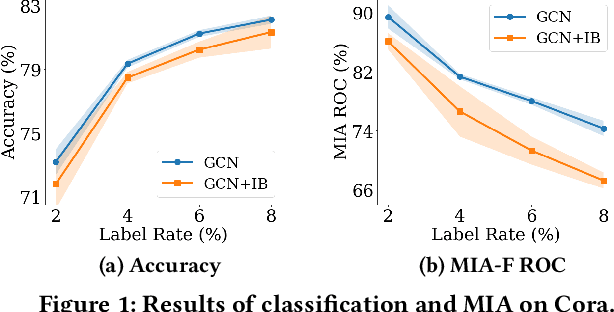
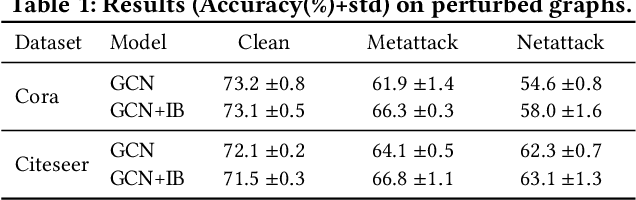
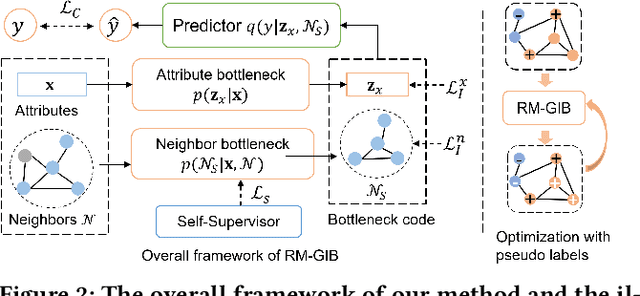
Graph Neural Networks (GNNs) have achieved great success in modeling graph-structured data. However, recent works show that GNNs are vulnerable to adversarial attacks which can fool the GNN model to make desired predictions of the attacker. In addition, training data of GNNs can be leaked under membership inference attacks. This largely hinders the adoption of GNNs in high-stake domains such as e-commerce, finance and bioinformatics. Though investigations have been made in conducting robust predictions and protecting membership privacy, they generally fail to simultaneously consider the robustness and membership privacy. Therefore, in this work, we study a novel problem of developing robust and membership privacy-preserving GNNs. Our analysis shows that Information Bottleneck (IB) can help filter out noisy information and regularize the predictions on labeled samples, which can benefit robustness and membership privacy. However, structural noises and lack of labels in node classification challenge the deployment of IB on graph-structured data. To mitigate these issues, we propose a novel graph information bottleneck framework that can alleviate structural noises with neighbor bottleneck. Pseudo labels are also incorporated in the optimization to minimize the gap between the predictions on the labeled set and unlabeled set for membership privacy. Extensive experiments on real-world datasets demonstrate that our method can give robust predictions and simultaneously preserve membership privacy.