 Add to Chrome
 Add to Firefox
 Add to Edge
LO-Free Joint Communication and Sensing via Inter-Antenna Cross-Correlation and Graph-Based Spatial Phase Inference
Jun 01, 2026
Joint communication and sensing (JCAS) typically rely on coherent downconversion to recover the phase relationships required for array processing. Meanwhile, Local Oscillators (LOs) are a major source of cost, power consumption, and implementation complexity in millimeter-wave (mmWave) and sub-THz receivers. Existing LO-free receiver designs are typically based on envelope detection or related non-coherent operations that do not preserve inter-branch phase information, which limits their applicability to JCAS. This work proposes an LO-free JCAS receiver architecture that leverages pairwise inter-branch correlation processing to suppress the common carrier component and to synthesize relative-phase observables across the antenna array, enabling both data communication and Direction-of-Arrival (DoA) estimation. The transmitted symbols are designed to induce distinct phase-difference patterns, such that the resulting correlation phases contain both a data-dependent component and a DoA-dependent component. We formulate recovery as inference over a correlation graph, where branches are nodes and pairwise correlations are edges, and show that the resulting cycle-consistent redundancy enables robust relative-phase recovery under noise and perturbations. We further derive a topology-aware Cramér-Rao lower bound for DoA estimation under a locally unwrapped approximation. Numerical results confirm that increasing graph connectivity improves both bit-error rate and DoA accuracy, with sensing performance approaching the derived bound.

Perceptual-Quality based AMC for Enhanced mmWave Spectral Efficiency: Concept and Experiment
May 29, 2026For high-throughput applications such as ultra-high-definition video streaming and immersive extended-reality, perceptual quality rather than bit-level accuracy defines the primary performance criterion and provides a more informative and spectrally efficient objective than strict bitwise reconstruction. This is particularly relevant in millimeter-wave (mmWave) and sub-Terahertz (sub-THz) systems, where path loss, short channel coherence times and phase noise introduce severe fluctuations that degrade link spectral efficiency. We propose an extension to conventional Adaptive Modulation and Coding (AMC) framework that incorporates perceptual quality awareness into link adaptation. In this framework, the decision metric is a Perceptual Quality Indicator (PQI) derived from the Structural Similarity Index Measure (SSIM). The receiver employs a Denoising Convolutional Neural Network (DnCNN) denoiser to enhance post-decoding image quality before feedback estimation. The resulting perceptual metric replaces the standard Channel Quality Indicator (CQI) in the AMC loop, enabling adaptation to maximize spectral efficiency while satisfying a perceptual-fidelity constraint. Experiments on a 5G-compliant mmWave testbed demonstrate up to a twofold gain in spectral efficiency while maintaining perceptual fidelity, underscoring the potential of perception-optimized link adaptation.
LO-Free Receiver: Next-Gen Low-Power Joint Communication and Sensing
May 11, 2026This paper introduces and analyzes Spatial Phase Manifold Communications (SPMC), a paradigm that facilitates joint communication and sensing (JCAS) over Local Oscillator (LO) free receiver. Information is embedded in, and recovered from, the relative spatial phase between antennas. In contrast to conventional coherent receivers that rely on LOs and on channel estimation/equalization, SPMC exploits antenna-domain correlation to form a baseband observable that is a function of inter-antenna phase differences. Since these phase differences are fundamentally tied to Direction-of-Arrival (DoA) and vice-versa, the formulation recasts communication and sensing as inference over the unit-circle manifold and thus naturally supports JCAS decomposition, i.e., data and spatial sensing are encoded and recovered through DoA signatures. We develop a comprehensive framework comprising: (i) a manifold-domain signal model and corresponding phase-alphabet design; (ii) an LO-free quadrature spatial-correlator receiver architecture that resolves the phase-sign ambiguity without requiring an LO; and (iii) an analysis of error probability and sensing precision, including robustness to phase noise. The proposed paradigm is particularly suited to massive Internet-of-Things (IoT) deployments, for which hardware simplicity, LO distribution cost, power consumption, and seamless sensing integration are critical, especially at millimeter-wave and higher carrier frequencies.
AI-Paging: Lease-Based Execution Anchoring for Network-Exposed AI-as-a-Service
Feb 17, 2026With AI-as-a-Service (AIaaS) now deployed across multiple providers and model tiers, selecting the appropriate model instance at run time is increasingly outside the end user's knowledge and operational control. Accordingly, the 6G service providers are envisioned to play a crucial role in exposing AIaaS in a setting where users submit only an intent while the network helps in the intent-to-model matching (resolution) and execution placement under policy, trust, and Quality of Service (QoS) constraints. The network role becomes to discover candidate execution endpoints and selects a suitable model/anchor under policy and QoS constraints in a process referred here to as AI-paging (by analogy to cellular call paging). In the proposed architecture, AI-paging is a control-plane transaction that resolves an intent into an AI service identity (AISI), a scoped session token (AIST), and an expiring admission lease (COMMIT) that authorizes user-plane steering to a selected AI execution anchor (AEXF) under a QoS binding. AI-Paging enforces two invariants: (i) lease-gated steering (without COMMIT, no steering state is installed) and (ii) make-before-break anchoring to support continuity and reliability of AIaaS services under dynamic network conditions. We prototype AI-Paging using existing control- and user-plane mechanisms (service-based control, QoS flows, and policy-based steering) with no new packet headers, ensuring compatibility with existing 3GPP-based exposure and management architectures, and evaluate transaction latency, relocation interruption, enforcement correctness under lease expiry, and audit-evidence overhead under mobility and failures.
High-Fidelity Network Management for Federated AI-as-a-Service: Cross-Domain Orchestration
Feb 17, 2026To support the emergence of AI-as-a-Service (AIaaS), communication service providers (CSPs) are on the verge of a radical transformation-from pure connectivity providers to AIaaS a managed network service (control-and-orchestration plane that exposes AI models). In this model, the CSP is responsible not only for transport/communications, but also for intent-to-model resolution and joint network-compute orchestration, i.e., reliable and timely end-to-end delivery. The resulting end-to-end AIaaS service thus becomes governed by communications impairments (delay, loss) and inference impairments (latency, error). A central open problem is an operational AIaaS control-and-orchestration framework that enforces high fidelity, particularly under multi-domain federation. This paper introduces an assurance-oriented AIaaS management plane based on Tail-Risk Envelopes (TREs): signed, composable per-domain descriptors that combine deterministic guardrails with stochastic rate-latency-impairment models. Using stochastic network calculus, we derive bounds on end-to-end delay violation probabilities across tandem domains and obtain an optimization-ready risk-budget decomposition. We show that tenant-level reservations prevent bursty traffic from inflating tail latency under TRE contracts. An auditing layer then uses runtime telemetry to estimate extreme-percentile performance, quantify uncertainty, and attribute tail-risk to each domain for accountability. Packet-level Monte-Carlo simulations demonstrate improved p99.9 compliance under overload via admission control and robust tenant isolation under correlated burstiness.
Predictive-State Communication: Innovation Coding and Reconciliation under Delay
Feb 11, 2026Shannon theory models communication as the reliable transfer of symbol sequences, with performance governed by capacity and rate-distortion limits. When both endpoints possess strong predictors -- as in modern large language models and related generative priors -- literal symbol transport is no longer the only operational regime. We propose predictive-state communication (PSC), in which the transmitter and receiver maintain an explicit shared predictive state, and the physical channel is used primarily to convey innovations, i.e., corrective information that reconciles the receiver's provisional trajectory with the transmitter's realized trajectory. This viewpoint replaces entropy-rate accounting by cross-entropy accounting under model mismatch, and it introduces feasibility constraints that depend jointly on capacity, delay, and perceptual continuity requirements; the resulting operating set is typically a bounded perception-capacity band rather than a one-sided threshold. We outline the protocol and architectural implications (state identifiers, anchors, bounded rollback, and patch-based updates) and provide a stylized illustrative example to visualize the induced feasibility region and its dependence on predictive quality.
On the Structure of the Optimal Detector for Sub-THz Multi-Hop Relays with Unknown Prior: Over-the-Air Diffusion
Jan 03, 2026Amplify and forward (AF) relaying is a viable strategy to extend the coverage of sub-terahertz (sub-THz) links, but inevitably propagates noise, leading to cumulative degradation across multiple hops. At the receiver, optimal decoding is desirable, yet challenging under non-Gaussian input distributions (video, voice, etc), for which neither the Minimum Mean Square Error (MMSE) estimator nor the mutual information admits a closed form. A further open question is whether knowledge of Channel State Information (CSI) and noise statistics at the intermediate relays is necessary for optimal detection. Aiming for an optimal decoder, this paper introduces a new framework that interprets the AF relay chain as a variance-preserving diffusion process and employs denoising diffusion implicit models (DDIMs) for signal recovery. We show that each AF hop is mathematically equivalent to a diffusion step with hop-dependent attenuation and noise injection. Consequently, the entire multi-hop chain collapses to an equivalent Gaussian channel fully described by only three real scalars per block: the cumulative complex gain and the effective noise variance. At the receiver, these end-to-end sufficient statistics define a matched reverse schedule that guides the DDIM-based denoiser, enabling near-optimal Bayesian decoding without per-hop CSI. We establish the information-theoretic foundation of this equivalence, proving that decoding performance depends solely on the final effective Signal-to-Noise-Ratio (SNR), regardless of intermediate noise/channel allocation or prior distribution. Simulations under AWGN and Rician fading confirm that the proposed AF-DDIM decoder reduces mean-squared error, symbol error rate, and bit error rate, particularly at moderate SNRs and for higher-order constellations.
On the Performance of ISAC over the D-Band in a Phase-Noise Aware OFDM Systems
Sep 10, 2025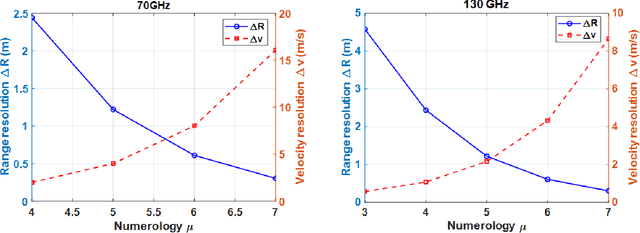
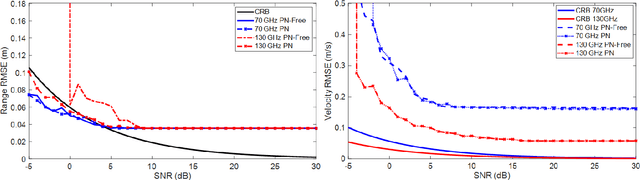
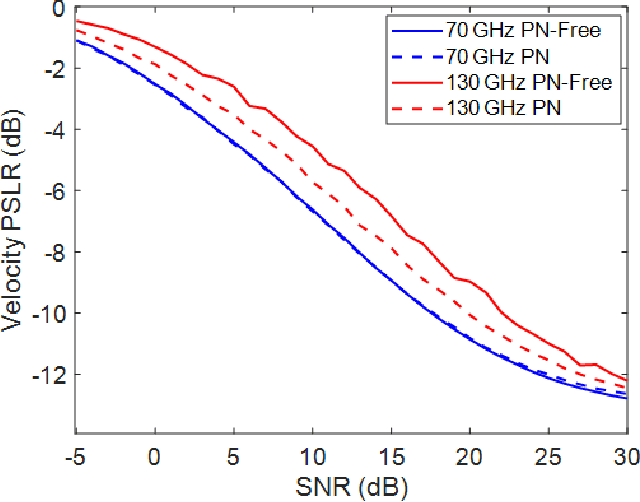
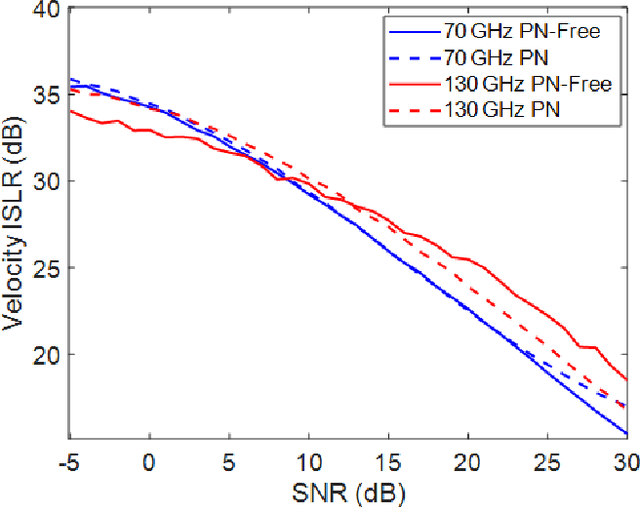
Phase noise (PN) is a critical impairment at D-band frequencies (110 to 170 GHz), which are widely investigated as promising candidates for beyond 5G/6G ISAC systems. This paper evaluates OFDM based ISAC sensing performance under realistic oscillator impairments using a hardware-tuned 3GPP PN model at 130 GHz and FFT based radar processing. With a numerology of 480 kHz, results show that PN introduces range RMSE floors of 0.04 to 0.05 m and velocity RMSE floors of 0.12 to 0.18 m/s. Doppler sidelobe metrics also saturate, with PSLR around minus 6 dB and ISLR around minus 4 dB. These findings confirm that range accuracy remains bandwidth limited, while velocity estimation and sidelobe suppression are strongly PN-sensitive. The study highlights the importance of PN-aware waveform and numerology design for sub-THz ISAC and provides insights for future multi-band transceivers. Communication metrics and PN mitigation strategies such as PTRS and CPE tracking are left for future work.
Theoretical and Experimental Assessment of Large Beam Codebook at mmWave Devices: How Much is Enough?
May 14, 2025Modern millimeter wave (mmWave) transceivers come with a large number of antennas, each of which can support thousands of phase shifter configurations. This capability enables beam sweeping with fine angular resolution, but results in large codebook sizes that can span more than six orders of magnitude. On the other hand, the mobility of user terminals and their randomly changing orientations require constantly adjusting the beam direction. A key focus of recent research has been on the design of beam sweeping codebooks that balance a trade-off between the achievable gain and the beam search time, governed by the codebook size. In this paper, we investigate the extent to which a large codebook can be reduced to fewer steering vectors while covering the entire angular space and maintaining performance close to the maximum array gain. We derive a closed-form expression for the angular coverage range of a steering vector, subject to maintaining a gain loss within \(\gamma\) dB (e.g., 2\, dB) with respect to the maximum gain achieved by an infinitely large codebook. We demonstrate, both theoretically and experimentally, that a large beam-steering codebooks (such as the \(1024^{16}\) set considered in our experiment) can be reduced to just a few steering vectors. This framework serves as a proof that only a few steering vectors are sufficient to achieve near-maximum gain, challenging the common belief that a large codebook with fine angular resolution is essential to fully reap the benefits of an antenna array.
Beam Codebook Refinement for mmWave Devices with Random Orientations: Concept and Experimental Validation
Dec 30, 2024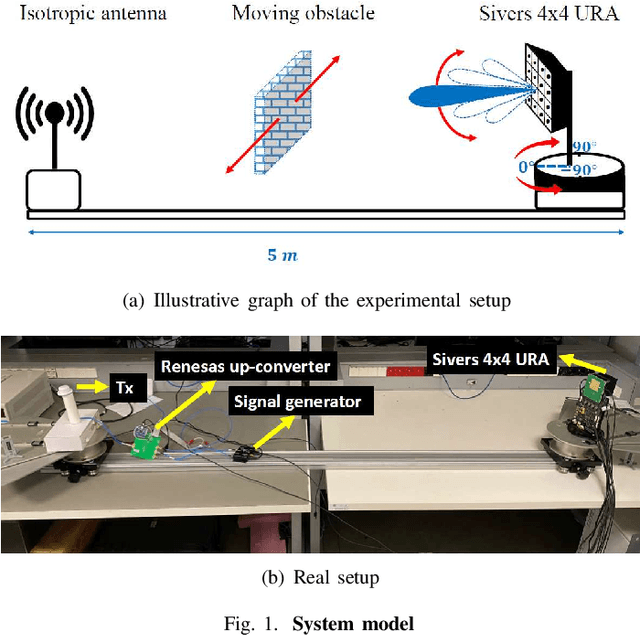

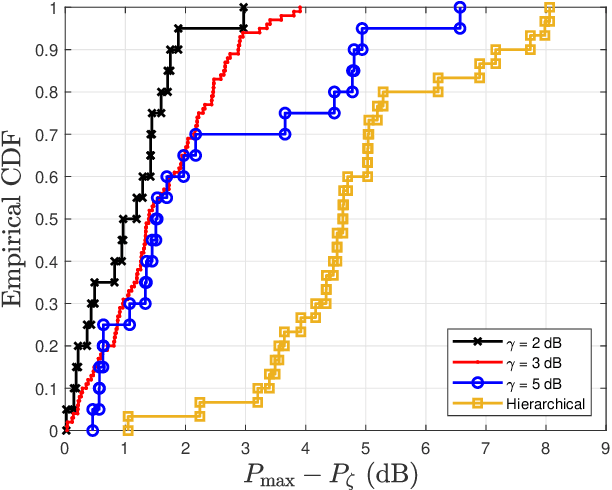
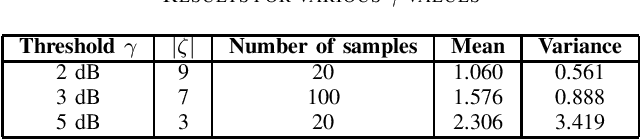
There is a growing interest in codebook-based beam-steering for millimeter-wave (mmWave) systems due to its potential for low complexity and rapid beam search. A key focus of recent research has been the design of codebooks that strike a trade-off between achievable gain and codebook size, which directly impacts beam search time. Statistical approaches have shown promise by leveraging the likelihood that certain beam directions (equivalently, sets of phase-shifter configurations) are more probable than others. Such approaches are shown to be valid for static, non-rotating transmission stations such as base stations. However, for the case of user terminals that are constantly changing orientation, the possible phase-shifter configurations become equally probable, rendering statistical methods less relevant. On the other hand, user terminals come with a large number of possible steering vector configurations, which can span up to six orders of magnitude. Therefore, efficient solutions to reduce the codebook size (set of possible steering vectors) without compromising array gain are needed. We address this challenge by proposing a novel and practical codebook refinement technique, aiming to reduce the codebook size while maintaining array gain within $\gamma$ dB of the maximum achievable gain at any random orientation of the user terminal. We project that a steering vector at a given angle could effectively cover adjacent angles with a small gain loss compared to the maximum achievable gain. We demonstrate experimentally that it is possible to reduce the codebook size from $1024^{16}$ to just a few configurations (e.g., less than ten), covering all angles while maintaining the gain within $\gamma=3$ dB of the maximum achievable gain.