 Add to Chrome
 Add to Firefox
 Add to Edge
Robust and Calibrated Detection of Authentic Multimedia Content
Dec 17, 2025
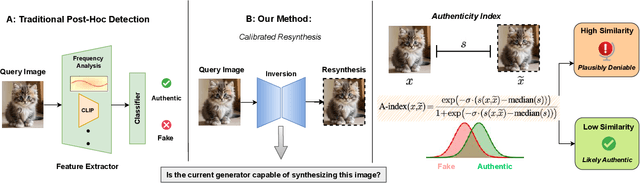
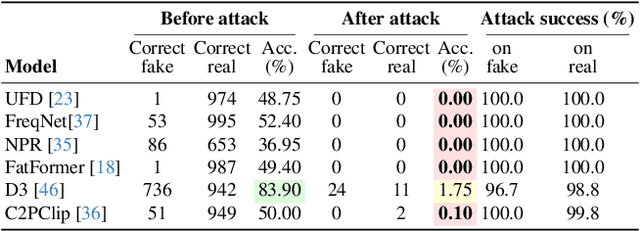
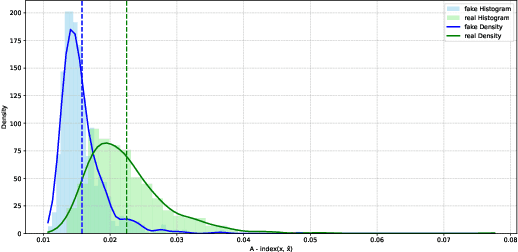
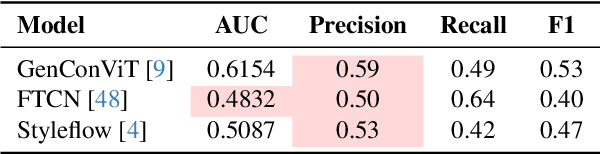
Generative models can synthesize highly realistic content, so-called deepfakes, that are already being misused at scale to undermine digital media authenticity. Current deepfake detection methods are unreliable for two reasons: (i) distinguishing inauthentic content post-hoc is often impossible (e.g., with memorized samples), leading to an unbounded false positive rate (FPR); and (ii) detection lacks robustness, as adversaries can adapt to known detectors with near-perfect accuracy using minimal computational resources. To address these limitations, we propose a resynthesis framework to determine if a sample is authentic or if its authenticity can be plausibly denied. We make two key contributions focusing on the high-precision, low-recall setting against efficient (i.e., compute-restricted) adversaries. First, we demonstrate that our calibrated resynthesis method is the most reliable approach for verifying authentic samples while maintaining controllable, low FPRs. Second, we show that our method achieves adversarial robustness against efficient adversaries, whereas prior methods are easily evaded under identical compute budgets. Our approach supports multiple modalities and leverages state-of-the-art inversion techniques.

MMRINet: Efficient Mamba-Based Segmentation with Dual-Path Refinement for Low-Resource MRI Analysis
Nov 15, 2025Automated brain tumor segmentation in multi-parametric MRI remains challenging in resource-constrained settings where deep 3D networks are computationally prohibitive. We propose MMRINet, a lightweight architecture that replaces quadratic-complexity attention with linear-complexity Mamba state-space models for efficient volumetric context modeling. Novel Dual-Path Feature Refinement (DPFR) modules maximize feature diversity without additional data requirements, while Progressive Feature Aggregation (PFA) enables effective multi-scale fusion. In the BraTS-Lighthouse SSA 2025, our model achieves strong performance with an average Dice score of (0.752) and an average HD95 of (12.23) with only ~2.5M parameters, demonstrating efficient and accurate segmentation suitable for low-resource clinical environments. Our GitHub repository can be accessed here: github.com/BioMedIA-MBZUAI/MMRINet.
SALT: Singular Value Adaptation with Low-Rank Transformation
Mar 20, 2025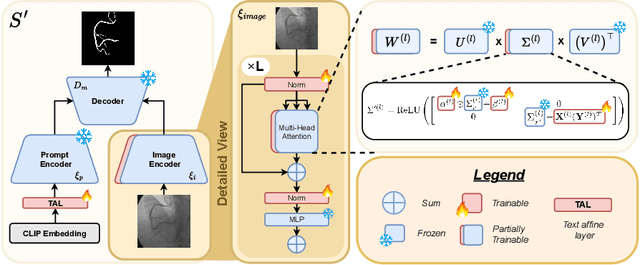

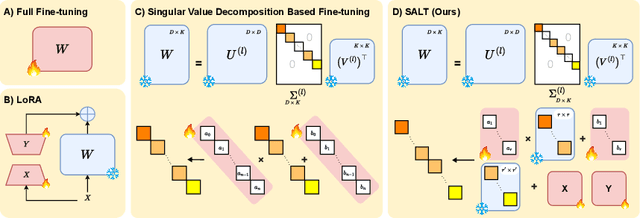
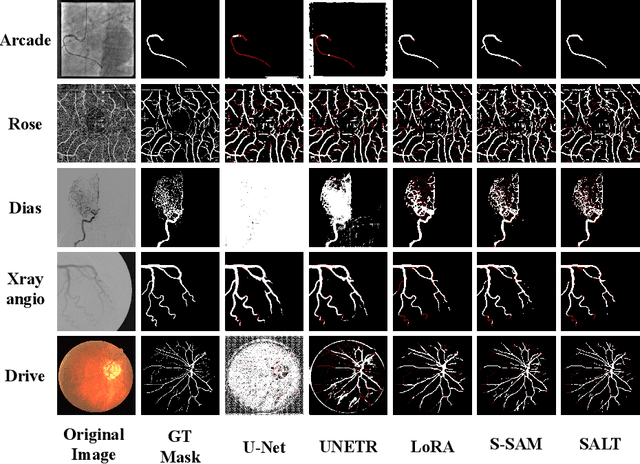
The complex nature of medical image segmentation calls for models that are specifically designed to capture detailed, domain-specific features. Large foundation models offer considerable flexibility, yet the cost of fine-tuning these models remains a significant barrier. Parameter-Efficient Fine-Tuning (PEFT) methods, such as Low-Rank Adaptation (LoRA), efficiently update model weights with low-rank matrices but may suffer from underfitting when the chosen rank is insufficient to capture domain-specific nuances. Conversely, full-rank Singular Value Decomposition (SVD) based methods provide comprehensive updates by modifying all singular values, yet they often lack flexibility and exhibit variable performance across datasets. We propose SALT (Singular Value Adaptation with Low-Rank Transformation), a method that selectively adapts the most influential singular values using trainable scale and shift parameters while complementing this with a low-rank update for the remaining subspace. This hybrid approach harnesses the advantages of both LoRA and SVD, enabling effective adaptation without relying on increasing model size or depth. Evaluated on 5 challenging medical datasets, ranging from as few as 20 samples to 1000, SALT outperforms state-of-the-art PEFT (LoRA and SVD) by 2% to 5% in Dice with only 3.9% trainable parameters, demonstrating robust adaptation even in low-resource settings. The code for SALT is available at: https://github.com/BioMedIA-MBZUAI/SALT
Optimizing Brain Tumor Segmentation with MedNeXt: BraTS 2024 SSA and Pediatrics
Nov 26, 2024
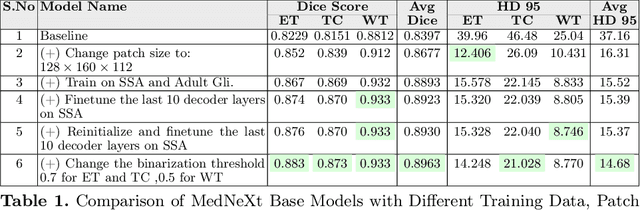
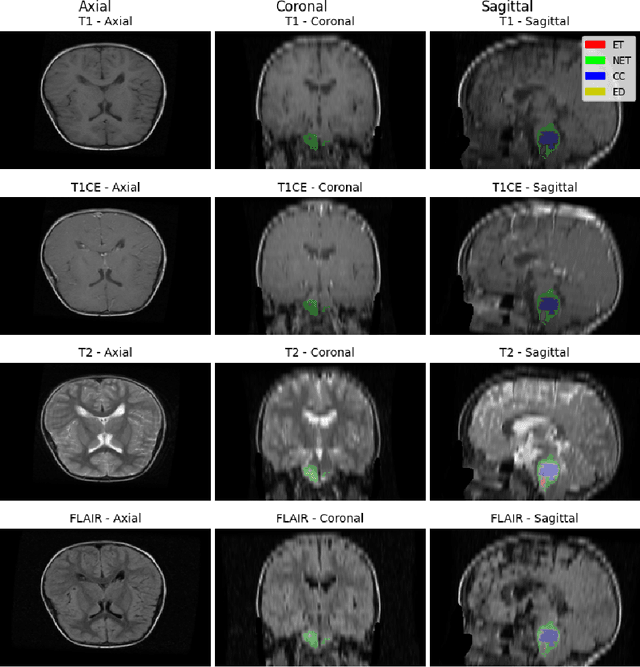

Identifying key pathological features in brain MRIs is crucial for the long-term survival of glioma patients. However, manual segmentation is time-consuming, requiring expert intervention and is susceptible to human error. Therefore, significant research has been devoted to developing machine learning methods that can accurately segment tumors in 3D multimodal brain MRI scans. Despite their progress, state-of-the-art models are often limited by the data they are trained on, raising concerns about their reliability when applied to diverse populations that may introduce distribution shifts. Such shifts can stem from lower quality MRI technology (e.g., in sub-Saharan Africa) or variations in patient demographics (e.g., children). The BraTS-2024 challenge provides a platform to address these issues. This study presents our methodology for segmenting tumors in the BraTS-2024 SSA and Pediatric Tumors tasks using MedNeXt, comprehensive model ensembling, and thorough postprocessing. Our approach demonstrated strong performance on the unseen validation set, achieving an average Dice Similarity Coefficient (DSC) of 0.896 on the BraTS-2024 SSA dataset and an average DSC of 0.830 on the BraTS Pediatric Tumor dataset. Additionally, our method achieved an average Hausdorff Distance (HD95) of 14.682 on the BraTS-2024 SSA dataset and an average HD95 of 37.508 on the BraTS Pediatric dataset. Our GitHub repository can be accessed here: Project Repository : https://github.com/python-arch/BioMbz-Optimizing-Brain-Tumor-Segmentation-with-MedNeXt-BraTS-2024-SSA-and-Pediatrics