 Add to Chrome
 Add to Firefox
 Add to Edge
Causal Attribution via Activation Patching
Mar 13, 2026
Attribution methods for Vision Transformers (ViTs) aim to identify image regions that influence model predictions, but producing faithful and well-localized attributions remains challenging. Existing gradient-based and perturbation-based techniques often fail to isolate the causal contribution of internal representations associated with individual image patches. The key challenge is that class-relevant evidence is formed through interactions between patch tokens across layers, and input-level perturbations can be poor proxies for patch importance, since they may fail to reconstruct the internal evidence actually used by the model. We propose Causal Attribution via Activation Patching (CAAP), which estimates the contribution of individual image patches to the ViT's prediction by directly intervening on internal activations rather than using learned masks or synthetic perturbation patterns. For each patch, CAAP inserts the corresponding source-image activations into a neutral target context over an intermediate range of layers and uses the resulting target-class score as the attribution signal. The resulting attribution map reflects the causal effect of patch-associated internal representations on the model's prediction. The causal intervention serves as a principled measure of patch influence by capturing class-relevant evidence after initial representation formation, while avoiding late-layer global mixing that can reduce spatial specificity. Across multiple ViT backbones and standard metrics, CAAP significantly outperforms existing methods and produces more faithful and localized attributions.

Mechanistic Interpretability of Large-Scale Counting in LLMs through a System-2 Strategy
Jan 06, 2026Large language models (LLMs), despite strong performance on complex mathematical problems, exhibit systematic limitations in counting tasks. This issue arises from architectural limits of transformers, where counting is performed across layers, leading to degraded precision for larger counting problems due to depth constraints. To address this limitation, we propose a simple test-time strategy inspired by System-2 cognitive processes that decomposes large counting tasks into smaller, independent sub-problems that the model can reliably solve. We evaluate this approach using observational and causal mediation analyses to understand the underlying mechanism of this System-2-like strategy. Our mechanistic analysis identifies key components: latent counts are computed and stored in the final item representations of each part, transferred to intermediate steps via dedicated attention heads, and aggregated in the final stage to produce the total count. Experimental results demonstrate that this strategy enables LLMs to surpass architectural limitations and achieve high accuracy on large-scale counting tasks. This work provides mechanistic insight into System-2 counting in LLMs and presents a generalizable approach for improving and understanding their reasoning behavior.
Limits and Gains of Test-Time Scaling in Vision-Language Reasoning
Dec 11, 2025Test-time scaling (TTS) has emerged as a powerful paradigm for improving the reasoning ability of Large Language Models (LLMs) by allocating additional computation at inference, yet its application to multimodal systems such as Vision-Language Models (VLMs) remains underexplored. In this work, we present a systematic empirical study of inference time reasoning methods applied across both open-source and closed-source VLMs on different benchmarks. Our results reveal that while closed-source models consistently benefit from structured reasoning and iterative Self-Refinement, open-source VLMs show inconsistent behavior: external verification provides the most reliable gains, whereas iterative refinement often degrades performance. We further find that the effectiveness of TTS is dataset-dependent, yielding clear improvements on multi-step reasoning tasks but offering only limited gains on perception-focused benchmarks. These findings demonstrate that TTS is not a universal solution and must be tailored to both model capabilities and task characteristics, motivating future work on adaptive TTS strategies and multimodal reward models.
CAREL: Instruction-guided reinforcement learning with cross-modal auxiliary objectives
Nov 29, 2024
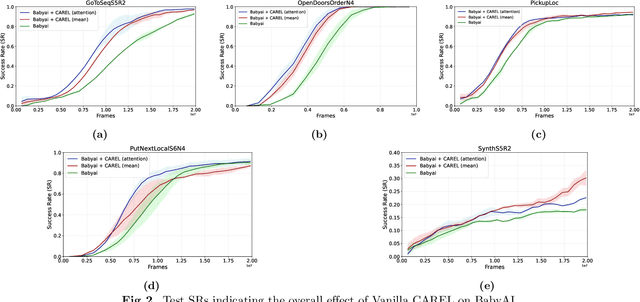
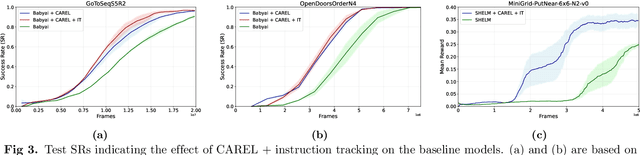
Grounding the instruction in the environment is a key step in solving language-guided goal-reaching reinforcement learning problems. In automated reinforcement learning, a key concern is to enhance the model's ability to generalize across various tasks and environments. In goal-reaching scenarios, the agent must comprehend the different parts of the instructions within the environmental context in order to complete the overall task successfully. In this work, we propose CAREL (Cross-modal Auxiliary REinforcement Learning) as a new framework to solve this problem using auxiliary loss functions inspired by video-text retrieval literature and a novel method called instruction tracking, which automatically keeps track of progress in an environment. The results of our experiments suggest superior sample efficiency and systematic generalization for this framework in multi-modal reinforcement learning problems. Our code base is available here.
ComAlign: Compositional Alignment in Vision-Language Models
Sep 12, 2024Vision-language models (VLMs) like CLIP have showcased a remarkable ability to extract transferable features for downstream tasks. Nonetheless, the training process of these models is usually based on a coarse-grained contrastive loss between the global embedding of images and texts which may lose the compositional structure of these modalities. Many recent studies have shown VLMs lack compositional understandings like attribute binding and identifying object relationships. Although some recent methods have tried to achieve finer-level alignments, they either are not based on extracting meaningful components of proper granularity or don't properly utilize the modalities' correspondence (especially in image-text pairs with more ingredients). Addressing these limitations, we introduce Compositional Alignment (ComAlign), a fine-grained approach to discover more exact correspondence of text and image components using only the weak supervision in the form of image-text pairs. Our methodology emphasizes that the compositional structure (including entities and relations) extracted from the text modality must also be retained in the image modality. To enforce correspondence of fine-grained concepts in image and text modalities, we train a lightweight network lying on top of existing visual and language encoders using a small dataset. The network is trained to align nodes and edges of the structure across the modalities. Experimental results on various VLMs and datasets demonstrate significant improvements in retrieval and compositional benchmarks, affirming the effectiveness of our plugin model.