 Add to Chrome
 Add to Firefox
 Add to Edge
TacticGen: Grounding Adaptable and Scalable Generation of Football Tactics
Apr 20, 2026
Success in association football relies on both individual skill and coordinated tactics. While recent advancements in spatio-temporal data and deep learning have enabled predictive analyses like trajectory forecasting, the development of tactical design remains limited. Bridging this gap is essential, as prediction reveals what is likely to occur, whereas tactic generation determines what should occur to achieve strategic objectives. In this work, we present TacticGen, a generative model for adaptable and scalable tactic generation. TacticGen formulates tactics as sequences of multi-agent movements and interactions conditioned on the game context. It employs a multi-agent diffusion transformer with agent-wise self-attention and context-aware cross-attention to capture cooperative and competitive dynamics among players and the ball. Trained with over 3.3 million events and 100 million tracking frames from top-tier leagues, TacticGen achieves state-of-the-art precision in predicting player trajectories. Building on it, TacticGen enables adaptable tactic generation tailored to diverse inference-time objectives through classifier guidance mechanism, specified via rules, natural language, or neural models. Its modeling performance is also inherently scalable. A case study with football experts confirms that TacticGen generates realistic, strategically valuable tactics, demonstrating its practical utility for tactical planning in professional football. The project page is available at: https://shengxu.net/TacticGen/.

How Effective is Pre-training of Large Masked Autoencoders for Downstream Earth Observation Tasks?
Sep 27, 2024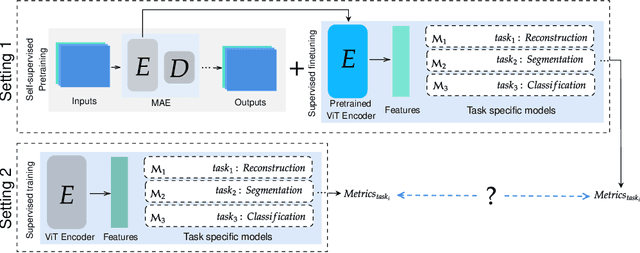
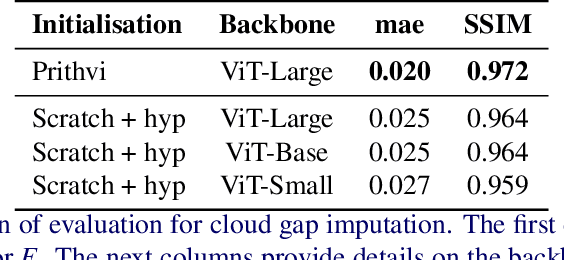
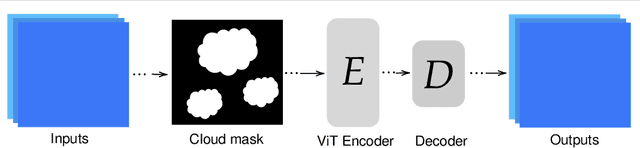
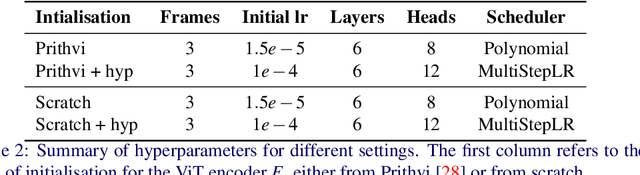
Self-supervised pre-training has proven highly effective for many computer vision tasks, particularly when labelled data are scarce. In the context of Earth Observation (EO), foundation models and various other Vision Transformer (ViT)-based approaches have been successfully applied for transfer learning to downstream tasks. However, it remains unclear under which conditions pre-trained models offer significant advantages over training from scratch. In this study, we investigate the effectiveness of pre-training ViT-based Masked Autoencoders (MAE) for downstream EO tasks, focusing on reconstruction, segmentation, and classification. We consider two large ViT-based MAE pre-trained models: a foundation model (Prithvi) and SatMAE. We evaluate Prithvi on reconstruction and segmentation-based downstream tasks, and for SatMAE we assess its performance on a classification downstream task. Our findings suggest that pre-training is particularly beneficial when the fine-tuning task closely resembles the pre-training task, e.g. reconstruction. In contrast, for tasks such as segmentation or classification, training from scratch with specific hyperparameter adjustments proved to be equally or more effective.