 Add to Chrome
 Add to Firefox
 Add to Edge
Reward-Guided Autoregressive Graph Generation for Efficient Multi-Agent Communication Topology Design
Aug 20, 2026
LLM-based Multi-Agent Systems (MAS) achieve strong performance on complex reasoning tasks by coordinating multiple agents, but at the cost of substantial token consumption. Recent work on automatic topology design, ARG-Designer, has reframed this problem as autoregressive graph generation. However, its training objective provides no explicit incentive for the model to generate sparse and efficient topologies. We address this limitation by introducing a Reward-Guided Autoregressive Graph Generation (RGA-Designer) inspired by Reinforcement Learning from Human Feedback (RLHF). We train a reward model that jointly captures task correctness and structural compactness, and then fine-tune the pretrained graph generator using the reward model as feedback. Our method preserves task accuracy at the level of ARG-Designer while reducing token consumption by an average of 20.5%.

How Effective is Pre-training of Large Masked Autoencoders for Downstream Earth Observation Tasks?
Sep 27, 2024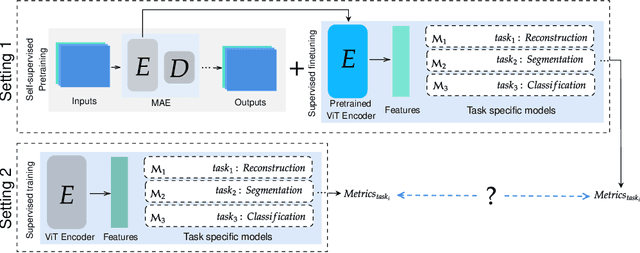
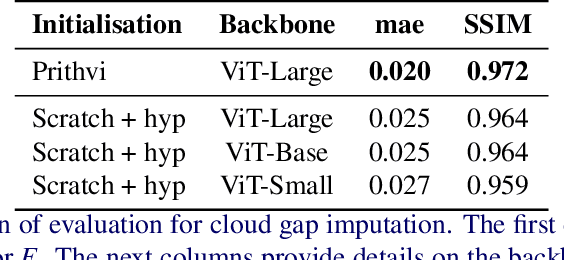
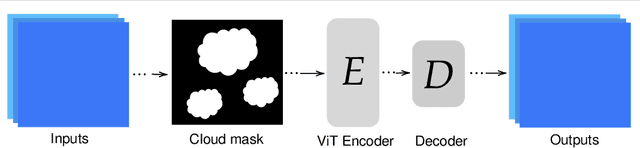
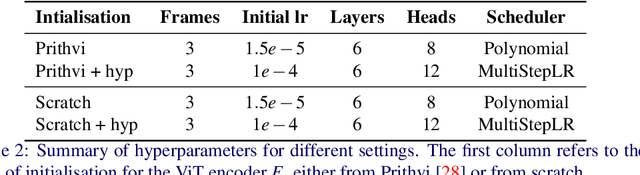
Self-supervised pre-training has proven highly effective for many computer vision tasks, particularly when labelled data are scarce. In the context of Earth Observation (EO), foundation models and various other Vision Transformer (ViT)-based approaches have been successfully applied for transfer learning to downstream tasks. However, it remains unclear under which conditions pre-trained models offer significant advantages over training from scratch. In this study, we investigate the effectiveness of pre-training ViT-based Masked Autoencoders (MAE) for downstream EO tasks, focusing on reconstruction, segmentation, and classification. We consider two large ViT-based MAE pre-trained models: a foundation model (Prithvi) and SatMAE. We evaluate Prithvi on reconstruction and segmentation-based downstream tasks, and for SatMAE we assess its performance on a classification downstream task. Our findings suggest that pre-training is particularly beneficial when the fine-tuning task closely resembles the pre-training task, e.g. reconstruction. In contrast, for tasks such as segmentation or classification, training from scratch with specific hyperparameter adjustments proved to be equally or more effective.