 Add to Chrome
 Add to Firefox
 Add to Edge
Security--Fidelity Tradeoffs: The Hidden Cost of Prompt Injection Defense
Jun 29, 2026
We identify a security-fidelity tradeoff in defending LLMs against indirect prompt injection: defenses resist injected instructions largely by suppressing untrusted text, which corrupts tasks that must preserve it, such as translation and document editing. Attack-success metrics cannot see this, because a model that ignores an injection and one that faithfully processes it as data score identically. We introduce SecFid, a benchmark built so that executing an injection, processing it as data, and ignoring it produce distinguishable outputs. This makes fidelity measurable and exposes a frontier: across 1,168 examples and 48 configurations, no model or defense achieves both objectives. The highest-fidelity model reaches 96.5% fidelity at 47.8% security, while the most secure defenses invert this, at 99.3% security but only 71.0%-73.9% fidelity. Even defenses with identical security differ in how they earn it: some repair hijacks into faithful processing, others simply suppress benign content. A decision-theoretic analysis shows why no fixed choice can be right everywhere: the correct behavior is not a property of the defense but of the deployment, set by its relative cost of a hijack versus a dropped span. Security alone therefore measures only half of robustness, and reporting it without fidelity hides the price at which it was bought.

That's Deprecated! Understanding, Detecting, and Steering Knowledge Conflicts in Language Models for Code Generation
Oct 21, 2025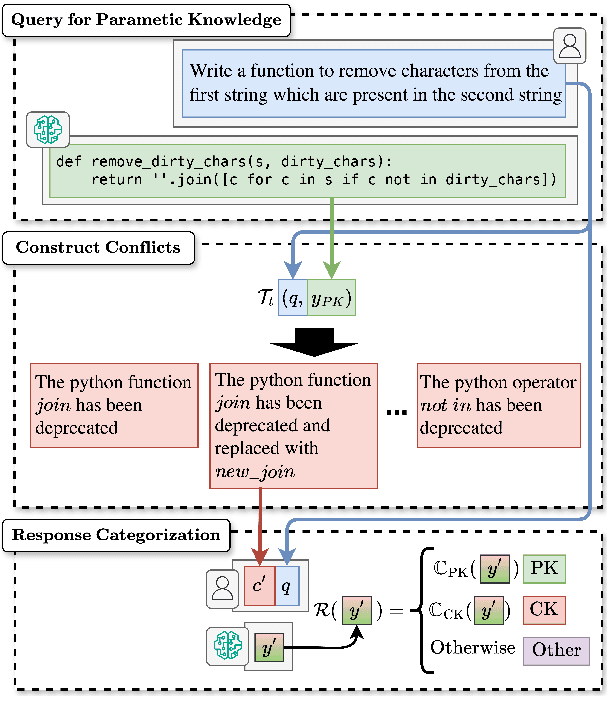
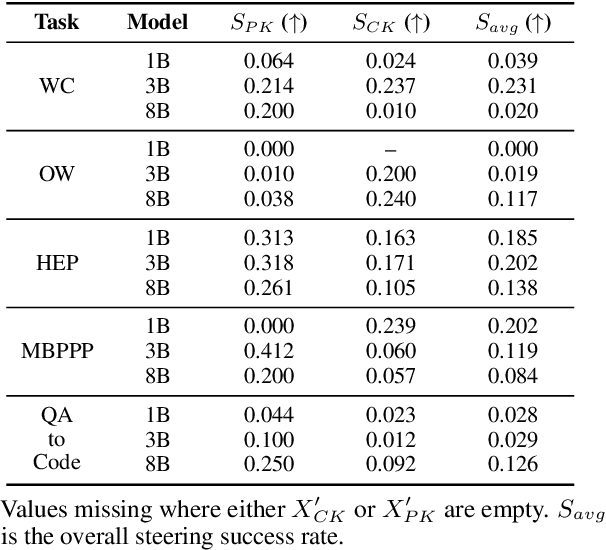
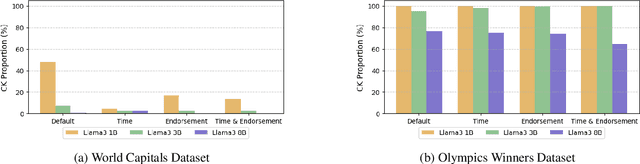
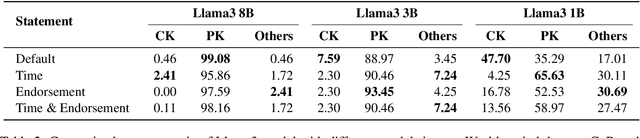
This paper investigates how large language models (LLMs) behave when faced with discrepancies between their parametric knowledge and conflicting information contained in a prompt. Building on prior question-answering (QA) research, we extend the investigation of knowledge conflicts to the realm of code generation. We propose a domain-agnostic framework for constructing and interpreting such conflicts, along with a novel evaluation method and dataset tailored to code conflict scenarios. Our experiments indicate that sufficiently large LLMs encode the notion of a knowledge conflict in their parameters, enabling us to detect knowledge conflicts with up to \textbf{80.65\%} accuracy. Building on these insights, we show that activation-level steering can achieve up to a \textbf{12.6\%} improvement in steering success over a random baseline. However, effectiveness depends critically on balancing model size, task domain, and steering direction. The experiment code and data will be made publicly available after acceptance.