 Add to Chrome
 Add to Firefox
 Add to Edge
SALSA: Speech Aware LLM Adaptation via Learned Steering Activation Vectors
May 30, 2026
Speech-aware large language models often generalize poorly to out-of-domain settings. We propose SALSA (Speech-Aware LLM Adaptation via Learned Steering Activations), a lightweight adaptation method that learns layer-wise steering vectors. Unlike commonly used steering approaches that rely on contrastive activation differences, SALSA directly optimizes steering vectors using a supervised objective. Across children's speech, multilingual speech, and Mandarin-English code-switching benchmarks, SALSA substantially improves performance over zero-shot inference and speech in-context learning baselines, achieving up to 46.8% relative improvements over zero-shot. Analysis further demonstrates that steering the encoder, particularly the later layers, is more effective than steering the LLM backbone. These findings suggest that steering improves downstream ASR performance by adapting higher-level acoustic and phonetic representations to better align with the pretrained language model representation space, rather than by modifying the decoder itself.

TICL+: A Case Study On Speech In-Context Learning for Children's Speech Recognition
Dec 20, 2025Children's speech recognition remains challenging due to substantial acoustic and linguistic variability, limited labeled data, and significant differences from adult speech. Speech foundation models can address these challenges through Speech In-Context Learning (SICL), allowing adaptation to new domains without fine-tuning. However, the effectiveness of SICL depends on how in-context examples are selected. We extend an existing retrieval-based method, Text-Embedding KNN for SICL (TICL), introducing an acoustic reranking step to create TICL+. This extension prioritizes examples that are both semantically and acoustically aligned with the test input. Experiments on four children's speech corpora show that TICL+ achieves up to a 53.3% relative word error rate reduction over zero-shot performance and 37.6% over baseline TICL, highlighting the value of combining semantic and acoustic information for robust, scalable ASR in children's speech.
That's Deprecated! Understanding, Detecting, and Steering Knowledge Conflicts in Language Models for Code Generation
Oct 21, 2025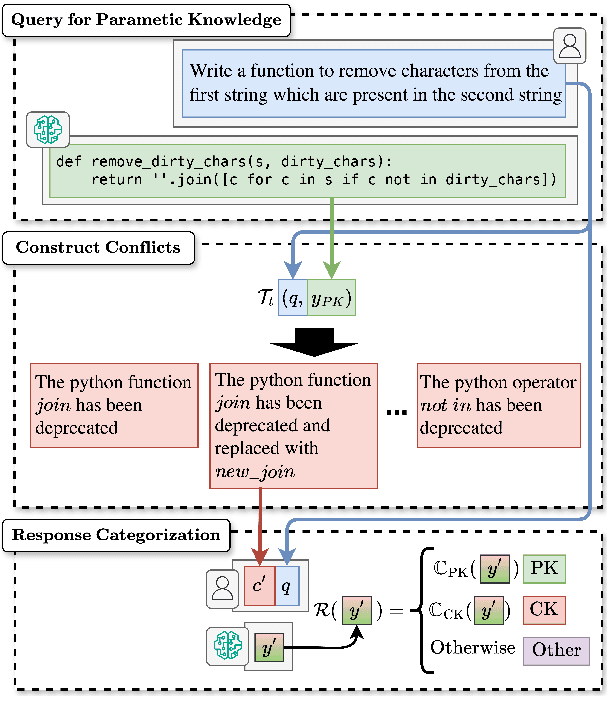
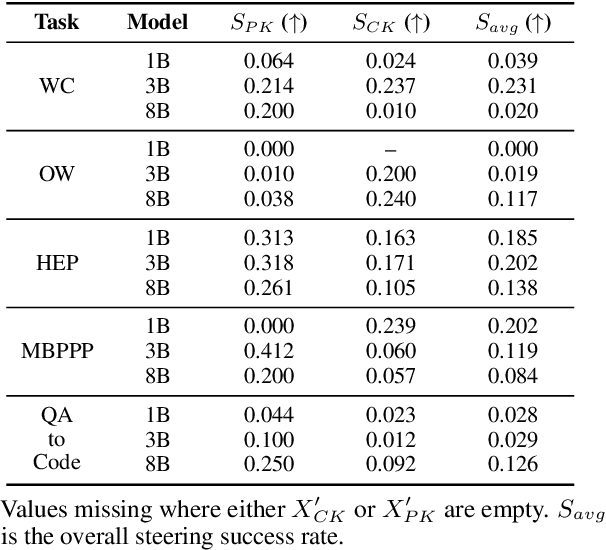
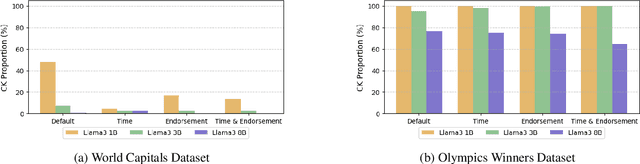
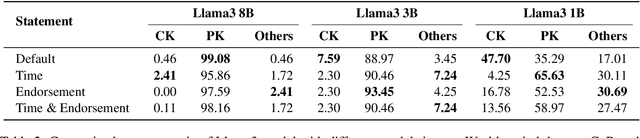
This paper investigates how large language models (LLMs) behave when faced with discrepancies between their parametric knowledge and conflicting information contained in a prompt. Building on prior question-answering (QA) research, we extend the investigation of knowledge conflicts to the realm of code generation. We propose a domain-agnostic framework for constructing and interpreting such conflicts, along with a novel evaluation method and dataset tailored to code conflict scenarios. Our experiments indicate that sufficiently large LLMs encode the notion of a knowledge conflict in their parameters, enabling us to detect knowledge conflicts with up to \textbf{80.65\%} accuracy. Building on these insights, we show that activation-level steering can achieve up to a \textbf{12.6\%} improvement in steering success over a random baseline. However, effectiveness depends critically on balancing model size, task domain, and steering direction. The experiment code and data will be made publicly available after acceptance.