 Add to Chrome
 Add to Firefox
 Add to Edge
RAwR: Role-Aware Rewiring via Approximate Equitable Partition
May 10, 2026
While Graph Neural Networks (GNNs) have demonstrated significant efficacy in node classification tasks, where predictions rely on local neighborhood information, the performance of GNNs often drops when prediction tasks depend on long-range interactions. These limitations are attributed to phenomena such as oversquashing, where structural bottlenecks restrict signal propagation across the network topology. To address this challenge, we introduce RAwR, a computationally efficient rewiring framework that augments the input graph with a quotient graph derived from equitable partitions. This approach facilitates accelerated communication between nodes that share identical structural roles, as identified by the Weisfeiler-Leman graph coloring, and thereby reduces the total effective resistance of the system. Furthermore, by employing an approximate definition of the equitable partition, RAwR enables a controllable reduction of the quotient graph, which, in its most condensed state, recovers the conventional Master Node rewiring technique. Empirical evaluations across a diverse suite of benchmarks -- including homophilic, heterophilic, and synthetic long-range datasets -- demonstrate that RAwR achieves state-of-the-art results. Our contribution is further supported by an analytical investigation using a teacher-student model of linear GNNs, which elucidates the theoretical foundations of role-based rewiring. This analysis leads to the formulation of Spectral Role Lift (SRL), a metric designed to identify the optimal approximate equitable partition for maximizing predictive performance.

Graph Neural Networks Do Not Always Oversmooth
Jun 04, 2024Graph neural networks (GNNs) have emerged as powerful tools for processing relational data in applications. However, GNNs suffer from the problem of oversmoothing, the property that the features of all nodes exponentially converge to the same vector over layers, prohibiting the design of deep GNNs. In this work we study oversmoothing in graph convolutional networks (GCNs) by using their Gaussian process (GP) equivalence in the limit of infinitely many hidden features. By generalizing methods from conventional deep neural networks (DNNs), we can describe the distribution of features at the output layer of deep GCNs in terms of a GP: as expected, we find that typical parameter choices from the literature lead to oversmoothing. The theory, however, allows us to identify a new, nonoversmoothing phase: if the initial weights of the network have sufficiently large variance, GCNs do not oversmooth, and node features remain informative even at large depth. We demonstrate the validity of this prediction in finite-size GCNs by training a linear classifier on their output. Moreover, using the linearization of the GCN GP, we generalize the concept of propagation depth of information from DNNs to GCNs. This propagation depth diverges at the transition between the oversmoothing and non-oversmoothing phase. We test the predictions of our approach and find good agreement with finite-size GCNs. Initializing GCNs near the transition to the non-oversmoothing phase, we obtain networks which are both deep and expressive.
Unified Field Theory for Deep and Recurrent Neural Networks
Jan 07, 2022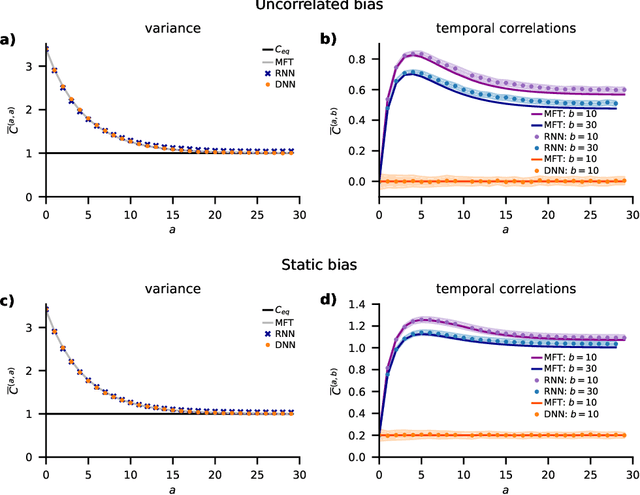

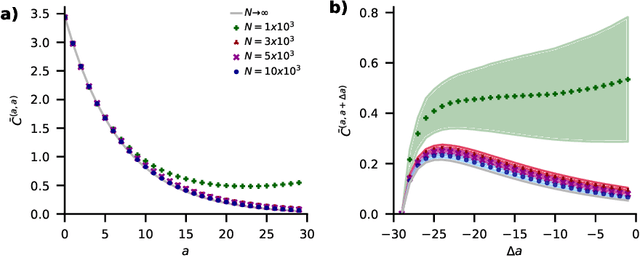
Understanding capabilities and limitations of different network architectures is of fundamental importance to machine learning. Bayesian inference on Gaussian processes has proven to be a viable approach for studying recurrent and deep networks in the limit of infinite layer width, $n\to\infty$. Here we present a unified and systematic derivation of the mean-field theory for both architectures that starts from first principles by employing established methods from statistical physics of disordered systems. The theory elucidates that while the mean-field equations are different with regard to their temporal structure, they yet yield identical Gaussian kernels when readouts are taken at a single time point or layer, respectively. Bayesian inference applied to classification then predicts identical performance and capabilities for the two architectures. Numerically, we find that convergence towards the mean-field theory is typically slower for recurrent networks than for deep networks and the convergence speed depends non-trivially on the parameters of the weight prior as well as the depth or number of time steps, respectively. Our method exposes that Gaussian processes are but the lowest order of a systematic expansion in $1/n$. The formalism thus paves the way to investigate the fundamental differences between recurrent and deep architectures at finite widths $n$.