 Add to Chrome
 Add to Firefox
 Add to Edge
RAwR: Role-Aware Rewiring via Approximate Equitable Partition
May 10, 2026
While Graph Neural Networks (GNNs) have demonstrated significant efficacy in node classification tasks, where predictions rely on local neighborhood information, the performance of GNNs often drops when prediction tasks depend on long-range interactions. These limitations are attributed to phenomena such as oversquashing, where structural bottlenecks restrict signal propagation across the network topology. To address this challenge, we introduce RAwR, a computationally efficient rewiring framework that augments the input graph with a quotient graph derived from equitable partitions. This approach facilitates accelerated communication between nodes that share identical structural roles, as identified by the Weisfeiler-Leman graph coloring, and thereby reduces the total effective resistance of the system. Furthermore, by employing an approximate definition of the equitable partition, RAwR enables a controllable reduction of the quotient graph, which, in its most condensed state, recovers the conventional Master Node rewiring technique. Empirical evaluations across a diverse suite of benchmarks -- including homophilic, heterophilic, and synthetic long-range datasets -- demonstrate that RAwR achieves state-of-the-art results. Our contribution is further supported by an analytical investigation using a teacher-student model of linear GNNs, which elucidates the theoretical foundations of role-based rewiring. This analysis leads to the formulation of Spectral Role Lift (SRL), a metric designed to identify the optimal approximate equitable partition for maximizing predictive performance.

Residual Connections and Normalization Can Provably Prevent Oversmoothing in GNNs
Jun 05, 2024Residual connections and normalization layers have become standard design choices for graph neural networks (GNNs), and were proposed as solutions to the mitigate the oversmoothing problem in GNNs. However, how exactly these methods help alleviate the oversmoothing problem from a theoretical perspective is not well understood. In this work, we provide a formal and precise characterization of (linearized) GNNs with residual connections and normalization layers. We establish that (a) for residual connections, the incorporation of the initial features at each layer can prevent the signal from becoming too smooth, and determines the subspace of possible node representations; (b) batch normalization prevents a complete collapse of the output embedding space to a one-dimensional subspace through the individual rescaling of each column of the feature matrix. This results in the convergence of node representations to the top-$k$ eigenspace of the message-passing operator; (c) moreover, we show that the centering step of a normalization layer -- which can be understood as a projection -- alters the graph signal in message-passing in such a way that relevant information can become harder to extract. We therefore introduce a novel, principled normalization layer called GraphNormv2 in which the centering step is learned such that it does not distort the original graph signal in an undesirable way. Experimental results confirm the effectiveness of our method.
Blind Extraction of Equitable Partitions from Graph Signals
Mar 10, 2022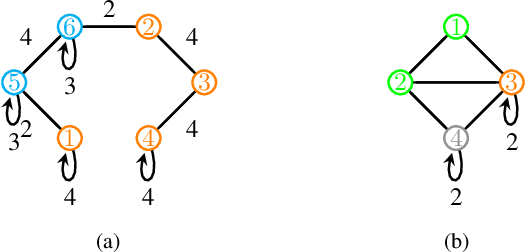
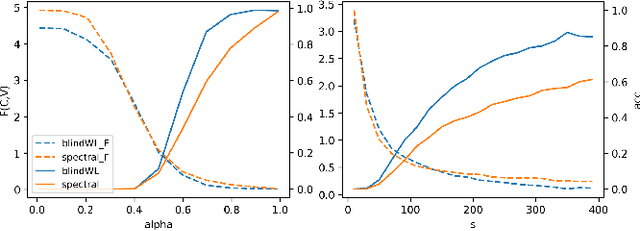
Finding equitable partitions is closely related to the extraction of graph symmetries and of interest in a variety of applications context such as node role detection, cluster synchronization, consensus dynamics, and network control problems. In this work we study a blind identification problem in which we aim to recover an equitable partition of a network without the knowledge of the network's edges but based solely on the observations of the outputs of an unknown graph filter. Specifically, we consider two settings. First, we consider a scenario in which we can control the input to the graph filter and present a method to extract the partition inspired by the well known Weisfeiler-Lehman (color refinement) algorithm. Second, we generalize this idea to a setting where only observe the outputs to random, low-rank excitations of the graph filter, and present a simple spectral algorithm to extract the relevant equitable partitions. Finally, we establish theoretical bounds on the error that this spectral detection scheme incurs and perform numerical experiments that illustrate our theoretical results and compare both algorithms.