 Add to Chrome
 Add to Firefox
 Add to Edge
torchtune: PyTorch native post-training library
May 20, 2026
Modern LLMs typically require multistage training pipelines to achieve strong downstream performance, with post-training serving as the main interface for adapting open-weight models. We introduce torchtune, a PyTorch-native library designed to streamline the post-training lifecycle of LLMs, enabling efficient fine-tuning, experimentation, and deployment-oriented workflows. Unlike many existing fine-tuning frameworks, which often optimize for ease of use, specialized recipes, or hardware efficiency at the cost of transparency and extensibility, torchtune emphasizes modularity, hackability, and direct access to the underlying PyTorch components. In this paper, we present the design principles behind torchtune, describe how they are reflected in its model builders, training recipes, and distributed training stack, and evaluate the library across representative post-training settings. We compare against popular fine-tuning frameworks, including Axolotl and Unsloth, and show that torchtune provides strong performance and memory efficiency across many settings while remaining flexible enough for rapid research iteration. These results position torchtune as a practical foundation for reproducible LLMs post-training research.

Lie Group Decompositions for Equivariant Neural Networks
Oct 17, 2023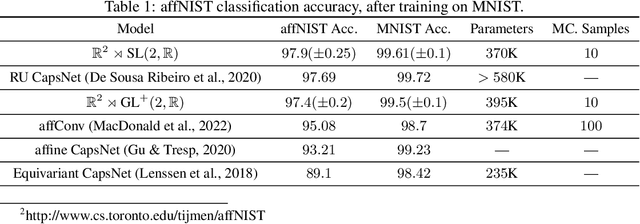
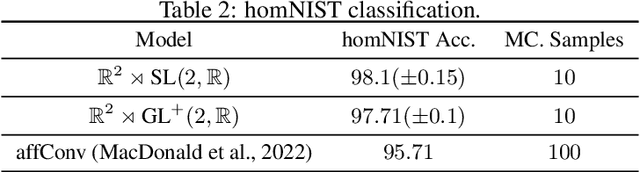
Invariance and equivariance to geometrical transformations have proven to be very useful inductive biases when training (convolutional) neural network models, especially in the low-data regime. Much work has focused on the case where the symmetry group employed is compact or abelian, or both. Recent work has explored enlarging the class of transformations used to the case of Lie groups, principally through the use of their Lie algebra, as well as the group exponential and logarithm maps. The applicability of such methods to larger transformation groups is limited by the fact that depending on the group of interest $G$, the exponential map may not be surjective. Further limitations are encountered when $G$ is neither compact nor abelian. Using the structure and geometry of Lie groups and their homogeneous spaces, we present a framework by which it is possible to work with such groups primarily focusing on the Lie groups $G = \text{GL}^{+}(n, \mathbb{R})$ and $G = \text{SL}(n, \mathbb{R})$, as well as their representation as affine transformations $\mathbb{R}^{n} \rtimes G$. Invariant integration as well as a global parametrization is realized by decomposing the `larger` groups into subgroups and submanifolds which can be handled individually. Under this framework, we show how convolution kernels can be parametrized to build models equivariant with respect to affine transformations. We evaluate the robustness and out-of-distribution generalisation capability of our model on the standard affine-invariant benchmark classification task, where we outperform all previous equivariant models as well as all Capsule Network proposals.
Examining Cooperation in Visual Dialog Models
Dec 04, 2017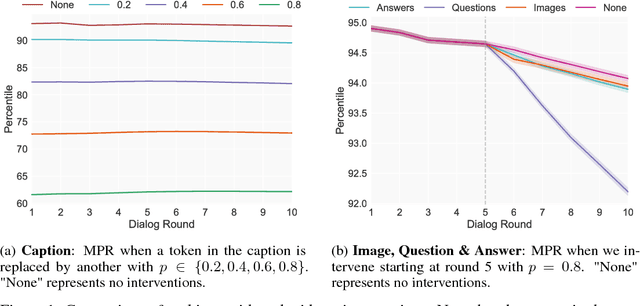
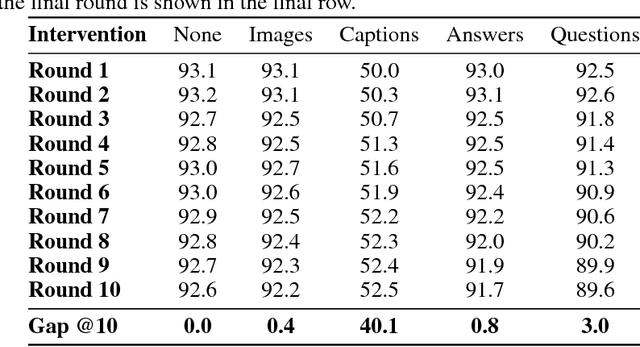
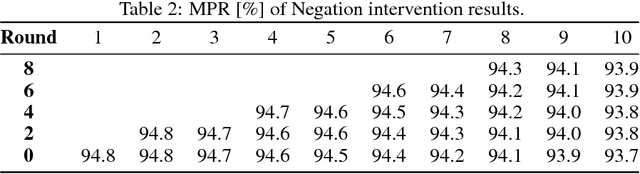
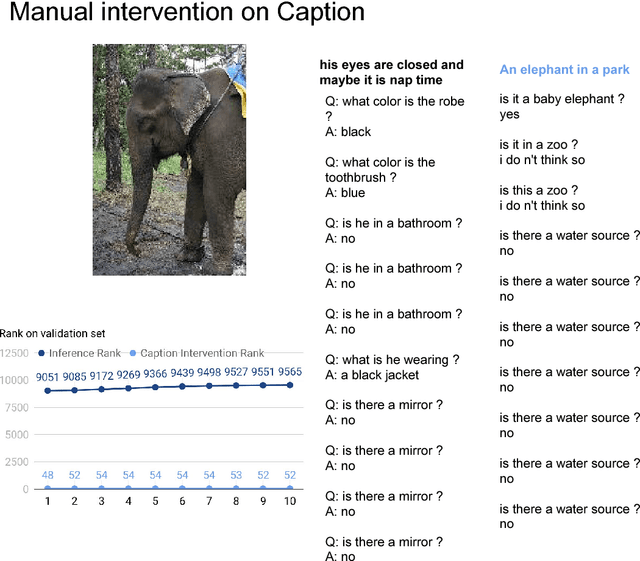
In this work we propose a blackbox intervention method for visual dialog models, with the aim of assessing the contribution of individual linguistic or visual components. Concretely, we conduct structured or randomized interventions that aim to impair an individual component of the model, and observe changes in task performance. We reproduce a state-of-the-art visual dialog model and demonstrate that our methodology yields surprising insights, namely that both dialog and image information have minimal contributions to task performance. The intervention method presented here can be applied as a sanity check for the strength and robustness of each component in visual dialog systems.