 Add to Chrome
 Add to Firefox
 Add to Edge
Causality-Aware End-to-End Autonomous Driving via Ego-Centric Joint Scene Modeling
May 13, 2026
End-to-end autonomous driving, which bypasses traditional modular pipelines by directly predicting future trajectories from sensor inputs, has recently achieved substantial progress. However, existing methods often overlook the causal inter-dependencies in ego-vehicle planning, ignoring the reciprocal relations between the ego vehicle and surrounding agents. This causal oversight leads to inconsistent and unreliable trajectory predictions, especially in interaction-critical scenarios where ego decisions and neighboring agent behaviors must be reasoned about jointly. To address this limitation, we propose CaAD, a Causality-aware end-to-end Autonomous Driving framework that captures these dependencies within a shared latent scene representation. First, we propose a ego-centric joint-causal modeling module that builds on the marginal prediction branch, and learns causal dependencies between the ego vehicle and interaction-relevant agents. Second, we employ a causality-aware policy alignment stage implemented with joint-mode embeddings to align the stochastic ego policy with planning-oriented closed-loop feedback computed from surrounding traffic and map context. On the Bench2Drive and NAVSIM benchmarks, CaAD demonstrates strong closed-loop planning performance, achieving a Driving Score of 87.53 and Success Rate of 71.81 on Bench2Drive, and a PDMS of 91.1 on NAVSIM.

Focus, Don't Prune: Identifying Instruction-Relevant Regions for Information-Rich Image Understanding
Mar 24, 2026Large Vision-Language Models (LVLMs) have shown strong performance across various multimodal tasks by leveraging the reasoning capabilities of Large Language Models (LLMs). However, processing visually complex and information-rich images, such as infographics or document layouts, requires these models to generate a large number of visual tokens, leading to significant computational overhead. To address this, we propose PinPoint, a novel two-stage framework that first identifies instruction-relevant image regions and then refines them to extract fine-grained visual features for improved reasoning and efficiency. Central to our approach is the Instruction-Region Alignment, which localizes relevant regions using both visual input and textual instructions. We further introduce new annotations that provide richer ground-truth supervision for instruction-relevant regions across challenging VQA benchmarks: InfographicVQA, MultiPageDocVQA, and SinglePageDocVQA. Experimental results show that PinPoint not only achieves superior accuracy compared to existing methods but also reduces computational overhead by minimizing irrelevant visual tokens.
Slot State Space Models
Jun 18, 2024Recent State Space Models (SSMs) such as S4, S5, and Mamba have shown remarkable computational benefits in long-range temporal dependency modeling. However, in many sequence modeling problems, the underlying process is inherently modular and it is of interest to have inductive biases that mimic this modular structure. In this paper, we introduce SlotSSMs, a novel framework for incorporating independent mechanisms into SSMs to preserve or encourage separation of information. Unlike conventional SSMs that maintain a monolithic state vector, SlotSSMs maintains the state as a collection of multiple vectors called slots. Crucially, the state transitions are performed independently per slot with sparse interactions across slots implemented via the bottleneck of self-attention. In experiments, we evaluate our model in object-centric video understanding, 3D visual reasoning, and video prediction tasks, which involve modeling multiple objects and their long-range temporal dependencies. We find that our proposed design offers substantial performance gains over existing sequence modeling methods.
Structured World Modeling via Semantic Vector Quantization
Feb 02, 2024
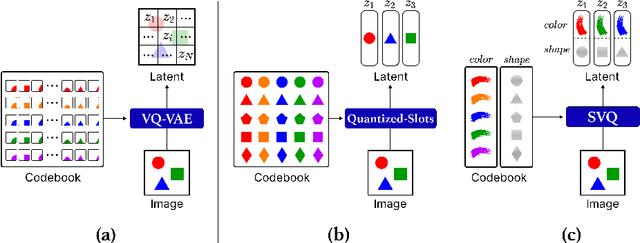


Neural discrete representations are crucial components of modern neural networks. However, their main limitation is that the primary strategies such as VQ-VAE can only provide representations at the patch level. Therefore, one of the main goals of representation learning, acquiring structured, semantic, and compositional abstractions such as the color and shape of an object, remains elusive. In this paper, we present the first approach to semantic neural discrete representation learning. The proposed model, called Semantic Vector-Quantized Variational Autoencoder (SVQ), leverages recent advances in unsupervised object-centric learning to address this limitation. Specifically, we observe that a simple approach quantizing at the object level poses a significant challenge and propose constructing scene representations hierarchically, from low-level discrete concept schemas to object representations. Additionally, we suggest a novel method for structured semantic world modeling by training a prior over these representations, enabling the ability to generate images by sampling the semantic properties of the objects in the scene. In experiments on various 2D and 3D object-centric datasets, we find that our model achieves superior generation performance compared to non-semantic vector quantization methods such as VQ-VAE and previous object-centric generative models. Furthermore, we find that the semantic discrete representations can solve downstream scene understanding tasks that require reasoning about the properties of different objects in the scene.