 Add to Chrome
 Add to Firefox
 Add to Edge
The Nuts and Bolts of Natural Language to SQL Translation: A Systematic Analysis of Model Pipeline Optimisation Approaches and their Interactions
Jul 12, 2026
In the age of large language models, Natural Language to SQL (NL2SQL) translation remains an open problem with many useful applications. We explore interactions between several NL2SQL pipeline extensions to inspire development of more lightweight models. Specifically, we integrate the NatSQL intermediate representation, include a preprocessing step and a fine-tuning step based on synthetic data, and develop a novel reranker model to improve SQL selection in the final beam. We perform an ablation study supplemented by a Shapley analysis of these different components integrated with two backbone architectures, SmBoP and RASAT. We find that simply combining all of them does not lead to best results, but that their impact depends on their interactions with the baseline system, as well as each other.

Log-Insight: Automating Microservice Incident Diagnosis via Neuro-Symbolic Log Analysis
Jul 09, 2026Diagnosing production incidents in large-scale microservice systems is time-critical for Site Reliability Engineers (SREs). A single 30-minute incident window in our deployment can generate over two million log lines--approximately 1.2 billion characters, far exceeding standard LLM context windows--making direct LLM-based Root Cause Analysis (RCA) infeasible. Existing approaches leave gaps: template-based parsers lack semantic anomaly reasoning, deep-learning detectors emit black-box binary signals, and LLM pipelines suffer context overflow and domain hallucination on raw telemetry. We present Log-Insight, an automated incident-diagnosis system deployed in production at Huawei. The core design principle automates the SRE's manual triage workflow: symbolic stages replicate the structured investigation a skilled SRE would perform--sampling, schema understanding, pattern clustering, and statistical anomaly ranking. This hands the LLM a compact, pre-ranked evidence dossier to synthesise into a hypothesis report. Our six-stage pipeline reduces millions of raw events by 1,000-7,000x while preserving statistically significant failure signals. Evaluated on 11 historical production incidents (110 runs, SRE-validated ground truth), Log-Insight achieves MRR = 0.790, returning the correct root cause within the top-3 hypotheses in over 90% of runs in under a minute of latency. We report systematic failure modes, active mitigations, and open research directions. The Forensic Evidence section--listing exact log templates and skew statistics--was consistently identified by operators as a key adoption factor, shifting the system's perceived role from opaque oracle to investigative assistant.
Efficient Multi-Cohort Inference for Long-Term Effects and Lifetime Value in A/B Testing with User Learning
Apr 22, 2026In streaming platforms churn is extremely costly, yet A/B tests are typically evaluated using outcomes observed within a limited experimental horizon. Even when both short- and predicted long-term engagement metrics are considered, they may fail to capture how a treatment affects users' retention. Consequently, an intervention may appear beneficial in the short term and neutral in the long term while still generating lower total value than the control due to users churn. To address this limitation, we introduce a method that estimates long-term treatment effects (LTE) and residual lifetime value change ($ΔERLV$) in short multi-cohort A/B tests under user learning. To estimate time-varying treatment effects efficiently, we introduce an inverse-variance weighted estimator that combines multiple cohorts estimates, reducing variance relative to standard approaches in the literature. The estimated treatment trajectory is then modeled as a parametric decay to recover both the asymptotic treatment effect and the cumulative value generated over time. Our framework enables simultaneous evaluation of steady-state impact and residual user value within a single experiment. Empirical results show improved precision in estimating LTE and $ΔERLV$ and identify scenarios in which relying on either short-term or long-term metrics alone would lead to incorrect product decisions.
BIS: NL2SQL Service Evaluation Benchmark for Business Intelligence Scenarios
Oct 30, 2024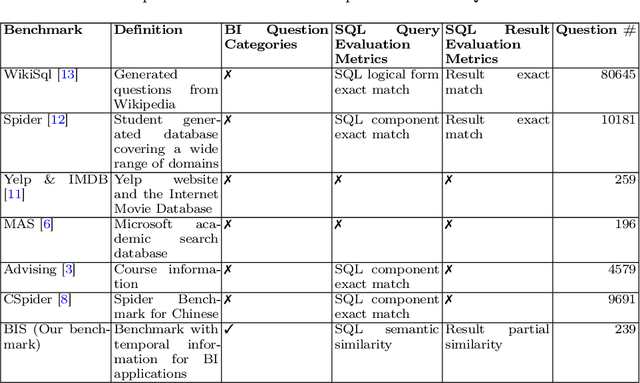
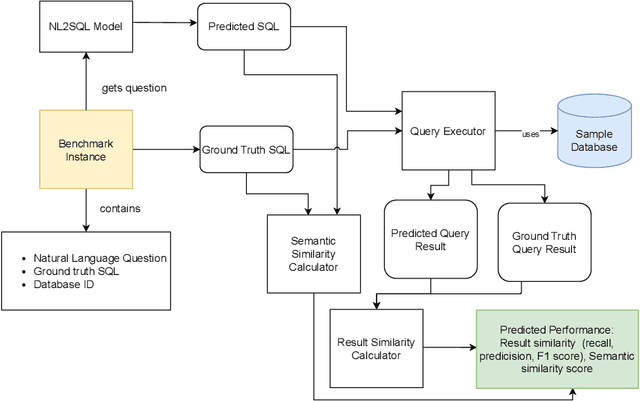
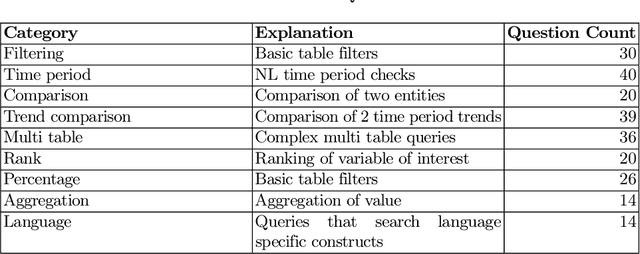
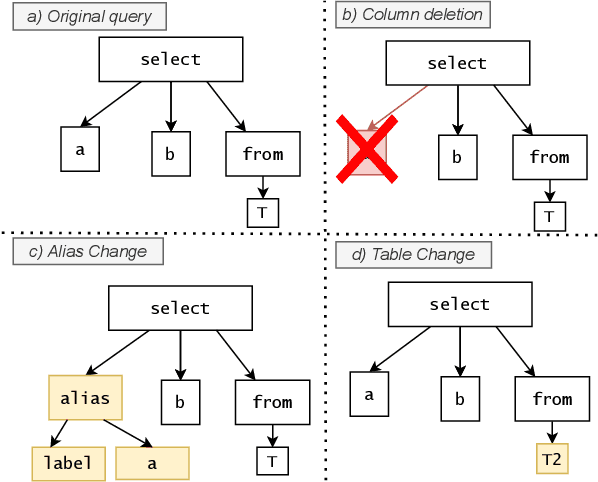
NL2SQL (Natural Language to Structured Query Language) transformation has seen wide adoption in Business Intelligence (BI) applications in recent years. However, existing NL2SQL benchmarks are not suitable for production BI scenarios, as they are not designed for common business intelligence questions. To address this gap, we have developed a new benchmark focused on typical NL questions in industrial BI scenarios. We discuss the challenges of constructing a BI-focused benchmark and the shortcomings of existing benchmarks. Additionally, we introduce question categories in our benchmark that reflect common BI inquiries. Lastly, we propose two novel semantic similarity evaluation metrics for assessing NL2SQL capabilities in BI applications and services.