 Add to Chrome
 Add to Firefox
 Add to Edge
Cluster, Route, Escalate: Cascaded Framework for Cost-Aware LLM Serving
Jun 25, 2026
Efficient deployment of large language models (LLMs) in production forces a trade-off between accuracy and cost. Operators often default to a single model that is either expensive for easy queries or insufficient for hard ones. To address this challenge, we propose a two-stage cascaded solution. Stage 1 clusters incoming queries and assigns each cluster to its most cost-effective model. The cost budget for this routing process is set by an interpretable hyperparameter, tuned offline. Stage 2 adds a quality estimation (QE) cascade; when an output from Stage 1 is judged low-quality, the query is escalated to a stronger model. This ensures only hard or low-confidence cases reach the expensive models. On the test datasets, the cascaded system retains 97-99% of the strongest model's accuracy while reducing Time Per Output Token (TPOT). It requires only task-correctness labels and adapts to changes in the model pool without manual reconfiguration.

Breaking MCP with Function Hijacking Attacks: Novel Threats for Function Calling and Agentic Models
Apr 22, 2026The growth of agentic AI has drawn significant attention to function calling Large Language Models (LLMs), which are designed to extend the capabilities of AI-powered system by invoking external functions. Injection and jailbreaking attacks have been extensively explored to showcase the vulnerabilities of LLMs to user prompt manipulation. The expanded capabilities of agentic models introduce further vulnerabilities via their function calling interface. Recent work in LLM security showed that function calling can be abused, leading to data tampering and theft, causing disruptive behavior such as endless loops, or causing LLMs to produce harmful content in the style of jailbreaking attacks. This paper introduces a novel function hijacking attack (FHA) that manipulates the tool selection process of agentic models to force the invocation of a specific, attacker-chosen function. While existing attacks focus on semantic preference of the model for function-calling tasks, we show that FHA is largely agnostic to the context semantics and robust to the function sets, making it applicable across diverse domains. We further demonstrate that FHA can be trained to produce universal adversarial functions, enabling a single attacked function to hijack tool selection across multiple queries and payload configurations. We conducted experiments on 5 different models, including instructed and reasoning variants, reaching 70% to 100% ASR over the established BFCL dataset. Our findings further demonstrate the need for strong guardrails and security modules for agentic systems.
TRACES: Tagging Reasoning Steps for Adaptive Cost-Efficient Early-Stopping
Apr 22, 2026The field of Language Reasoning Models (LRMs) has been very active over the past few years with advances in training and inference techniques enabling LRMs to reason longer, and more accurately. However, a growing body of studies show that LRMs are still inefficient, over-generating verification and reflection steps. Additionally, the high-level role of each reasoning step and how different step types contribute to the generation of correct answers, is largely underexplored. To address this challenge, we introduce TRACES (Tagging of the Reasoning steps enabling Adaptive Cost-Efficient early-Stopping), a lightweight framework that tags reasoning steps in real-time, and enable adaptive, cost-efficient early stopping of large-language-model inferences. Building on this framework we monitor reasoning behaviors during inferences, and we find that LRMs tend to shift their reasoning behavior after reaching a correct answer. We demonstrate that the monitoring of the specific type of steps can produce effective interpretable early stopping criteria. We evaluate the TRACES framework on three mathematical reasoning benchmarks, namely, MATH500, GSM8K, AIME and two knowledge and reasoning benchmarks, MMLU and GPQA respectively. We achieve 20 to 50% token reduction while maintaining comparable accuracy to standard generation.
Step-Tagging: Toward controlling the generation of Language Reasoning Models through step monitoring
Dec 16, 2025The field of Language Reasoning Models (LRMs) has been very active over the past few years with advances in training and inference techniques enabling LRMs to reason longer, and more accurately. However, a growing body of studies show that LRMs are still inefficient, over-generating verification and reflection steps. To address this challenge, we introduce the Step-Tagging framework, a lightweight sentence-classifier enabling real-time annotation of the type of reasoning steps that an LRM is generating. To monitor reasoning behaviors, we introduced ReasonType: a novel taxonomy of reasoning steps. Building on this framework, we demonstrated that online monitoring of the count of specific steps can produce effective interpretable early stopping criteria of LRM inferences. We evaluate the Step-tagging framework on three open-source reasoning models across standard benchmark datasets: MATH500, GSM8K, AIME and non-mathematical tasks (GPQA and MMLU-Pro). We achieve 20 to 50\% token reduction while maintaining comparable accuracy to standard generation, with largest gains observed on more computation-heavy tasks. This work offers a novel way to increase control over the generation of LRMs, and a new tool to study behaviors of LRMs.
Iterative Layer Pruning for Efficient Translation Inference
Oct 26, 2025Large language models (LLMs) have transformed many areas of natural language processing, including machine translation. However, efficient deployment of LLMs remains challenging due to their intensive computational requirements. In this paper, we address this challenge and present our submissions to the Model Compression track at the Conference on Machine Translation (WMT 2025). In our experiments, we investigate iterative layer pruning guided by layer importance analysis. We evaluate this method using the Aya-Expanse-8B model for translation from Czech to German, and from English to Egyptian Arabic. Our approach achieves substantial reductions in model size and inference time, while maintaining the translation quality of the baseline models.
* WMT 2025
Pre-Hoc Predictions in AutoML: Leveraging LLMs to Enhance Model Selection and Benchmarking for Tabular datasets
Oct 02, 2025The field of AutoML has made remarkable progress in post-hoc model selection, with libraries capable of automatically identifying the most performing models for a given dataset. Nevertheless, these methods often rely on exhaustive hyperparameter searches, where methods automatically train and test different types of models on the target dataset. Contrastingly, pre-hoc prediction emerges as a promising alternative, capable of bypassing exhaustive search through intelligent pre-selection of models. Despite its potential, pre-hoc prediction remains under-explored in the literature. This paper explores the intersection of AutoML and pre-hoc model selection by leveraging traditional models and Large Language Model (LLM) agents to reduce the search space of AutoML libraries. By relying on dataset descriptions and statistical information, we reduce the AutoML search space. Our methodology is applied to the AWS AutoGluon portfolio dataset, a state-of-the-art AutoML benchmark containing 175 tabular classification datasets available on OpenML. The proposed approach offers a shift in AutoML workflows, significantly reducing computational overhead, while still selecting the best model for the given dataset.
Active Learning and Transfer Learning for Anomaly Detection in Time-Series Data
Aug 05, 2025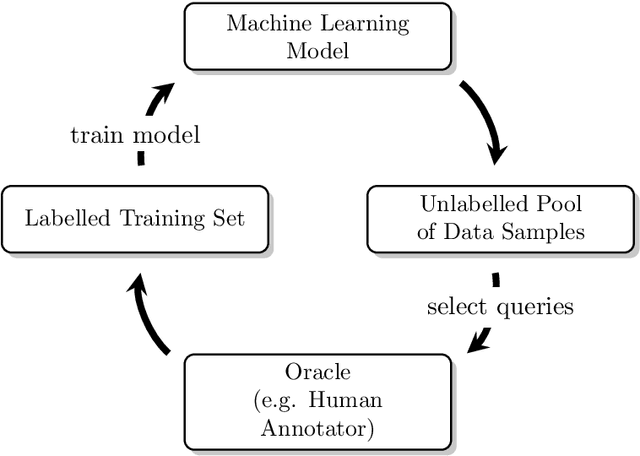
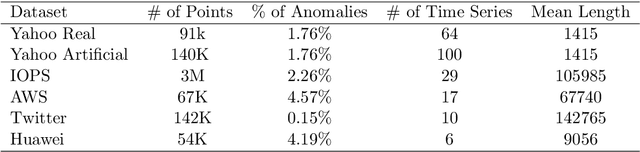
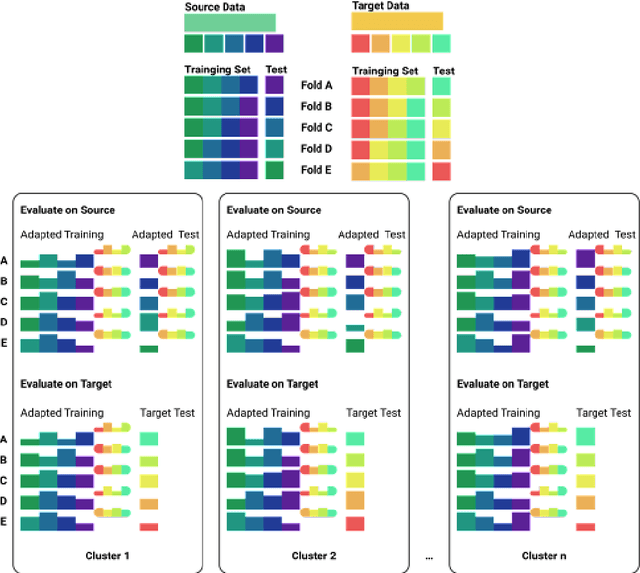
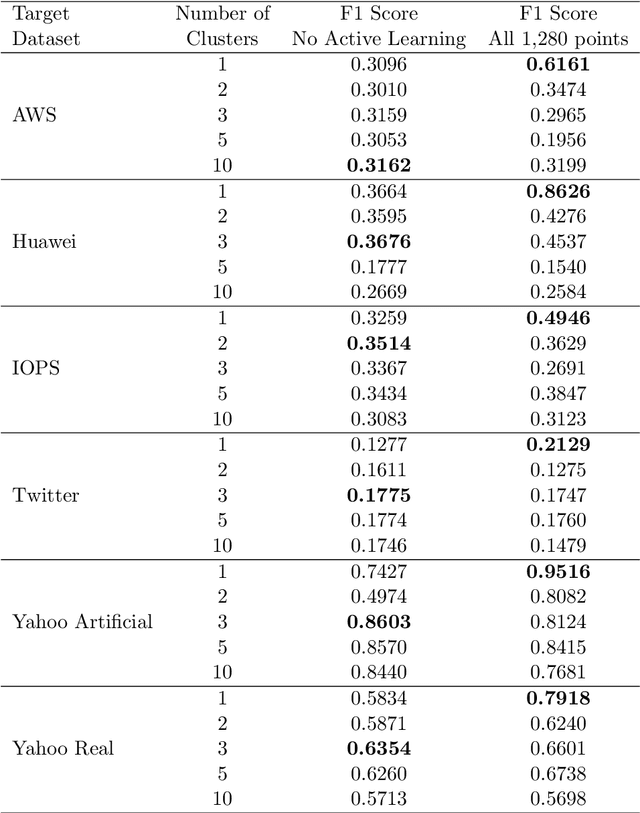
This paper examines the effectiveness of combining active learning and transfer learning for anomaly detection in cross-domain time-series data. Our results indicate that there is an interaction between clustering and active learning and in general the best performance is achieved using a single cluster (in other words when clustering is not applied). Also, we find that adding new samples to the training set using active learning does improve model performance but that in general, the rate of improvement is slower than the results reported in the literature suggest. We attribute this difference to an improved experimental design where distinct data samples are used for the sampling and testing pools. Finally, we assess the ceiling performance of transfer learning in combination with active learning across several datasets and find that performance does initially improve but eventually begins to tail off as more target points are selected for inclusion in training. This tail-off in performance may indicate that the active learning process is doing a good job of sequencing data points for selection, pushing the less useful points towards the end of the selection process and that this tail-off occurs when these less useful points are eventually added. Taken together our results indicate that active learning is effective but that the improvement in model performance follows a linear flat function concerning the number of points selected and labelled.
Extending TWIG: Zero-Shot Predictive Hyperparameter Selection for KGEs based on Graph Structure
Dec 19, 2024Knowledge Graphs (KGs) have seen increasing use across various domains -- from biomedicine and linguistics to general knowledge modelling. In order to facilitate the analysis of knowledge graphs, Knowledge Graph Embeddings (KGEs) have been developed to automatically analyse KGs and predict new facts based on the information in a KG, a task called "link prediction". Many existing studies have documented that the structure of a KG, KGE model components, and KGE hyperparameters can significantly change how well KGEs perform and what relationships they are able to learn. Recently, the Topologically-Weighted Intelligence Generation (TWIG) model has been proposed as a solution to modelling how each of these elements relate. In this work, we extend the previous research on TWIG and evaluate its ability to simulate the output of the KGE model ComplEx in the cross-KG setting. Our results are twofold. First, TWIG is able to summarise KGE performance on a wide range of hyperparameter settings and KGs being learned, suggesting that it represents a general knowledge of how to predict KGE performance from KG structure. Second, we show that TWIG can successfully predict hyperparameter performance on unseen KGs in the zero-shot setting. This second observation leads us to propose that, with additional research, optimal hyperparameter selection for KGE models could be determined in a pre-hoc manner using TWIG-like methods, rather than by using a full hyperparameter search.
A Survey on Knowledge Graph Structure and Knowledge Graph Embeddings
Dec 13, 2024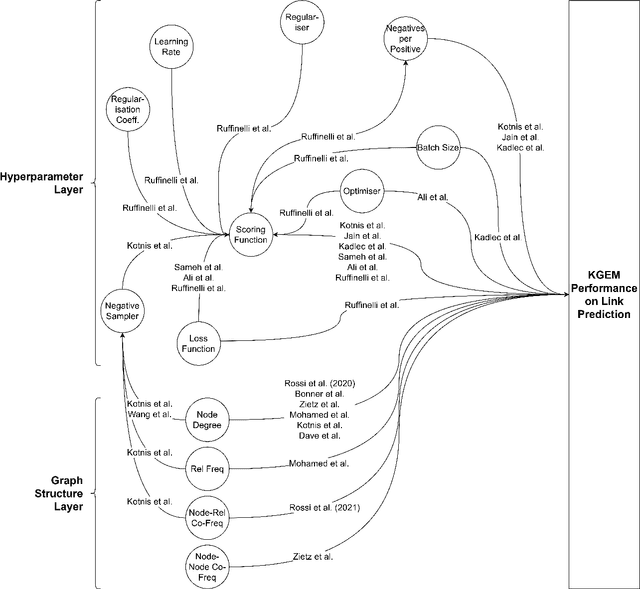
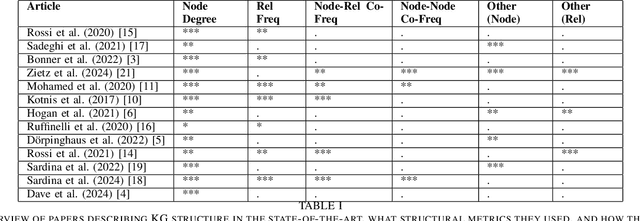

Knowledge Graphs (KGs) and their machine learning counterpart, Knowledge Graph Embedding Models (KGEMs), have seen ever-increasing use in a wide variety of academic and applied settings. In particular, KGEMs are typically applied to KGs to solve the link prediction task; i.e. to predict new facts in the domain of a KG based on existing, observed facts. While this approach has been shown substantial power in many end-use cases, it remains incompletely characterised in terms of how KGEMs react differently to KG structure. This is of particular concern in light of recent studies showing that KG structure can be a significant source of bias as well as partially determinant of overall KGEM performance. This paper seeks to address this gap in the state-of-the-art. This paper provides, to the authors' knowledge, the first comprehensive survey exploring established relationships of Knowledge Graph Embedding Models and Graph structure in the literature. It is the hope of the authors that this work will inspire further studies in this area, and contribute to a more holistic understanding of KGs, KGEMs, and the link prediction task.
BIS: NL2SQL Service Evaluation Benchmark for Business Intelligence Scenarios
Oct 30, 2024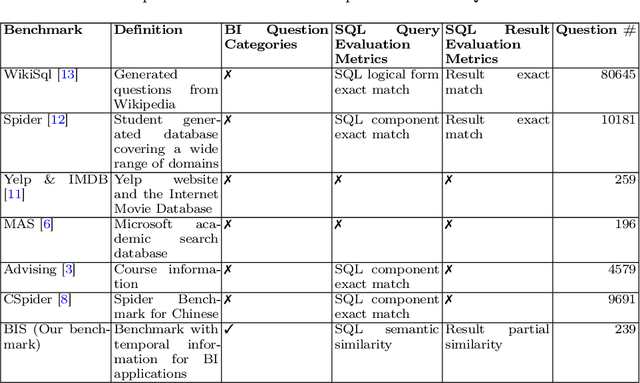
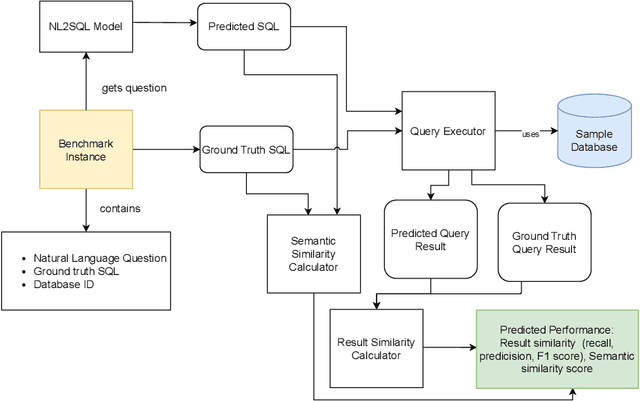
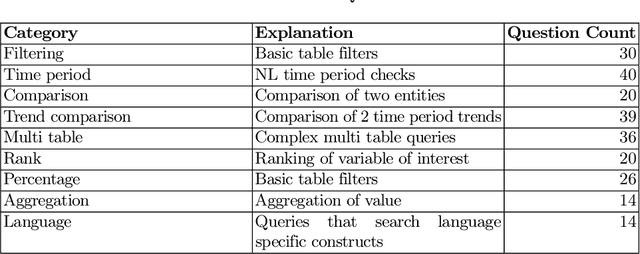
NL2SQL (Natural Language to Structured Query Language) transformation has seen wide adoption in Business Intelligence (BI) applications in recent years. However, existing NL2SQL benchmarks are not suitable for production BI scenarios, as they are not designed for common business intelligence questions. To address this gap, we have developed a new benchmark focused on typical NL questions in industrial BI scenarios. We discuss the challenges of constructing a BI-focused benchmark and the shortcomings of existing benchmarks. Additionally, we introduce question categories in our benchmark that reflect common BI inquiries. Lastly, we propose two novel semantic similarity evaluation metrics for assessing NL2SQL capabilities in BI applications and services.