 Add to Chrome
 Add to Firefox
 Add to Edge
WavesFM: Hierarchical Representation Learning for Longitudinal Wearable Sensor Waveforms
May 09, 2026
Wearable sensors enable the continuous acquisition of high-resolution physiological waveforms, such as photoplethysmography and accelerometry, under free-living conditions. However, inferring health-related phenotypes from these signals presents significant challenges due to high sampling frequencies, multimodal dependencies, and extreme sequence lengths (e.g., weeks of recordings), compounded by a scarcity of ground-truth labels. To address these challenges, existing self-supervised learning (SSL) methodologies typically follow two paradigms: (1) learning rich morphological representations from short waveform segments while collapsing longitudinal dynamics through simple aggregation, or (2) modeling behavioral patterns from coarse, hand-crafted features (e.g. heart rate, step counts) spanning longer horizons but foregoing subtle, predictive signatures in raw waveforms. To bridge this gap, we propose WavesFM, a foundation model utilizing a two-stage SSL framework for longitudinal physiological data. Specifically, we decompose the learning problem into two stages: first, a segment-level encoder is pretrained to extract local embeddings from short waveforms; subsequently, a temporal encoder is trained to model the sequence of these embeddings across a multi-day horizon. This hierarchical approach overcomes the computational complexity of high-resolution, long-sequence data, allowing the overall model to capture both local signal semantics and the complex circadian and inter-day variations governing physiological dynamics. Pretrained on over 6.8M hours (N=324k individuals) of recordings for the first stage and 5.3M hours (N=10k) for the second stage, WavesFM demonstrates superior performance across 58 diverse tasks spanning demographics, lifestyle, health conditions, and medications.

Representation and Reinforcement Learning for Personalized Glycemic Control in Septic Patients
Dec 02, 2017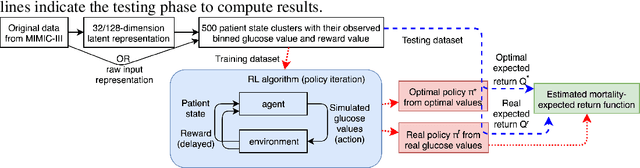

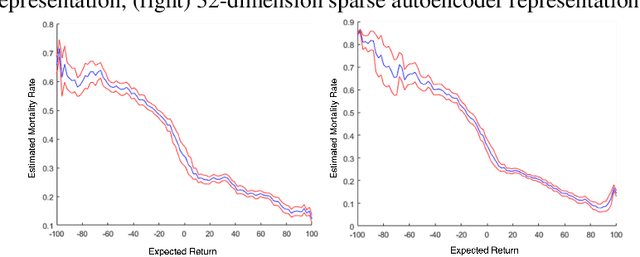
Glycemic control is essential for critical care. However, it is a challenging task because there has been no study on personalized optimal strategies for glycemic control. This work aims to learn personalized optimal glycemic trajectories for severely ill septic patients by learning data-driven policies to identify optimal targeted blood glucose levels as a reference for clinicians. We encoded patient states using a sparse autoencoder and adopted a reinforcement learning paradigm using policy iteration to learn the optimal policy from data. We also estimated the expected return following the policy learned from the recorded glycemic trajectories, which yielded a function indicating the relationship between real blood glucose values and 90-day mortality rates. This suggests that the learned optimal policy could reduce the patients' estimated 90-day mortality rate by 6.3%, from 31% to 24.7%. The result demonstrates that reinforcement learning with appropriate patient state encoding can potentially provide optimal glycemic trajectories and allow clinicians to design a personalized strategy for glycemic control in septic patients.