 Add to Chrome
 Add to Firefox
 Add to Edge
Modeling Scientific Experiment Scenes: Dataset and Model
Aug 06, 2026
Scene Graph Generation (SGG) is fundamental to structured visual understanding, yet existing benchmarks focus mainly on daily life images and overlook scientific experiment scenes with specialized instruments, task-specific experimental semantics, and dense, fine-grained physical relations. These scenes are increasingly important for automated experimental analysis and smart education. To bridge this gap, we introduce PhysScene, the first SGG dataset for physical experiment scenes, providing densely annotated scene graphs and benchmarks under multiple supervision and protocol settings. PhysScene further exposes two key algorithmic challenges for SGG: pronounced long-tail relational predicate distributions and a substantial visual-textual semantic gap. To address these challenges, we propose the Cross-Modal Dual-Path Generator (CM-DPG), a model for robust open-vocabulary SGG. The model enhances object-level semantic representations through joint visual-textual encoding and improves relational reasoning using complementary visual and geometric cues. We also incorporate relation-aware pre-training, caption-derived pseudo-supervision, and adaptive weighting to support balanced learning across head and tail predicates. Extensive experiments on PhysScene and VG150 show that CM-DPG achieves competitive performance across multiple evaluation settings, with ablation studies validating the contribution of each component. The dataset and code are publicly available at https://github.com/ZMH-SDUST/CM-DPG.

PhysScene: A Scene Graph Dataset for Scientific Visual Reasoning in Physics Experiments
Jun 08, 2026Scene Graphs (SGs) provide structured representations of visual scenes by modeling objects and their pairwise relationships. Despite recent progress, existing datasets primarily focus on generic natural contexts, leaving domain-specific and function-oriented scenes largely underexplored. This limitation restricts the evaluation of relational reasoning in scientific experimental scenes, thereby hindering the development of intelligent monitoring, analysis, and related applications in such scenes. To address this gap, we introduce PhysScene, the first SG dataset tailored to physics experiments. PhysScene encompasses specialized instruments, structured experimental setups, and functional relations intrinsic to experimental environments, enabling reasoning that extends beyond spatial co-occurrence to logical dependencies. Rather than pursuing large data scale, PhysScene focuses on strong semantic constraints and high relation density in experimental scenes, posing new challenges for existing scene parsing algorithms while offering opportunities for further improvements. Extensive analyses and experiments show that PhysScene complements existing benchmarks and establishes a valuable testbed for advancing scientific visual reasoning. The dataset is publicly available at https://github.com/ZMH-SDUST/PhysScene.
Conjugate Relation Modeling for Few-Shot Knowledge Graph Completion
Oct 26, 2025Few-shot Knowledge Graph Completion (FKGC) infers missing triples from limited support samples, tackling long-tail distribution challenges. Existing methods, however, struggle to capture complex relational patterns and mitigate data sparsity. To address these challenges, we propose a novel FKGC framework for conjugate relation modeling (CR-FKGC). Specifically, it employs a neighborhood aggregation encoder to integrate higher-order neighbor information, a conjugate relation learner combining an implicit conditional diffusion relation module with a stable relation module to capture stable semantics and uncertainty offsets, and a manifold conjugate decoder for efficient evaluation and inference of missing triples in manifold space. Experiments on three benchmarks demonstrate that our method achieves superior performance over state-of-the-art methods.
PhysLab: A Benchmark Dataset for Multi-Granularity Visual Parsing of Physics Experiments
Jun 07, 2025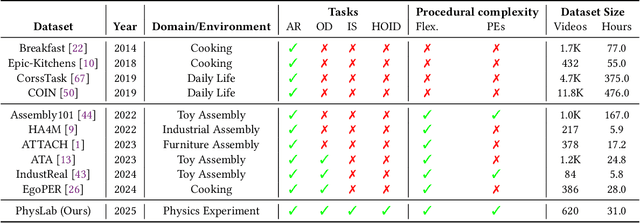
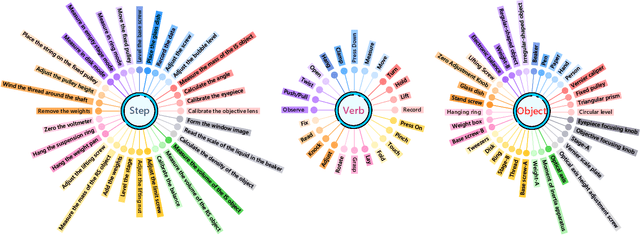
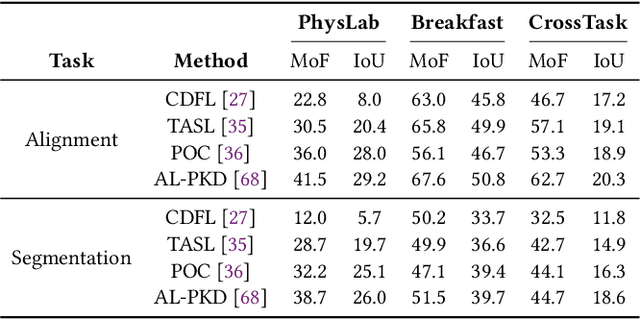
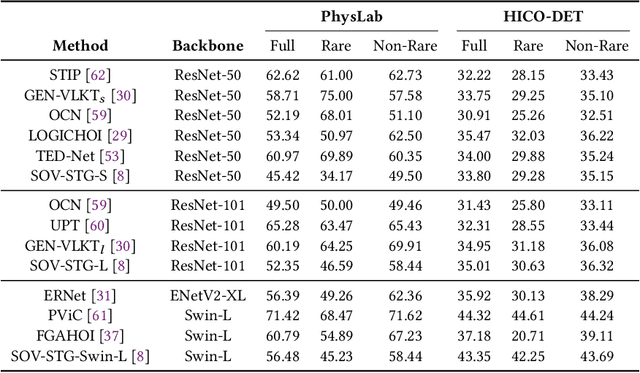
Visual parsing of images and videos is critical for a wide range of real-world applications. However, progress in this field is constrained by limitations of existing datasets: (1) insufficient annotation granularity, which impedes fine-grained scene understanding and high-level reasoning; (2) limited coverage of domains, particularly a lack of datasets tailored for educational scenarios; and (3) lack of explicit procedural guidance, with minimal logical rules and insufficient representation of structured task process. To address these gaps, we introduce PhysLab, the first video dataset that captures students conducting complex physics experiments. The dataset includes four representative experiments that feature diverse scientific instruments and rich human-object interaction (HOI) patterns. PhysLab comprises 620 long-form videos and provides multilevel annotations that support a variety of vision tasks, including action recognition, object detection, HOI analysis, etc. We establish strong baselines and perform extensive evaluations to highlight key challenges in the parsing of procedural educational videos. We expect PhysLab to serve as a valuable resource for advancing fine-grained visual parsing, facilitating intelligent classroom systems, and fostering closer integration between computer vision and educational technologies. The dataset and the evaluation toolkit are publicly available at https://github.com/ZMH-SDUST/PhysLab.