 Add to Chrome
 Add to Firefox
 Add to Edge
GeoAgent: Learning to Geolocate Everywhere with Reinforced Geographic Characteristics
Feb 13, 2026
This paper presents GeoAgent, a model capable of reasoning closely with humans and deriving fine-grained address conclusions. Previous RL-based methods have achieved breakthroughs in performance and interpretability but still remain concerns because of their reliance on AI-generated chain-of-thought (CoT) data and training strategies, which conflict with geographic characteristics. To address these issues, we first introduce GeoSeek, a new geolocation dataset comprising CoT data annotated by geographic experts and professional players. We further thoroughly explore the inherent characteristics of geographic tasks and propose a geo-similarity reward and a consistency reward assessed by a consistency agent to assist training. This encourages the model to converge towards correct answers from a geographic perspective while ensuring the integrity and consistency of its reasoning process. Experimental results show that GeoAgent outperforms existing methods and a series of general VLLMs across multiple grains, while generating reasoning that closely aligns with humans.

Step-wise Distribution Alignment Guided Style Prompt Tuning for Source-free Cross-domain Few-shot Learning
Nov 15, 2024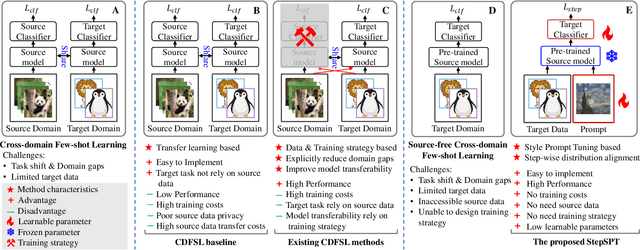
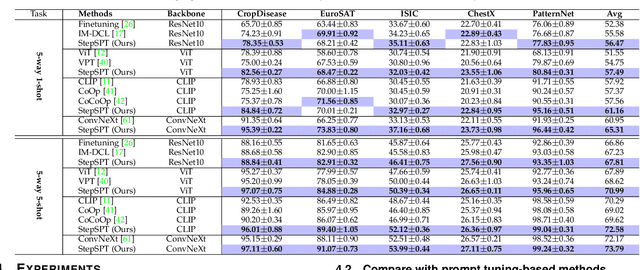
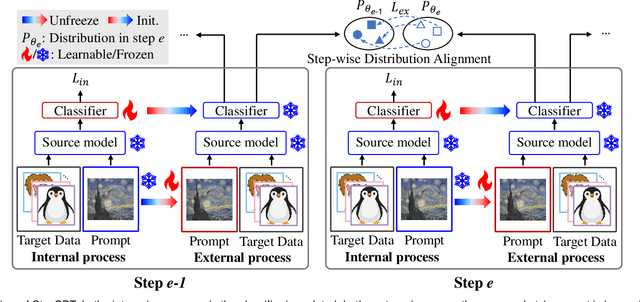

Existing cross-domain few-shot learning (CDFSL) methods, which develop source-domain training strategies to enhance model transferability, face challenges with large-scale pre-trained models (LMs) due to inaccessible source data and training strategies. Moreover, fine-tuning LMs for CDFSL demands substantial computational resources, limiting practicality. This paper addresses the source-free CDFSL (SF-CDFSL) problem, tackling few-shot learning (FSL) in the target domain using only pre-trained models and a few target samples without source data or strategies. To overcome the challenge of inaccessible source data, this paper introduces Step-wise Distribution Alignment Guided Style Prompt Tuning (StepSPT), which implicitly narrows domain gaps through prediction distribution optimization. StepSPT proposes a style prompt to align target samples with the desired distribution and adopts a dual-phase optimization process. In the external process, a step-wise distribution alignment strategy factorizes prediction distribution optimization into a multi-step alignment problem to tune the style prompt. In the internal process, the classifier is updated using standard cross-entropy loss. Evaluations on five datasets demonstrate that StepSPT outperforms existing prompt tuning-based methods and SOTAs. Ablation studies further verify its effectiveness. Code will be made publicly available at \url{https://github.com/xuhuali-mxj/StepSPT}.