 Add to Chrome
 Add to Firefox
 Add to Edge
Fusing Transferred Priors and Physics-based Decomposition for Underwater Image Enhancement
Jun 14, 2026
The underwater images are captured within diverse water-medium conditions, leading to complex degradation, including color bias, low contrast, and blur effect. Recently, learning-based methods have demonstrated their potential for underwater image enhancement (UIE). However, most of the previous work focus on the training strategy or network design to make the enhanced result aligned well with the labels in datasets, ignoring that the labels are selected from the enhanced results of previous UIE methods and these pseudo-labels are noisy. Consequently, the performance of their models is not satisfactory to a certain extent. However, collecting the true labels of the underwater images is challenging. In this work, we propose a transfer learning-based UIE that does not require underwater images to have paired noisy or true labels for learning. Instead, the UIE task is first divided into global color correction, haze removal, and background noise suppression following the underwater physics. Then multiple types of prior from other vision tasks are leveraged as cross-domain supervision in each step. In this way, a novel UIE is available via transfer learning, and the physics-aligned UIE decomposition provides theoretical soundness. Qualitative and quantitative experiments demonstrate that our proposal based on physics and priors fusion achieves SOTA performance in the UIE task and effectively boosts downstream vision tasks, significantly outperforming benchmark methods. Project repo: https://github.com/Haru2022/P2-UIE.

NTIRE 2024 Challenge on Night Photography Rendering
Jun 18, 2024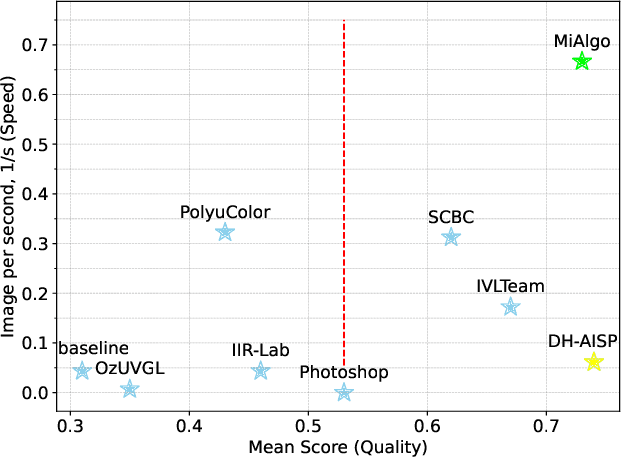
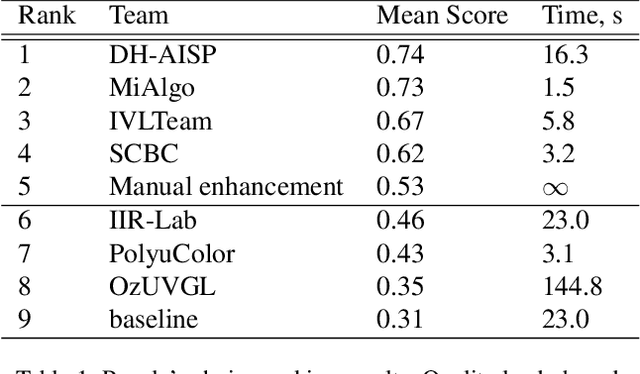
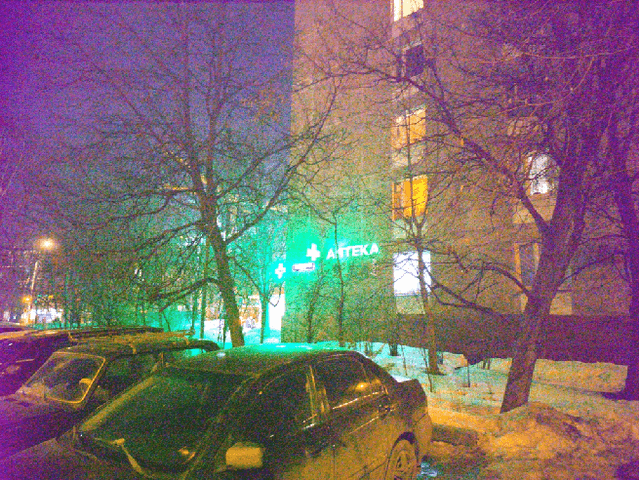
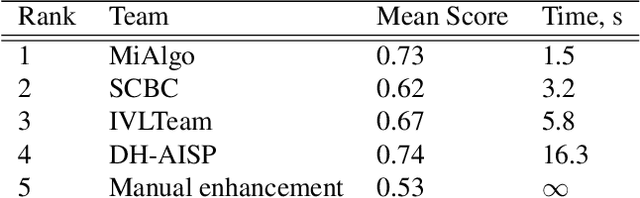
This paper presents a review of the NTIRE 2024 challenge on night photography rendering. The goal of the challenge was to find solutions that process raw camera images taken in nighttime conditions, and thereby produce a photo-quality output images in the standard RGB (sRGB) space. Unlike the previous year's competition, the challenge images were collected with a mobile phone and the speed of algorithms was also measured alongside the quality of their output. To evaluate the results, a sufficient number of viewers were asked to assess the visual quality of the proposed solutions, considering the subjective nature of the task. There were 2 nominations: quality and efficiency. Top 5 solutions in terms of output quality were sorted by evaluation time (see Fig. 1). The top ranking participants' solutions effectively represent the state-of-the-art in nighttime photography rendering. More results can be found at https://nightimaging.org.
Practical cross-sensor color constancy using a dual-mapping strategy
Nov 20, 2023Deep Neural Networks (DNNs) have been widely used for illumination estimation, which is time-consuming and requires sensor-specific data collection. Our proposed method uses a dual-mapping strategy and only requires a simple white point from a test sensor under a D65 condition. This allows us to derive a mapping matrix, enabling the reconstructions of image data and illuminants. In the second mapping phase, we transform the re-constructed image data into sparse features, which are then optimized with a lightweight multi-layer perceptron (MLP) model using the re-constructed illuminants as ground truths. This approach effectively reduces sensor discrepancies and delivers performance on par with leading cross-sensor methods. It only requires a small amount of memory (~0.003 MB), and takes ~1 hour training on an RTX3070Ti GPU. More importantly, the method can be implemented very fast, with ~0.3 ms and ~1 ms on a GPU or CPU respectively, and is not sensitive to the input image resolution. Therefore, it offers a practical solution to the great challenges of data recollection that is faced by the industry.