 Add to Chrome
 Add to Firefox
 Add to Edge
LDLT L-Lipschitz Network Weight Parameterization Initialization
Jan 13, 2026
We analyze initialization dynamics for LDLT-based $\mathcal{L}$-Lipschitz layers by deriving the exact marginal output variance when the underlying parameter matrix $W_0\in \mathbb{R}^{m\times n}$ is initialized with IID Gaussian entries $\mathcal{N}(0,σ^2)$. The Wishart distribution, $S=W_0W_0^\top\sim\mathcal{W}_m(n,σ^2 \boldsymbol{I}_m)$, used for computing the output marginal variance is derived in closed form using expectations of zonal polynomials via James' theorem and a Laplace-integral expansion of $(α\boldsymbol{I}_m+S)^{-1}$. We develop an Isserlis/Wick-based combinatorial expansion for $\operatorname{\mathbb{E}}\left[\operatorname{tr}(S^k)\right]$ and provide explicit truncated moments up to $k=10$, which yield accurate series approximations for small-to-moderate $σ^2$. Monte Carlo experiments confirm the theoretical estimates. Furthermore, empirical analysis was performed to quantify that, using current He or Kaiming initialization with scaling $1/\sqrt{n}$, the output variance is $0.41$, whereas the new parameterization with $10/ \sqrt{n}$ for $α=1$ results in an output variance of $0.9$. The findings clarify why deep $\mathcal{L}$-Lipschitz networks suffer rapid information loss at initialization and offer practical prescriptions for choosing initialization hyperparameters to mitigate this effect. However, using the Higgs boson classification dataset, a hyperparameter sweep over optimizers, initialization scale, and depth was conducted to validate the results on real-world data, showing that although the derivation ensures variance preservation, empirical results indicate He initialization still performs better.

Neuro-Symbolic Generation of Explanations for Robot Policies with Weighted Signal Temporal Logic
Apr 30, 2025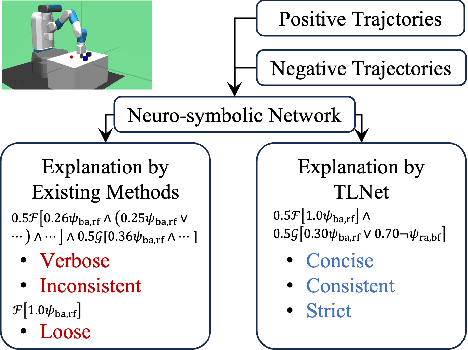
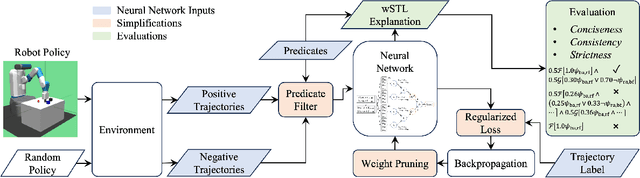
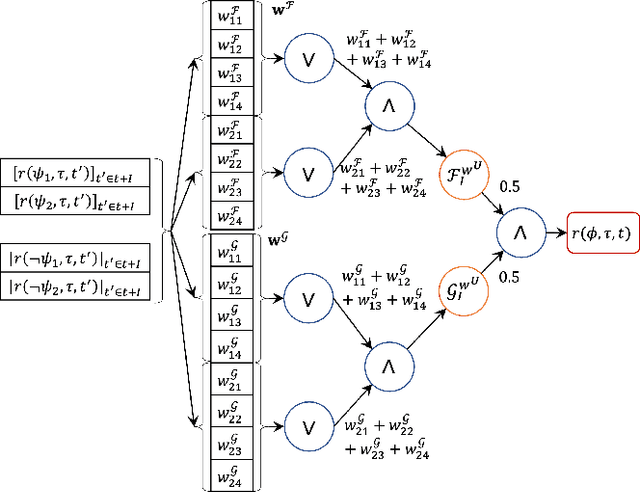
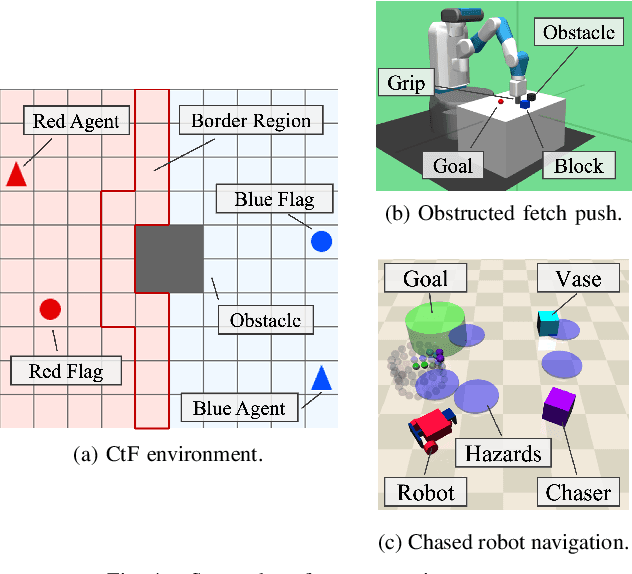
Neural network-based policies have demonstrated success in many robotic applications, but often lack human-explanability, which poses challenges in safety-critical deployments. To address this, we propose a neuro-symbolic explanation framework that generates a weighted signal temporal logic (wSTL) specification to describe a robot policy in a interpretable form. Existing methods typically produce explanations that are verbose and inconsistent, which hinders explainability, and loose, which do not give meaningful insights into the underlying policy. We address these issues by introducing a simplification process consisting of predicate filtering, regularization, and iterative pruning. We also introduce three novel explainability evaluation metrics -- conciseness, consistency, and strictness -- to assess explanation quality beyond conventional classification metrics. Our method is validated in three simulated robotic environments, where it outperforms baselines in generating concise, consistent, and strict wSTL explanations without sacrificing classification accuracy. This work bridges policy learning with formal methods, contributing to safer and more transparent decision-making in robotics.
On Generating Explanations for Reinforcement Learning Policies: An Empirical Study
Sep 29, 2023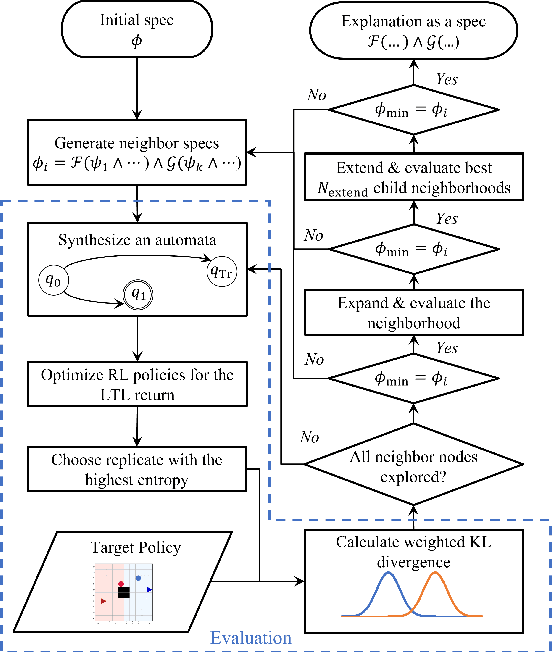
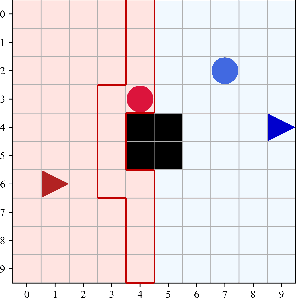
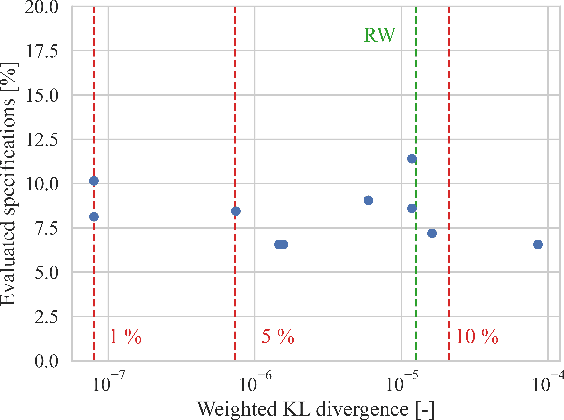
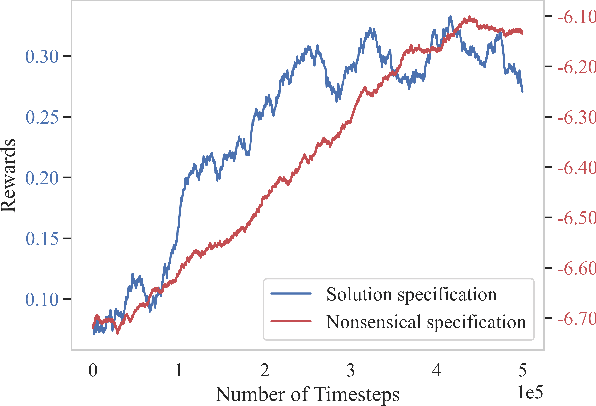
In this paper, we introduce a set of \textit{Linear Temporal Logic} (LTL) formulae designed to provide explanations for policies. Our focus is on crafting explanations that elucidate both the ultimate objectives accomplished by the policy and the prerequisites it upholds throughout its execution. These LTL-based explanations feature a structured representation, which is particularly well-suited for local-search techniques. The effectiveness of our proposed approach is illustrated through a simulated capture the flag environment. The paper concludes with suggested directions for future research.