 Add to Chrome
 Add to Firefox
 Add to Edge
X4Val: Learning Neural Surrogates for Variance-Reduced Policy Evaluation
Jun 03, 2026
Rigorous evaluation of learning-based robotic systems is an essential prerequisite for deployment. However, real-world test data is expensive to gather; moreover, in a typical iterative development context, data gathered from the latest policy is necessarily limited in scale. This motivates evaluation methodologies that make use of heterogeneous data sources, including simulation, historical policy logs, and data collected from related platforms or environments. While such auxiliary data are abundant and inexpensive, they are generally not directly representative of real-world outcomes -- for example, performance in simulation may differ substantially from performance in the real world -- making their principled use for high-confidence performance estimation challenging. In this paper, we introduce X4Val, a general framework for variance-reduced real-world metric estimation in the presence of non-paired, multi-domain data. X4Val embeds samples from real and auxiliary domains into a shared representation space and learns a transferable predictor of real-world metrics; this learned predictor is then incorporated into a control-variates estimator, enabling variance reduction even when paired samples are unavailable. We provide theoretical analysis and empirical evaluations on autonomous driving and real-world robot manipulation tasks, domains across which X4Val achieves up to 38.4% variance reduction and demonstrates consistent improvements over strong baselines. These results show that non-paired, heterogeneous data can be leveraged to substantially improve the sample efficiency of rigorous robotic system validation.

Leveraging Correlation Across Test Platforms for Variance-Reduced Metric Estimation
Jun 25, 2025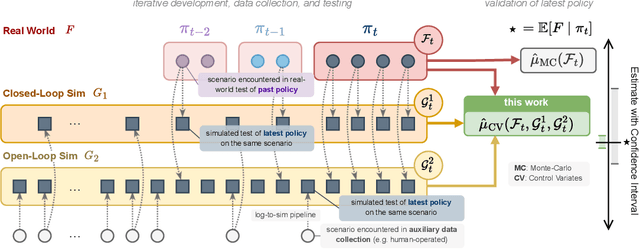
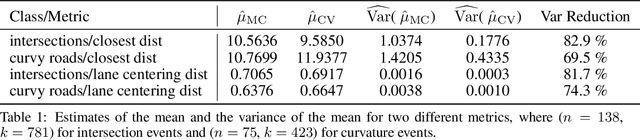
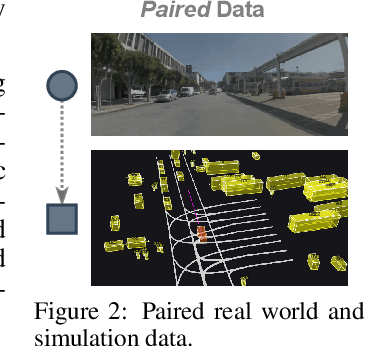

Learning-based robotic systems demand rigorous validation to assure reliable performance, but extensive real-world testing is often prohibitively expensive, and if conducted may still yield insufficient data for high-confidence guarantees. In this work, we introduce a general estimation framework that leverages paired data across test platforms, e.g., paired simulation and real-world observations, to achieve better estimates of real-world metrics via the method of control variates. By incorporating cheap and abundant auxiliary measurements (for example, simulator outputs) as control variates for costly real-world samples, our method provably reduces the variance of Monte Carlo estimates and thus requires significantly fewer real-world samples to attain a specified confidence bound on the mean performance. We provide theoretical analysis characterizing the variance and sample-efficiency improvement, and demonstrate empirically in autonomous driving and quadruped robotics settings that our approach achieves high-probability bounds with markedly improved sample efficiency. Our technique can lower the real-world testing burden for validating the performance of the stack, thereby enabling more efficient and cost-effective experimental evaluation of robotic systems.