 Add to Chrome
 Add to Firefox
 Add to Edge
Towards Human-AI Accessibility Mapping in India: VLM-Guided Annotations and POI-Centric Analysis in Chandigarh
Feb 17, 2026
Project Sidewalk is a web-based platform that enables crowdsourcing accessibility of sidewalks at city-scale by virtually walking through city streets using Google Street View. The tool has been used in 40 cities across the world, including the US, Mexico, Chile, and Europe. In this paper, we describe adaptation efforts to enable deployment in Chandigarh, India, including modifying annotation types, provided examples, and integrating VLM-based mission guidance, which adapts instructions based on a street scene and metadata analysis. Our evaluation with 3 annotators indicates the utility of AI-mission guidance with an average score of 4.66. Using this adapted Project Sidewalk tool, we conduct a Points of Interest (POI)-centric accessibility analysis for three sectors in Chandigarh with very different land uses, residential, commercial and institutional covering about 40 km of sidewalks. Across 40 km of roads audited in three sectors and around 230 POIs, we identified 1,644 of 2,913 locations where infrastructure improvements could enhance accessibility.

LabelAId: Just-in-time AI Interventions for Improving Human Labeling Quality and Domain Knowledge in Crowdsourcing Systems
Mar 14, 2024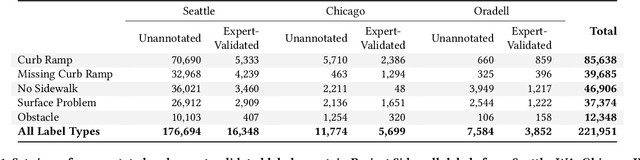
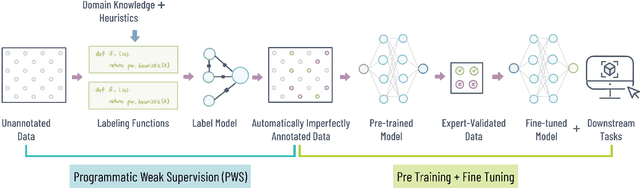
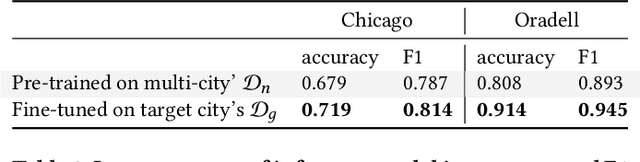
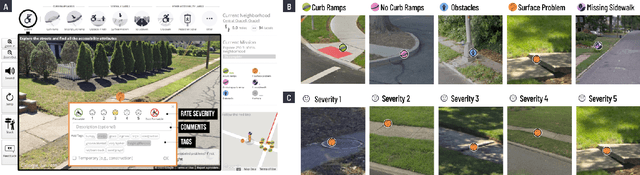
Crowdsourcing platforms have transformed distributed problem-solving, yet quality control remains a persistent challenge. Traditional quality control measures, such as prescreening workers and refining instructions, often focus solely on optimizing economic output. This paper explores just-in-time AI interventions to enhance both labeling quality and domain-specific knowledge among crowdworkers. We introduce LabelAId, an advanced inference model combining Programmatic Weak Supervision (PWS) with FT-Transformers to infer label correctness based on user behavior and domain knowledge. Our technical evaluation shows that our LabelAId pipeline consistently outperforms state-of-the-art ML baselines, improving mistake inference accuracy by 36.7% with 50 downstream samples. We then implemented LabelAId into Project Sidewalk, an open-source crowdsourcing platform for urban accessibility. A between-subjects study with 34 participants demonstrates that LabelAId significantly enhances label precision without compromising efficiency while also increasing labeler confidence. We discuss LabelAId's success factors, limitations, and its generalizability to other crowdsourced science domains.