 Add to Chrome
 Add to Firefox
 Add to Edge
Towards Human-AI Accessibility Mapping in India: VLM-Guided Annotations and POI-Centric Analysis in Chandigarh
Feb 17, 2026
Project Sidewalk is a web-based platform that enables crowdsourcing accessibility of sidewalks at city-scale by virtually walking through city streets using Google Street View. The tool has been used in 40 cities across the world, including the US, Mexico, Chile, and Europe. In this paper, we describe adaptation efforts to enable deployment in Chandigarh, India, including modifying annotation types, provided examples, and integrating VLM-based mission guidance, which adapts instructions based on a street scene and metadata analysis. Our evaluation with 3 annotators indicates the utility of AI-mission guidance with an average score of 4.66. Using this adapted Project Sidewalk tool, we conduct a Points of Interest (POI)-centric accessibility analysis for three sectors in Chandigarh with very different land uses, residential, commercial and institutional covering about 40 km of sidewalks. Across 40 km of roads audited in three sectors and around 230 POIs, we identified 1,644 of 2,913 locations where infrastructure improvements could enhance accessibility.

LAMA-Net: Unsupervised Domain Adaptation via Latent Alignment and Manifold Learning for RUL Prediction
Aug 17, 2022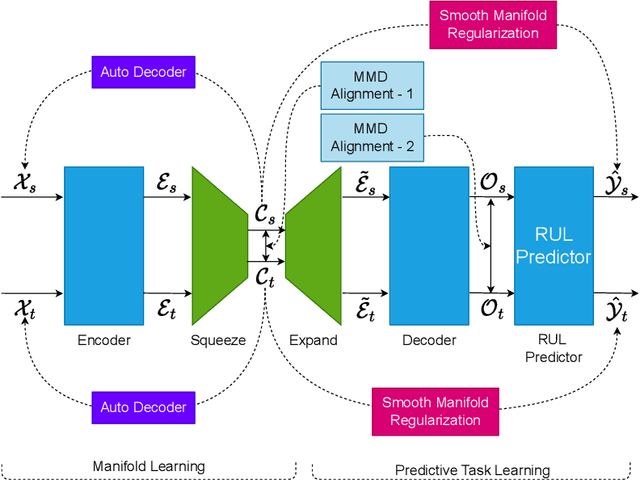
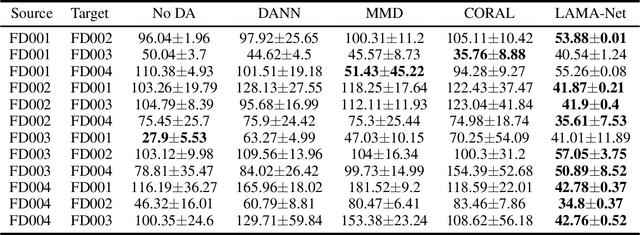
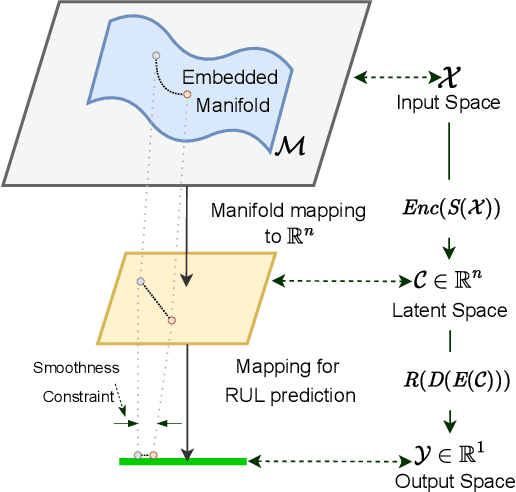
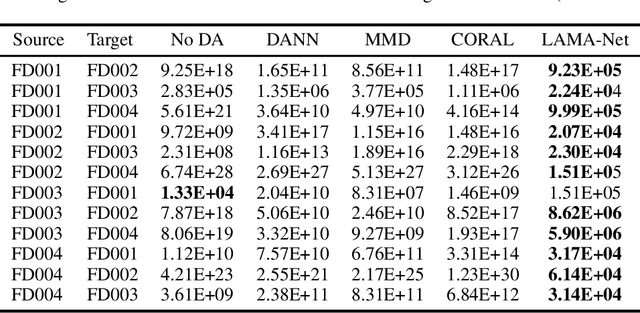
Prognostics and Health Management (PHM) is an emerging field which has received much attention from the manufacturing industry because of the benefits and efficiencies it brings to the table. And Remaining Useful Life (RUL) prediction is at the heart of any PHM system. Most recent data-driven research demand substantial volumes of labelled training data before a performant model can be trained under the supervised learning paradigm. This is where Transfer Learning (TL) and Domain Adaptation (DA) methods step in and make it possible for us to generalize a supervised model to other domains with different data distributions with no labelled data. In this paper, we propose \textit{LAMA-Net}, an encoder-decoder based model (Transformer) with an induced bottleneck, Latent Alignment using Maximum Mean Discrepancy (MMD) and manifold learning is proposed to tackle the problem of Unsupervised Homogeneous Domain Adaptation for RUL prediction. \textit{LAMA-Net} is validated using the C-MAPSS Turbofan Engine dataset by NASA and compared against other state-of-the-art techniques for DA. The results suggest that the proposed method offers a promising approach to perform domain adaptation in RUL prediction. Code will be made available once the paper comes out of review.