 Add to Chrome
 Add to Firefox
 Add to Edge
Breakthrough the Suboptimal Stable Point in Value-Factorization-Based Multi-Agent Reinforcement Learning
Apr 07, 2026
Value factorization, a popular paradigm in MARL, faces significant theoretical and algorithmic bottlenecks: its tendency to converge to suboptimal solutions remains poorly understood and unsolved. Theoretically, existing analyses fail to explain this due to their primary focus on the optimal case. To bridge this gap, we introduce a novel theoretical concept: the stable point, which characterizes the potential convergence of value factorization in general cases. Through an analysis of stable point distributions in existing methods, we reveal that non-optimal stable points are the primary cause of poor performance. However, algorithmically, making the optimal action the unique stable point is nearly infeasible. In contrast, iteratively filtering suboptimal actions by rendering them unstable emerges as a more practical approach for global optimality. Inspired by this, we propose a novel Multi-Round Value Factorization (MRVF) framework. Specifically, by measuring a non-negative payoff increment relative to the previously selected action, MRVF transforms inferior actions into unstable points, thereby driving each iteration toward a stable point with a superior action. Experiments on challenging benchmarks, including predator-prey tasks and StarCraft II Multi-Agent Challenge (SMAC), validate our analysis of stable points and demonstrate the superiority of MRVF over state-of-the-art methods.

FFINet: Future Feedback Interaction Network for Motion Forecasting
Nov 08, 2023Motion forecasting plays a crucial role in autonomous driving, with the aim of predicting the future reasonable motions of traffic agents. Most existing methods mainly model the historical interactions between agents and the environment, and predict multi-modal trajectories in a feedforward process, ignoring potential trajectory changes caused by future interactions between agents. In this paper, we propose a novel Future Feedback Interaction Network (FFINet) to aggregate features the current observations and potential future interactions for trajectory prediction. Firstly, we employ different spatial-temporal encoders to embed the decomposed position vectors and the current position of each scene, providing rich features for the subsequent cross-temporal aggregation. Secondly, the relative interaction and cross-temporal aggregation strategies are sequentially adopted to integrate features in the current fusion module, observation interaction module, future feedback module and global fusion module, in which the future feedback module can enable the understanding of pre-action by feeding the influence of preview information to feedforward prediction. Thirdly, the comprehensive interaction features are further fed into final predictor to generate the joint predicted trajectories of multiple agents. Extensive experimental results show that our FFINet achieves the state-of-the-art performance on Argoverse 1 and Argoverse 2 motion forecasting benchmarks.
Dual-Stream Pyramid Registration Network
Sep 26, 2019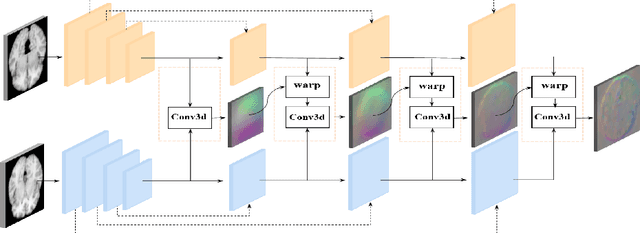
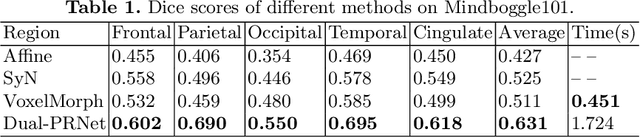
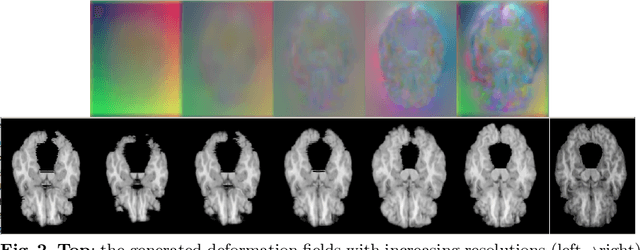
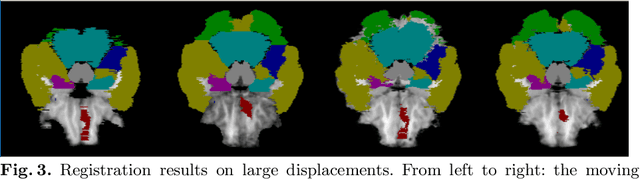
We propose a Dual-Stream Pyramid Registration Network (referred as Dual-PRNet) for unsupervised 3D medical image registration. Unlike recent CNN-based registration approaches, such as VoxelMorph, which explores a single-stream encoder-decoder network to compute a registration fields from a pair of 3D volumes, we design a two-stream architecture able to compute multi-scale registration fields from convolutional feature pyramids. Our contributions are two-fold: (i) we design a two-stream 3D encoder-decoder network which computes two convolutional feature pyramids separately for a pair of input volumes, resulting in strong deep representations that are meaningful for deformation estimation; (ii) we propose a pyramid registration module able to predict multi-scale registration fields directly from the decoding feature pyramids. This allows it to refine the registration fields gradually in a coarse-to-fine manner via sequential warping, and enable the model with the capability for handling significant deformations between two volumes, such as large displacements in spatial domain or slice space. The proposed Dual-PRNet is evaluated on two standard benchmarks for brain MRI registration, where it outperforms the state-of-the-art approaches by a large margin, e.g., having improvements over recent VoxelMorph [2] with 0.683->0.778 on the LPBA40, and 0.511->0.631 on the Mindboggle101, in term of average Dice score.