 Add to Chrome
 Add to Firefox
 Add to Edge
Foundation Agents Meet Agentic Deep Research: Evidence-Grounded Clinical Code Forecasting
Aug 17, 2026
Next-encounter ICD forecasting predicts which standardized diagnosis codes will be documented at a future visit from the longitudinal record available beforehand. The task is prospective and multi-label: the target note does not yet exist, and several codes may be correct. Structured EHR foundation models capture recurrence and temporal progression, whereas language foundation models generate flexible diagnostic hypotheses. We introduce ICD-Deepresearch, a DeepResearch workflow that composes these predictive foundation models with medical search and ICD dictionaries. Because no source reveals the future code set, research evaluates candidate transitions by linking patient evidence, external clinical relations, and exact code semantics under a fixed top-K budget. Candidate Generation uses SparseEHR to produce an EHR Prior that initializes two bounded Research Expansion rounds; an independent GPT-5 Direct Forecast supplies complementary candidates. Final Selection validates, deduplicates, and jointly ranks both paths, after which a separate module writes rationales without changing predictions. Finally ICD-Deepresearch achieves patient-averaged precision/recall of 24.60/35.09% on MIMIC-III and 25.14/48.32% on MIMIC-IV. Physicians rate 51% and 68% of its retrieved documents useful, compared with 22% and 39% for standalone GPT-5 web search and 32% and 41% for Medical Deep Research. ICD-Deepresearch therefore improves over the registered local comparators while retrieving evidence with higher physician-rated usefulness than the standalone research systems

Text Over Image: Auditing Multimodal Robustness in Synthetic Medical Image Detection
Jul 01, 2026With the rapid adoption of generative AI, synthetic medical images pose growing risks, including diagnostic deception and insurance fraud. Although prior work has explored vision-language model (VLM)-based synthetic image detection, these evaluations typically consider images in isolation. In clinical practice, however, images are interpreted alongside structured records and metadata, and VLMs are increasingly deployed under joint image-record inputs. We uncover a previously underexamined multimodal vulnerability: when given both modalities, VLMs may overweight record context in authenticity judgments, such that the same image receives different predictions solely due to changes in its accompanying text. This raises concerns about robustness in real-world deployment. To systematically characterize this effect, we reformulate synthetic medical image detection as an audit of multimodal robustness at the image-record interface and introduce a paired benchmark that holds the image fixed while swapping controlled metadata variants. Across multiple imaging modalities, we evaluate diverse open-weight and frontier API VLMs and find that changing the metadata context alone can flip authenticity judgments, with accuracy on authentic images dropping by 61.1% on average under an explicit AI-origin tag. We further propose an inference-time mitigation pipeline that detects and neutralizes provenance shortcuts without model retraining, substantially outperforming direct prompt-based suppression on the affected subset. Our benchmark provides a standardized tool for assessing and improving multimodal robustness beyond image-only settings. Code and data will be released upon acceptance.
Reasoning Quality Emerges Early: Data Curation for Reasoning Models
Jun 25, 2026Supervised fine-tuning (SFT) on a small, high-quality set of long reasoning traces is an effective approach for eliciting strong reasoning capabilities in Large Language Models (LLMs). However, existing methods for curating high-quality SFT data rely heavily on strong reasoning models to filter examples based on diversity and difficulty, making the curation process costly while often yielding suboptimal data quality. In this work, we show that diverse and challenging reasoning examples can be identified using only the initial reasoning tokens. Specifically, we demonstrate that difficult problems can be reliably detected based on the loss of the first 100 reasoning tokens evaluated at a randomly perturbed checkpoint of the pretrained model. We further show that examples exhibiting similar loss patterns over their first 1k reasoning tokens across a small number of perturbed checkpoints extrapolating along the fine-tuning trajectory provably induce similar gradients. We validate our approach through extensive experiments on fine-tuning Qwen2.5-7B and Llama3.1-8B models on the M23K medical reasoning and OpenThoughts-Math datasets. Our method outperforms existing baselines by up to 1.7% while being 91% more token efficient.
Beyond Visual Forensics: Auditing Multimodal Robustness for Synthetic Medical Image Detection
Jun 24, 2026With the rapid adoption of generative AI, synthetic medical images pose growing risks, including diagnostic deception and insurance fraud. Although prior work has explored vision-language model (VLM)-based synthetic image detection, these evaluations typically consider images in isolation. In clinical practice, however, images are interpreted alongside structured records and metadata, and VLMs are increasingly deployed under joint image-record inputs. We uncover a previously underexamined multimodal vulnerability: when given both modalities, VLMs may overweight record context in authenticity judgments, such that the same image receives different predictions solely due to changes in its accompanying text. This raises concerns about robustness in real-world deployment. To systematically characterize this effect, we reformulate synthetic medical image detection as an audit of multimodal robustness at the image-record interface and introduce a paired benchmark that holds the image fixed while swapping controlled metadata variants. Across multiple imaging modalities, we evaluate diverse open-weight and frontier API VLMs and quantify how metadata alone shifts authenticity predictions. Our benchmark provides a standardized tool for assessing and improving multimodal robustness beyond image-only settings. The code is available at https://github.com/chiuhaohao/Beyond-Visual-Forensics.
High-resolution home location prediction from tweets using deep learning with dynamic structure
Feb 03, 2019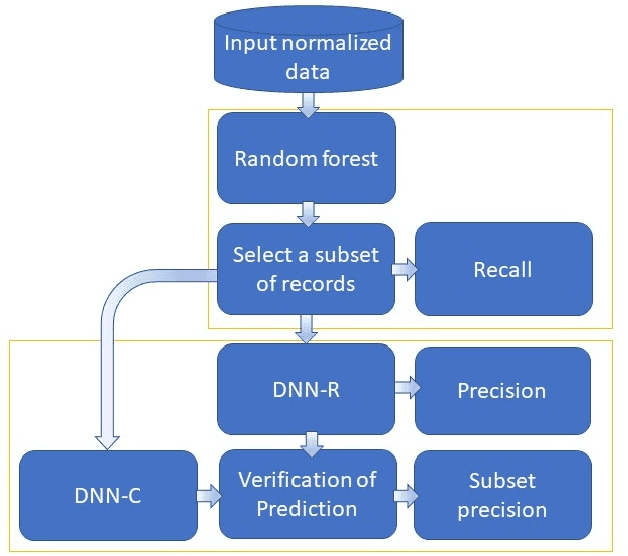
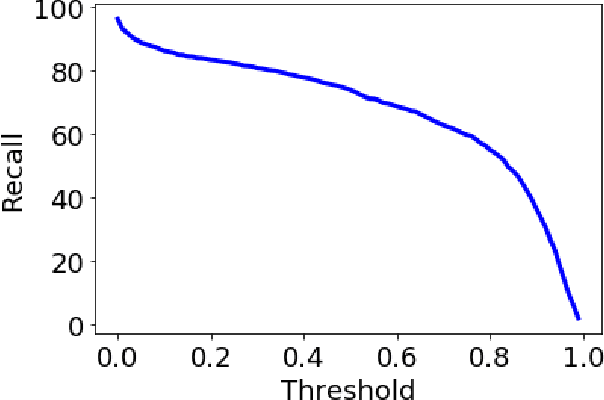
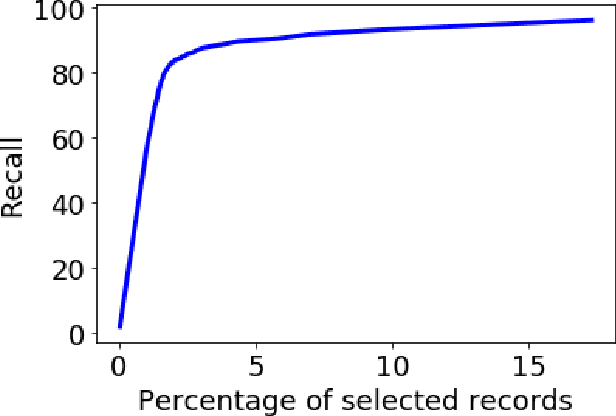
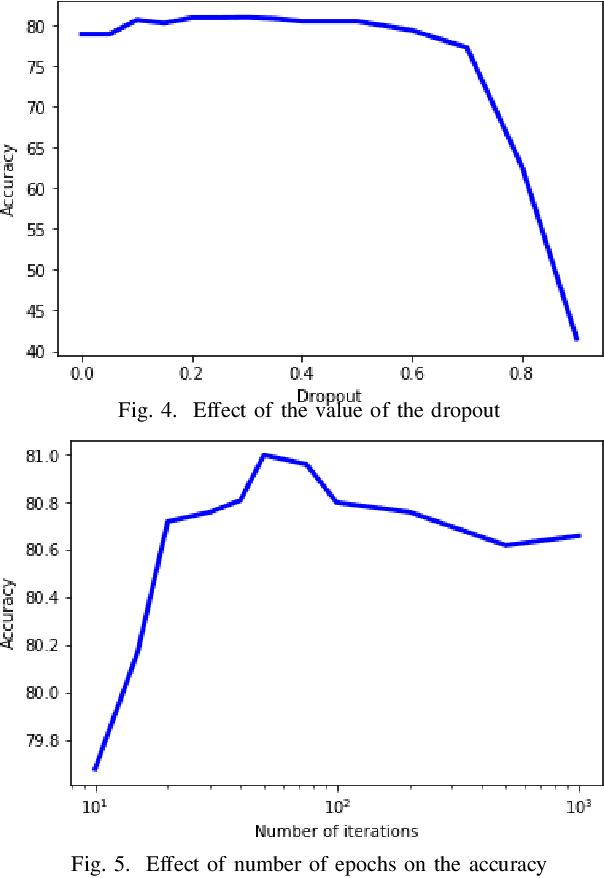
High-resolution prediction of the home location of people has applications in diverse fields, including agriculture, transportation, and public health. The goal here is to obtain an accurate estimate of home locations of a sufficiently large subset of the population to subsequently use in models for the application domain. Conventional data sources, such as census and surveys, have a substantial time-lag and cannot capture seasonal trends. There has been much recent interest in the use of social media data to overcome this limitation. However, this data is usually sparse, noisy and user's home location is just one of several check-in locations. Due to these constraints, much of previous research has aimed at a coarse spatial resolution, such as at the time zone, state, and city levels. This is inadequate for important applications. For example, vector control to prevent epidemics would benefit from 200m resolution. Recent work has used a Support Vector Classifier on Twitter meta-data for such resolution, obtaining 70% accuracy for a 76% subset of the test population with 100m resolution. In contrast, we developed a deep learning model for this problem, applying a dynamic structure consisting of a random forest in the first phase and two fully connected deep neural networks in the second phase. We obtained over 90% on 30% subset of the test population. Given the large user base for Twitter, this is a sufficiently large subset for use in the modeling applications that we target. We believe that ours is the highest accuracy obtained for high-resolution home location prediction from Twitter data for both the entire sample and for its subsets. The primary contribution of this work lies in developing a deep-learning solution that uses a dynamic structure to deal with sparse and noisy social media data to yield accurate high resolution home locations from Twitter data.
Improving image watermarking based on Tabu search by Chaos
Sep 16, 2015



With the fast development of communication and multimedia technology, the rights of the owners of multimedia products is vulnerable to the unauthorized copies and watermarking is one of the best known methods for proving the ownership of a product. In this paper we prosper the previous watermarking method which was based on Tabu search by Chaos. The modification applied in the permutation step of watermarking and the initial population generation of the Tabu search. We analyze our method on some well known images and experimental results shows the improvement in the quality and speed of the proposed watermarking method.
Generating Graphical Chain by Mutual Matching of Bayesian Network and Extracted Rules of Bayesian Network Using Genetic Algorithm
Dec 15, 2014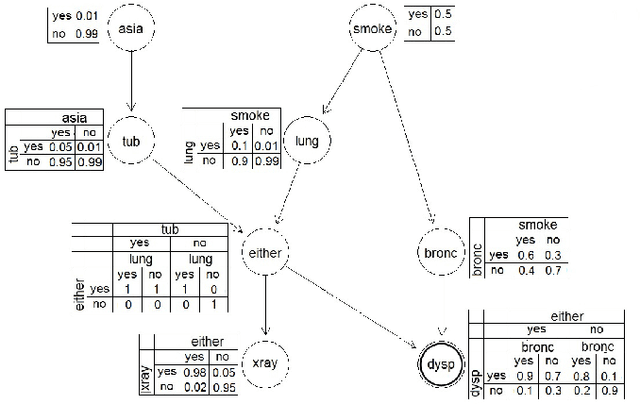

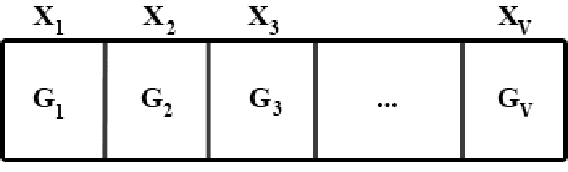
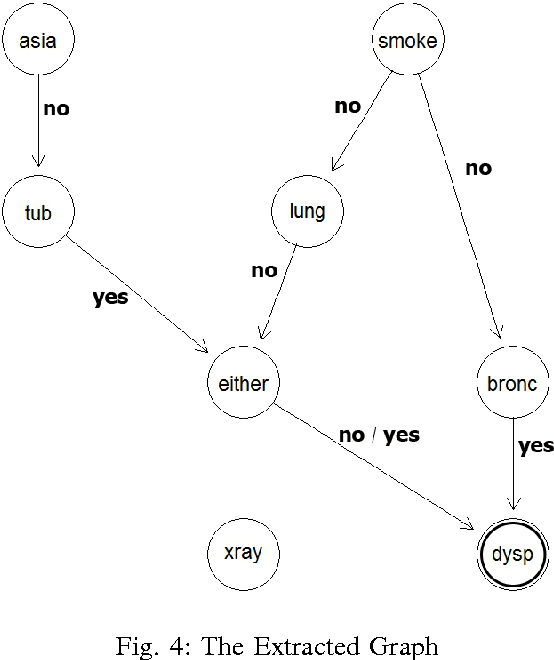
With the technology development, the need of analyze and extraction of useful information is increasing. Bayesian networks contain knowledge from data and experts that could be used for decision making processes But they are not easily understandable thus the rule extraction methods have been used but they have high computation costs. To overcome this problem we extract rules from Bayesian network using genetic algorithm. Then we generate the graphical chain by mutually matching the extracted rules and Bayesian network. This graphical chain could shows the sequence of events that lead to the target which could help the decision making process. The experimental results on small networks show that the proposed method has comparable results with brute force method which has a significantly higher computation cost.
Ambiguity-Driven Fuzzy C-Means Clustering: How to Detect Uncertain Clustered Records
Sep 09, 2014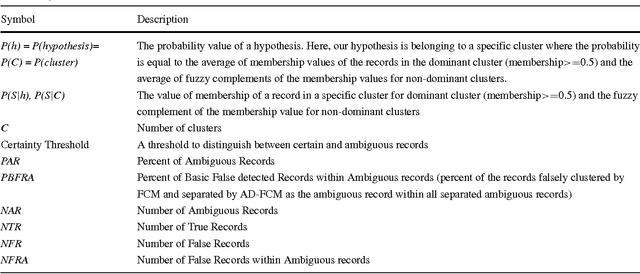
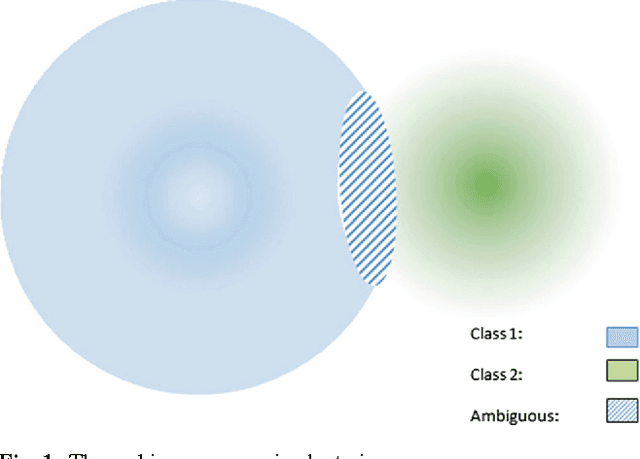
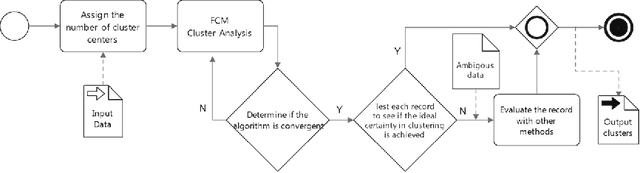
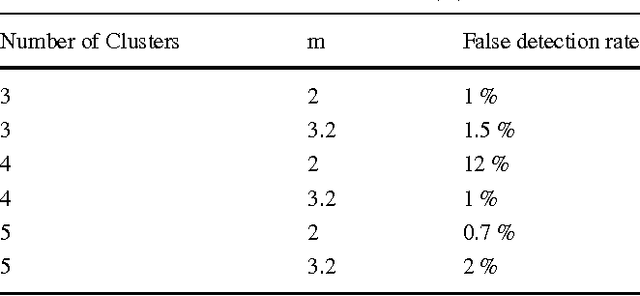
As a well-known clustering algorithm, Fuzzy C-Means (FCM) allows each input sample to belong to more than one cluster, providing more flexibility than non-fuzzy clustering methods. However, the accuracy of FCM is subject to false detections caused by noisy records, weak feature selection and low certainty of the algorithm in some cases. The false detections are very important in some decision-making application domains like network security and medical diagnosis, where weak decisions based on such false detections may lead to catastrophic outcomes. They are mainly emerged from making decisions about a subset of records that do not provide enough evidence to make a good decision. In this paper, we propose a method for detecting such ambiguous records in FCM by introducing a certainty factor to decrease invalid detections. This approach enables us to send the detected ambiguous records to another discrimination method for a deeper investigation, thus increasing the accuracy by lowering the error rate. Most of the records are still processed quickly and with low error rate which prevents performance loss compared to similar hybrid methods. Experimental results of applying the proposed method on several datasets from different domains show a significant decrease in error rate as well as improved sensitivity of the algorithm.