 Add to Chrome
 Add to Firefox
 Add to Edge
REFINE: Super-efficient 3D Gaussian Splatting Pruning via Rendering-Free Primitive Importance
Jun 08, 2026
Existing pruning methods for 3D Gaussian splatting (3DGS) suffer from either severe quality degradation or prohibitive computational overhead. In this paper, we propose REFINE, a highly accelerated 3DGS pruning framework centered on a novel rendering-free primitive importance metric. Our approach leverages an analytically approximated, rendering-aware Hessian field to quantify the expected perceptual error induced by the removal of individual primitives. By modeling the joint modulation of visibility, projection geometry and the content adaptive hyperparameter, we entirely bypass costly forward rendering passes and derive an anisotropic perceptual weight field that serves as a high-fidelity proxy for primitive importance. Extensive experiments across multiple benchmark datasets demonstrate that REFINE maintains highly competitive rendering quality while achieving an unprecedented $3,000\times$ reduction in pruning-related computational complexity compared to state-of-the-art pruning methods.

An Object-Centered Data Acquisition Method for 3D Gaussian Splatting using Mobile Phones
Apr 21, 2026Data acquisition through mobile phones remains a challenge for 3D Gaussian Splatting (3DGS). In this work we target the object-centered scenario and enable reliable mobile acquisition by providing on-device capture guidance and recording onboard sensor signals for offline reconstruction. After the calibration step, the device orientations are aligned to a baseline frame to obtain relative poses, and the optical axis of the camera is mapped to an object-centered spherical grid for uniform viewpoint indexing. To curb polar sampling bias, we compute area-weighted spherical coverage in real-time and guide the user's motion accordingly. We compare the proposed method with RealityScan and the free-capture strategy. Our method achieves superior reconstruction quality using fewer input images compared to free capture and RealityScan. Further analysis shows that the proposed method is able to obtain more comprehensive and uniform viewpoint coverage during object-centered acquisition.
RBFIM: Perceptual Quality Assessment for Compressed Point Clouds Using Radial Basis Function Interpolation
Mar 18, 2025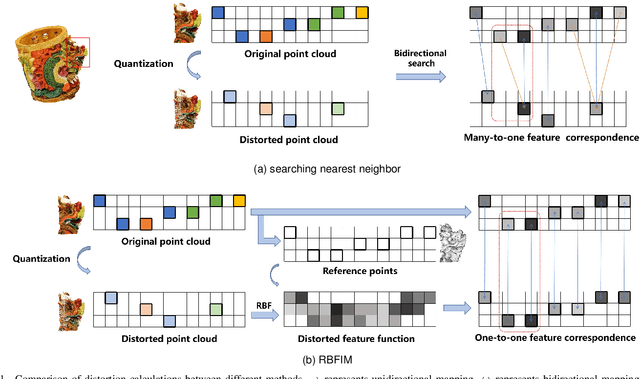
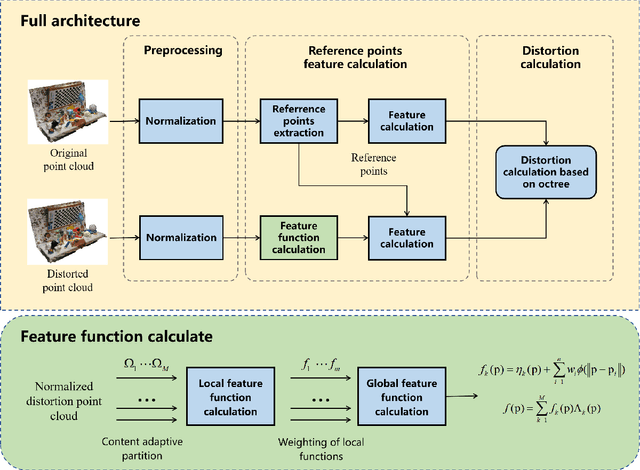
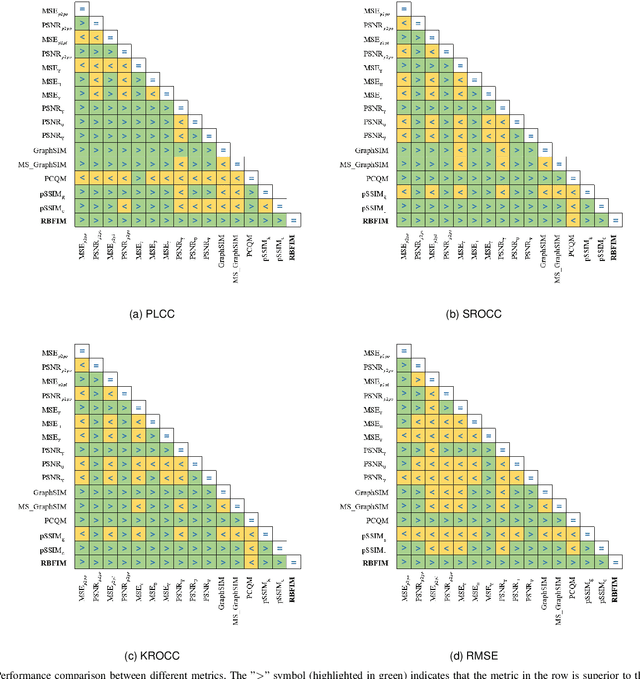
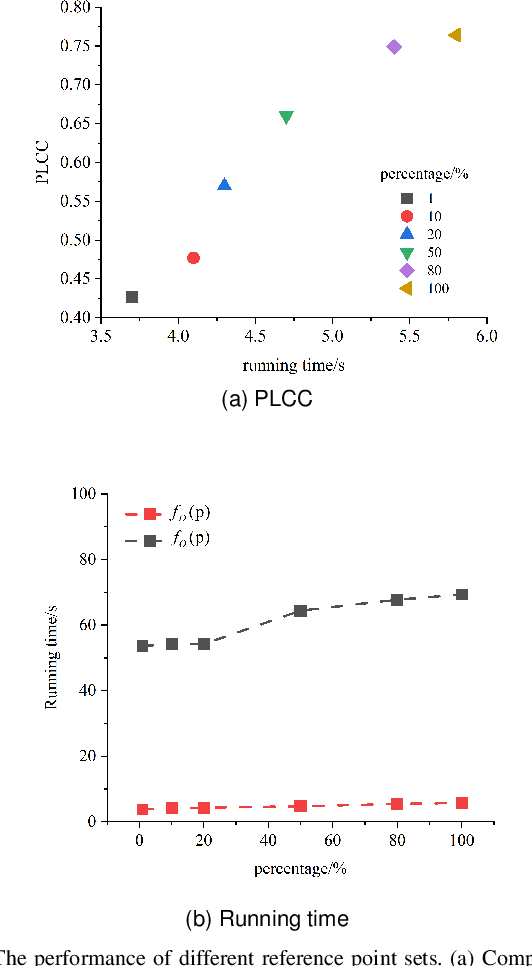
One of the main challenges in point cloud compression (PCC) is how to evaluate the perceived distortion so that the codec can be optimized for perceptual quality. Current standard practices in PCC highlight a primary issue: while single-feature metrics are widely used to assess compression distortion, the classic method of searching point-to-point nearest neighbors frequently fails to adequately build precise correspondences between point clouds, resulting in an ineffective capture of human perceptual features. To overcome the related limitations, we propose a novel assessment method called RBFIM, utilizing radial basis function (RBF) interpolation to convert discrete point features into a continuous feature function for the distorted point cloud. By substituting the geometry coordinates of the original point cloud into the feature function, we obtain the bijective sets of point features. This enables an establishment of precise corresponding features between distorted and original point clouds and significantly improves the accuracy of quality assessments. Moreover, this method avoids the complexity caused by bidirectional searches. Extensive experiments on multiple subjective quality datasets of compressed point clouds demonstrate that our RBFIM excels in addressing human perception tasks, thereby providing robust support for PCC optimization efforts.