 Add to Chrome
 Add to Firefox
 Add to Edge
Feasible strategies for conflict resolution within intuitionistic fuzzy preference-based conflict situations
Feb 03, 2026
In three-way conflict analysis, preference-based conflict situations characterize agents' attitudes towards issues by formally modeling their preferences over pairs of issues. However, existing preference-based conflict models rely exclusively on three qualitative relations, namely, preference, converse, and indifference, to describe agents' attitudes towards issue pairs, which significantly limits their capacity in capturing the essence of conflict. To overcome this limitation, we introduce the concept of an intuitionistic fuzzy preference-based conflict situation that captures agents' attitudes towards issue pairs with finer granularity than that afforded by classical preference-based models. Afterwards, we develop intuitionistic fuzzy preference-based conflict measures within this framework, and construct three-way conflict analysis models for trisecting the set of agent pairs, the agent set, and the issue set. Additionally, relative loss functions built on the proposed conflict functions are employed to calculate thresholds for three-way conflict analysis. Finally, we present adjustment mechanism-based feasible strategies that simultaneously account for both adjustment magnitudes and conflict degrees, together with an algorithm for constructing such feasible strategies, and provide an illustrative example to demonstrate the validity and effectiveness of the proposed model.

Feasible strategies in three-way conflict analysis with three-valued ratings
Dec 24, 2025Most existing work on three-way conflict analysis has focused on trisecting agent pairs, agents, or issues, which contributes to understanding the nature of conflicts but falls short in addressing their resolution. Specifically, the formulation of feasible strategies, as an essential component of conflict resolution and mitigation, has received insufficient scholarly attention. Therefore, this paper aims to investigate feasible strategies from two perspectives of consistency and non-consistency. Particularly, we begin with computing the overall rating of a clique of agents based on positive and negative similarity degrees. Afterwards, considering the weights of both agents and issues, we propose weighted consistency and non-consistency measures, which are respectively used to identify the feasible strategies for a clique of agents. Algorithms are developed to identify feasible strategies, $L$-order feasible strategies, and the corresponding optimal ones. Finally, to demonstrate the practicality, effectiveness, and superiority of the proposed models, we apply them to two commonly used case studies on NBA labor negotiations and development plans for Gansu Province and conduct a sensitivity analysis on parameters and a comparative analysis with existing state-of-the-art conflict analysis approaches. The comparison results demonstrate that our conflict resolution models outperform the conventional approaches by unifying weighted agent-issue evaluation with consistency and non-consistency measures to enable the systematic identification of not only feasible strategies but also optimal solutions.
Three-way conflict analysis based on alliance and conflict functions
Dec 24, 2025Trisecting agents, issues, and agent pairs are essential topics of three-way conflict analysis. They have been commonly studied based on either a rating or an auxiliary function. A rating function defines the positive, negative, or neutral ratings of agents on issues. An auxiliary function defines the alliance, conflict, and neutrality relations between agents. These functions measure two opposite aspects in a single function, leading to challenges in interpreting their aggregations over a group of issues or agents. For example, when studying agent relations regarding a set of issues, a standard aggregation takes the average of an auxiliary function concerning single issues. Therefore, a pair of alliance +1 and conflict -1 relations will produce the same result as a pair of neutrality 0 relations, although the attitudes represented by the two pairs are very different. To clarify semantics, we separate the two opposite aspects in an auxiliary function into a pair of alliance and conflict functions. Accordingly, we trisect the agents, issues, and agent pairs and investigate their applications in solving a few crucial questions in conflict analysis. Particularly, we explore the concepts of alliance sets and strategies. A real-world application is given to illustrate the proposed models.
Three-way decision with incomplete information based on similarity and satisfiability
Dec 24, 2025
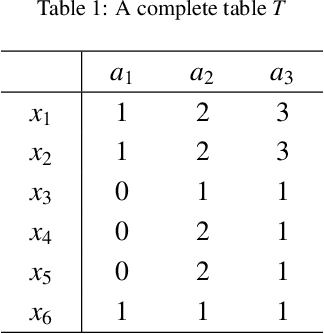
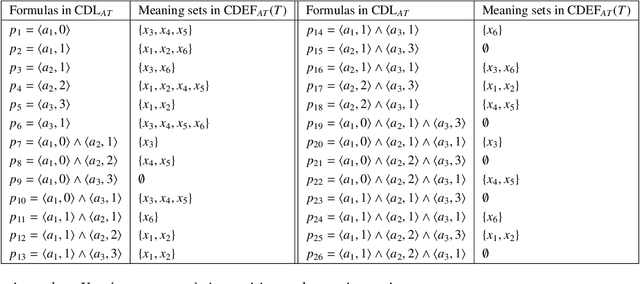

Three-way decision is widely applied with rough set theory to learn classification or decision rules. The approaches dealing with complete information are well established in the literature, including the two complementary computational and conceptual formulations. The computational formulation uses equivalence relations, and the conceptual formulation uses satisfiability of logic formulas. In this paper, based on a briefly review of these two formulations, we generalize both formulations into three-way decision with incomplete information that is more practical in real-world applications. For the computational formulation, we propose a new measure of similarity degree of objects as a generalization of equivalence relations. Based on it, we discuss two approaches to three-way decision using alpha-similarity classes and approximability of objects, respectively. For the conceptual formulation, we propose a measure of satisfiability degree of formulas as a quantitative generalization of satisfiability with complete information. Based on it, we study two approaches to three-way decision using alpha-meaning sets of formulas and confidence of formulas, respectively. While using similarity classes is a common method of analyzing incomplete information in the literature, the proposed concept of approximability and the two approaches in conceptual formulation point out new promising directions.