 Add to Chrome
 Add to Firefox
 Add to Edge
A3-FPN: Asymptotic Content-Aware Pyramid Attention Network for Dense Visual Prediction
Apr 11, 2026
Learning multi-scale representations is the common strategy to tackle object scale variation in dense prediction tasks. Although existing feature pyramid networks have greatly advanced visual recognition, inherent design defects inhibit them from capturing discriminative features and recognizing small objects. In this work, we propose Asymptotic Content-Aware Pyramid Attention Network (A3-FPN), to augment multi-scale feature representation via the asymptotically disentangled framework and content-aware attention modules. Specifically, A3-FPN employs a horizontally-spread column network that enables asymptotically global feature interaction and disentangles each level from all hierarchical representations. In feature fusion, it collects supplementary content from the adjacent level to generate position-wise offsets and weights for context-aware resampling, and learns deep context reweights to improve intra-category similarity. In feature reassembly, it further strengthens intra-scale discriminative feature learning and reassembles redundant features based on information content and spatial variation of feature maps. Extensive experiments on MS COCO, VisDrone2019-DET and Cityscapes demonstrate that A3-FPN can be easily integrated into state-of-the-art CNN and Transformer-based architectures, yielding remarkable performance gains. Notably, when paired with OneFormer and Swin-L backbone, A3-FPN achieves 49.6 mask AP on MS COCO and 85.6 mIoU on Cityscapes. Codes are available at https://github.com/mason-ching/A3-FPN.

Significance and Stability Analysis of Gene-Environment Interaction using RGxEStat
Apr 03, 2026Genotype-by-Environment (GxE) interactions influence the performance of genotypes across diverse environments, reducing the predictability of phenotypes in target environments. In-depth analysis of GxE interactions facilitates the identification of how genetic advantages or defects are expressed or suppressed under specific environmental conditions, thereby enabling genetic selection and enhancing breeding practices. This paper introduces two key models for GxE interaction research. Specifically, it includes significance analysis based on the mixed effect model to determine whether genes or GxE interactions significantly affect phenotypic traits; stability analysis, which further investigates the interactive relationships between genes and environments, as well as the relative superiority or inferiority of genotypes across environments. Additionally, this paper presents RGxEStat, a lightweight interactive tool, which is developed by the authors and integrates the construction, solution, and visualization of the aforementioned models. Designed to eliminate the need for breeders and agronomists to learn complex SAS or R programming, RGxEStat provides a user-friendly interface for streamlined breeding data analysis, significantly accelerating research cycles. Codes and datasets are available at https://github.com/mason-ching/RGxEStat.
IB-AdCSCNet:Adaptive Convolutional Sparse Coding Network Driven by Information Bottleneck
May 23, 2024

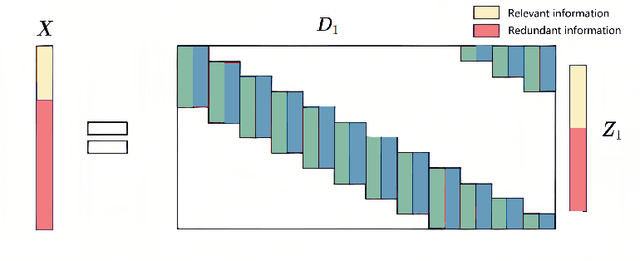

In the realm of neural network models, the perpetual challenge remains in retaining task-relevant information while effectively discarding redundant data during propagation. In this paper, we introduce IB-AdCSCNet, a deep learning model grounded in information bottleneck theory. IB-AdCSCNet seamlessly integrates the information bottleneck trade-off strategy into deep networks by dynamically adjusting the trade-off hyperparameter $\lambda$ through gradient descent, updating it within the FISTA(Fast Iterative Shrinkage-Thresholding Algorithm ) framework. By optimizing the compressive excitation loss function induced by the information bottleneck principle, IB-AdCSCNet achieves an optimal balance between compression and fitting at a global level, approximating the globally optimal representation feature. This information bottleneck trade-off strategy driven by downstream tasks not only helps to learn effective features of the data, but also improves the generalization of the model. This study's contribution lies in presenting a model with consistent performance and offering a fresh perspective on merging deep learning with sparse representation theory, grounded in the information bottleneck concept. Experimental results on CIFAR-10 and CIFAR-100 datasets demonstrate that IB-AdCSCNet not only matches the performance of deep residual convolutional networks but also outperforms them when handling corrupted data. Through the inference of the IB trade-off, the model's robustness is notably enhanced.