 Add to Chrome
 Add to Firefox
 Add to Edge
ESIA: An Energy-Based Spatiotemporal Interaction-Aware Framework for Pedestrian Intention Prediction
Apr 26, 2026
Recent advances in autonomous driving have motivated research on pedestrian intention prediction, which aims to infer future crossing decisions and actions by modeling temporal dynamics, social interactions, and environmental context. However, existing studies remain constrained by oversimplified multi-agent interaction patterns, opaque reasoning logic, and a lack of global consistency in behavioral predictions, which compromise both robustness and interpretability. In this work, we propose ESIA (Energy-based Spatiotemporal Interaction-Aware framework), a novel Conditional Random Field (CRF)-based paradigm. We cast the intention prediction task as a structured prediction problem over a unified graph-based representation, treating pedestrians and the environment as spatiotemporal nodes. To characterize their distinct roles, we assign unary potentials to nodes to capture individual intentions, and pairwise potentials to edges to encode social and environmental interactions. These potentials are integrated into a unified global energy function to ensure scene-level consistency across behavioral predictions. To further constrain inference without ground-truth supervision, we introduce structural consistency terms to penalize logical contradictions. This optimization is efficiently solved via a novel Unary-Seeded Simulated Annealing (U-SSA) algorithm, which leverages high-confidence unary priors to rapidly converge to a high-quality solution. Extensive experiments on standard benchmarks demonstrate that ESIA achieves state-of-the-art performance with improved interpretability over existing methods.

Free Energy-Inspired Cognitive Risk Integration for AV Navigation in Pedestrian-Rich Environments
Jul 28, 2025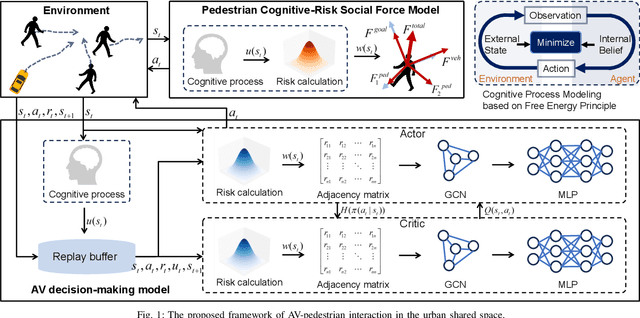
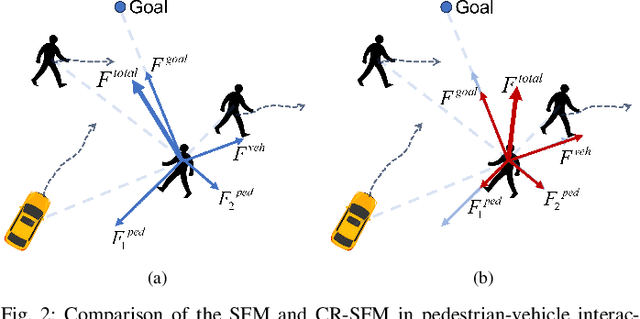
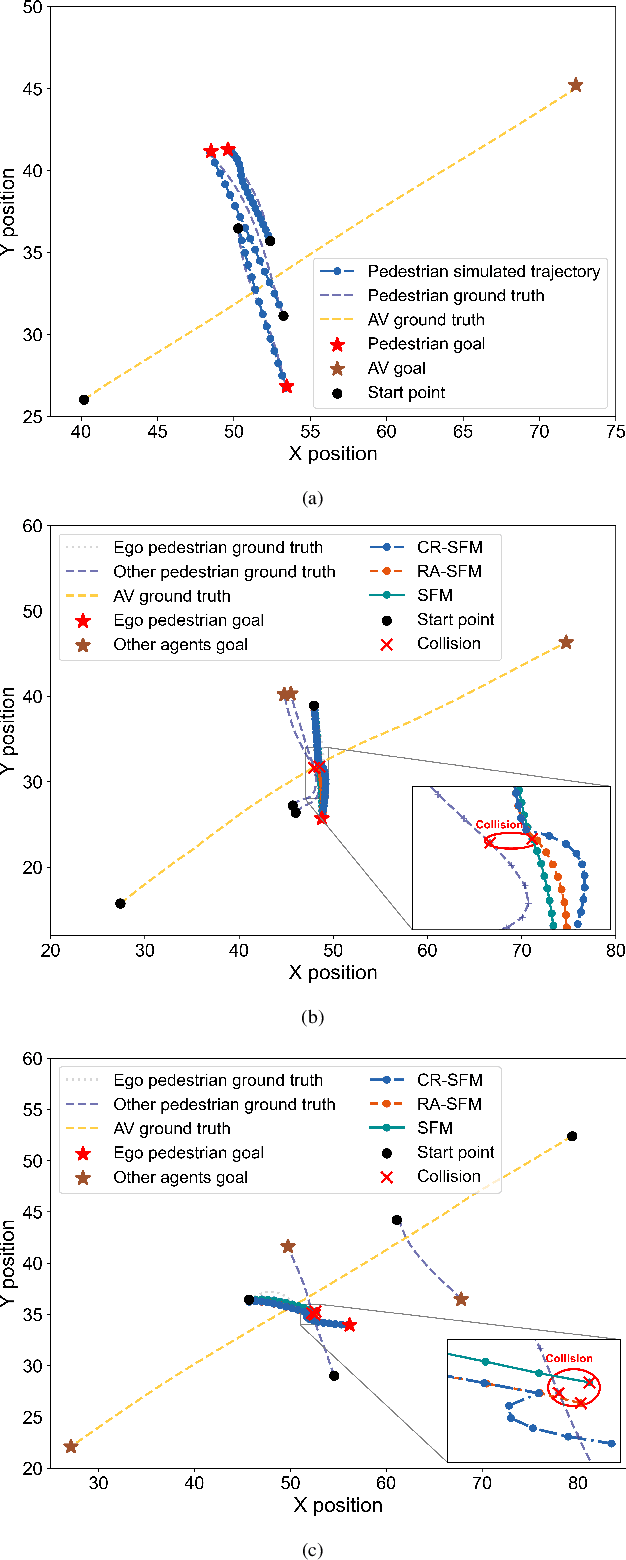
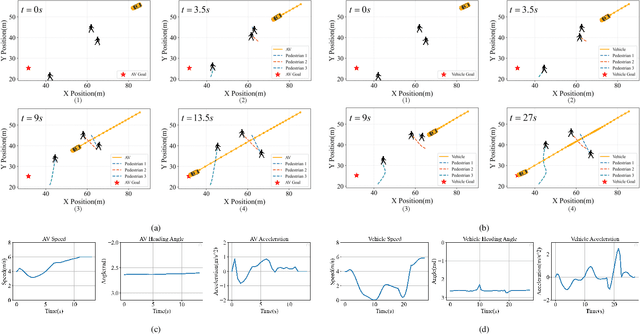
Recent advances in autonomous vehicle (AV) behavior planning have shown impressive social interaction capabilities when interacting with other road users. However, achieving human-like prediction and decision-making in interactions with vulnerable road users remains a key challenge in complex multi-agent interactive environments. Existing research focuses primarily on crowd navigation for small mobile robots, which cannot be directly applied to AVs due to inherent differences in their decision-making strategies and dynamic boundaries. Moreover, pedestrians in these multi-agent simulations follow fixed behavior patterns that cannot dynamically respond to AV actions. To overcome these limitations, this paper proposes a novel framework for modeling interactions between the AV and multiple pedestrians. In this framework, a cognitive process modeling approach inspired by the Free Energy Principle is integrated into both the AV and pedestrian models to simulate more realistic interaction dynamics. Specifically, the proposed pedestrian Cognitive-Risk Social Force Model adjusts goal-directed and repulsive forces using a fused measure of cognitive uncertainty and physical risk to produce human-like trajectories. Meanwhile, the AV leverages this fused risk to construct a dynamic, risk-aware adjacency matrix for a Graph Convolutional Network within a Soft Actor-Critic architecture, allowing it to make more reasonable and informed decisions. Simulation results indicate that our proposed framework effectively improves safety, efficiency, and smoothness of AV navigation compared to the state-of-the-art method.