 Add to Chrome
 Add to Firefox
 Add to Edge
Two-Stage Signal Reconstruction for Amplitude-Phase-Time Block Modulation-based Communications
Dec 20, 2025
Operating power amplifiers (PAs) at lower input back-off (IBO) levels is an effective way to improve PA efficiency, but often introduces severe nonlinear distortion that degrades transmission performance. Amplitude-phase-time block modulation (APTBM) has recently emerged as an effective solution to this problem. By leveraging the intrinsic amplitude and phase constraints of each APTBM block, PA-induced nonlinear distortion can be mitigated through constraint-guided signal reconstruction. However, existing reconstruction methods apply these constraints only heuristically and statistically, limiting the achievable IBO reduction and PA efficiency improvement. This paper addresses this limitation by decomposing the nonlinear distortion into dominant and residual components, and accordingly develops a novel two-stage signal reconstruction algorithm consisting of coarse and fine reconstruction stages. The coarse reconstruction stage eliminates the dominant distortion by jointly exploiting the APTBM block structure and PA nonlinear characteristics. The fine reconstruction stage minimizes the residual distortion by formulating a nonconvex optimization problem that explicitly enforces the APTBM constraints. To handle this problem efficiently, a low-complexity iterative variable substitution method is introduced, which relaxes the problem into a sequence of trust-region subproblems, each solvable in closed form. The proposed algorithm is validated through comprehensive numerical simulations and testbed experiments. Results show that it achieves up to 4 dB IBO reduction in simulations and up to 2 dB IBO reduction in experiments while maintaining transmission performance, corresponding to PA efficiency improvements of 59.1\% and 33.9\%, respectively, over existing methods.

Coordinated Beamforming for Networked Integrated Communication and Multi-TMT Localization
Oct 06, 2025Networked integrated sensing and communication (ISAC) has gained significant attention as a promising technology for enabling next-generation wireless systems. To further enhance networked ISAC, delegating the reception of sensing signals to dedicated target monitoring terminals (TMTs) instead of base stations (BSs) offers significant advantages in terms of sensing capability and deployment flexibility. Despite its potential, the coordinated beamforming design for networked integrated communication and time-of-arrival (ToA)-based multi-TMT localization remains largely unexplored. In this paper, we present a comprehensive study to fill this gap. Specifically, we first establish signal models for both communication and localization, and, for the first time, derive a closed-form Cram\'er-Rao lower bound (CRLB) to characterize the localization performance. Subsequently, we exploit this CRLB to formulate two optimization problems, focusing on sensing-centric and communication-centric criteria, respectively. For the sensing-centric problem, we develop a globally optimal algorithm based on semidefinite relaxation (SDR) when each BS is equipped with more antennas than the total number of communication users. While for the communication-centric problem, we design a globally optimal algorithm for the single-BS case using bisection search. For the general case of both problems, we propose a unified successive convex approximation (SCA)-based algorithm, which is suboptimal yet efficient, and further extend it from single-target scenarios to more practical multi-target scenarios. Finally, simulation results demonstrate the effectiveness of our proposed algorithms, reveal the intrinsic performance trade-offs between communication and localization, and further show that deploying more TMTs is always preferable to deploying more BSs in networked ISAC systems.
Multi-Cell Coordinated Beamforming for Integrate Communication and Multi-TMT Localization
Feb 25, 2025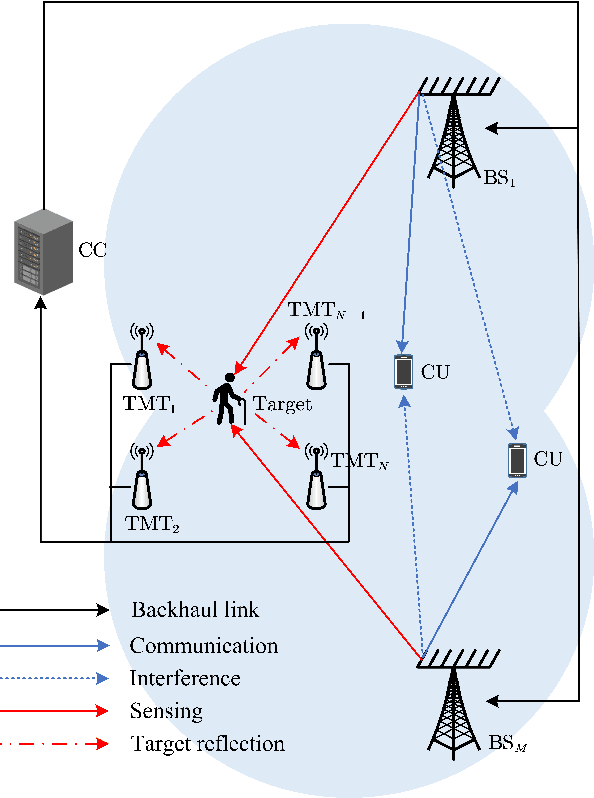
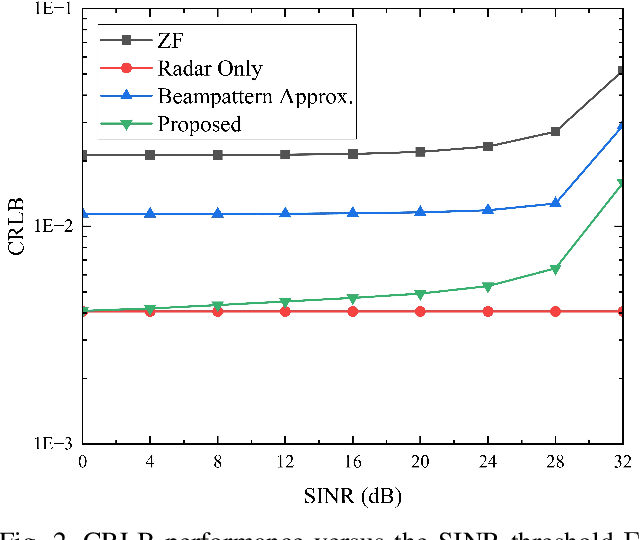
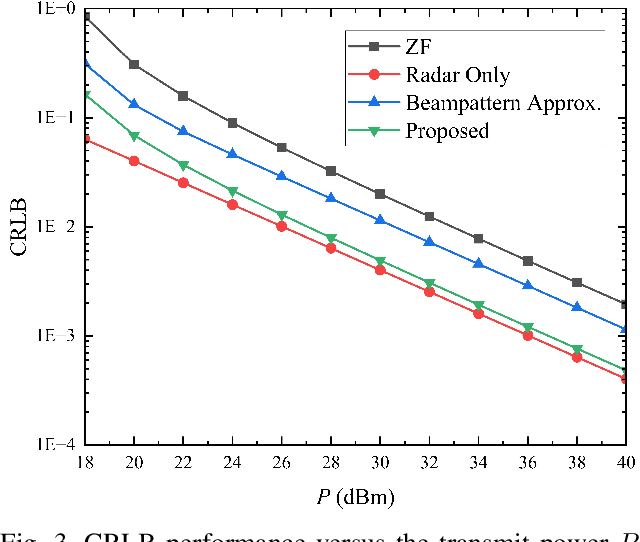
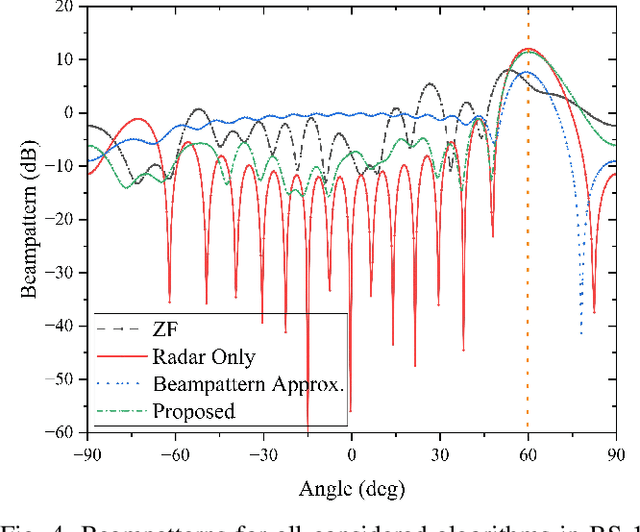
This paper investigates integrated localization and communication in a multi-cell system and proposes a coordinated beamforming algorithm to enhance target localization accuracy while preserving communication performance. Within this integrated sensing and communication (ISAC) system, the Cramer-Rao lower bound (CRLB) is adopted to quantify the accuracy of target localization, with its closed-form expression derived for the first time. It is shown that the nuisance parameters can be disregarded without impacting the CRLB of time of arrival (TOA)-based target localization. Capitalizing on the derived CRLB, we formulate a nonconvex coordinated beamforming problem to minimize the CRLB while satisfying signal-to-interference-plus-noise ratio (SINR) constraints in communication. To facilitate the development of solution, we reformulate the original problem into a more tractable form and solve it through semi-definite programming (SDP). Notably, we show that the proposed algorithm can always obtain rank-one global optimal solutions under mild conditions. Finally, numerical results demonstrate the superiority of the proposed algorithm over benchmark algorithms and reveal the performance trade-off between localization accuracy and communication SINR.