 Add to Chrome
 Add to Firefox
 Add to Edge
Synthetic Network Packet Generation through Statistical Learning and Genetic Algorithms
Jun 18, 2026
Developing robust intrusion detection systems (IDS) for IoT environments requires large, labeled datasets capturing realistic traffic distributions across both benign and malicious activity. Existing public datasets suffer from fixed activity distributions and extreme class imbalance, while deep generative models (GANs, VAEs) provide no mechanism to enforce that synthetic packets remain within physically valid feature ranges. This paper proposes and compares two constraint-enforcing approaches for synthetic IoT network packet generation: (i) a statistical learning method combining PCA-based latent space sampling with dual One-Class SVM (OCSVM) and Isolation Forest (IF) boundary enforcement, and (ii) a genetic algorithm (GA) method that treats packet generation as a multi-objective optimization problem with explicit fitness criteria for anomaly model acceptance and distributional fidelity. Both methods embed hard validity constraints -- dual anomaly-detection gating, feature-range clamping, and independent validation -- directly into the synthesis pipeline. Evaluation on the complete ACI IoT 2023 dataset (1,231,411 packets, 12 attack categories, class imbalance up to 175,805:1) demonstrates that both methods achieve PASS status across all categories under independently trained validators with a 30% anomaly rate threshold: the statistical method attains 1.20% average anomaly rate with ~1,091 packets/s throughput, while the GA attains 0.62% average anomaly rate with organic per-class variance (0.00%-2.50%) at ~5.7 packets/s. Both methods successfully amplify the 5-sample ARP Spoofing category by 200x to 1,000 validated packets. The ~190:1 throughput ratio between methods, combined with their complementary quality profiles, provides evidence-based selection criteria for deployment contexts ranging from rapid dataset augmentation to adversarial robustness testing.

Categorical Robustness Assessment for Machine Learning based Network Intrusion Detection Systems
Jun 10, 2026Network Intrusion Detection Systems (NIDS) heavily utlize Machine Learning (ML) but ML models can be manipulated via adversarial attacks. These attacks add carefully crafted perturbations to network traffic data that leads to misclassifications. While prior work has demonstrated adversarial vulnerabilities in isolated settings, systematic cross-architecture as well as class and category of attack based comparisons under controlled attack conditions remain limited, leaving practitioners without clear guidance on which models to deploy in adversarial environments. This paper asks a simple question: what type of classifier architectures actually hold up when attackers try to manipulate the systems? We put three popular architectures through their paces: a 1D Convolutional Neural Network, a Long Short-Term Memory (LSTM) network, and a Random Forest (RF) ensemble. Using the ACI-IoT-2023 dataset (over 1.2 million samples spanning 12 attack types), we subject each model with FGSM and PGD adversarial attacks, which apply gradient-based perturbations in normalized feature space consistent with established adversarial ML evaluation protocols, at perturbation budgets ranging from $ε=0.01$ to $ε=0.1$. Surprisingly, Random Forest achieved near-perfect baseline accuracy (99.98\%), yet collapsed catastrophically under attack, dropping 73 percentage points at the smallest perturbation we tested. CNN, on the other hand, retained 95.5\% accuracy at $ε=0.01$ and degraded gracefully as perturbations increased. LSTM fell somewhere in between. These findings flip the conventional wisdom where high baseline accuracy means nothing if a model shatters at the first sign of adversarial pressure. For practitioners deploying intrusion detection in adversarial environments, we recommend CNN-based architectures and provide scenario-specific deployment guidance.
Solomon at SemEval-2020 Task 11: Ensemble Architecture for Fine-Tuned Propaganda Detection in News Articles
Sep 16, 2020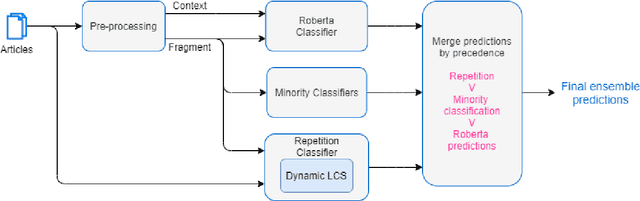
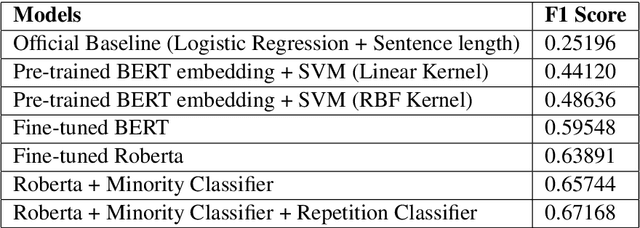
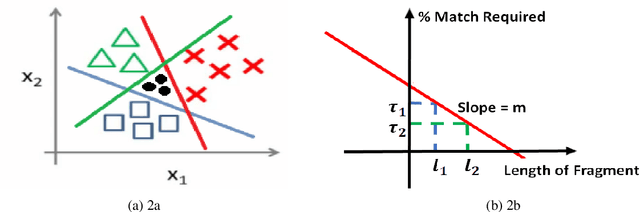
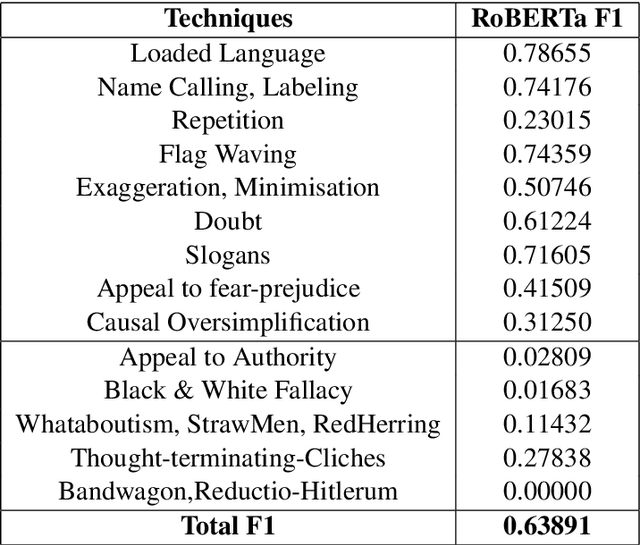
This paper describes our system (Solomon) details and results of participation in the SemEval 2020 Task 11 "Detection of Propaganda Techniques in News Articles"\cite{DaSanMartinoSemeval20task11}. We participated in Task "Technique Classification" (TC) which is a multi-class classification task. To address the TC task, we used RoBERTa based transformer architecture for fine-tuning on the propaganda dataset. The predictions of RoBERTa were further fine-tuned by class-dependent-minority-class classifiers. A special classifier, which employs dynamically adapted Least Common Sub-sequence algorithm, is used to adapt to the intricacies of repetition class. Compared to the other participating systems, our submission is ranked 4th on the leaderboard.