 Add to Chrome
 Add to Firefox
 Add to Edge
StormWave: An Open-Source Portable SDR Platform for Over-the-Air Resilience Evaluation of Terrestrial and Aerial Communications
May 05, 2026
This paper presents \emph{StormWave}, an open-source, portable software-defined Radio Frequency (RF) interference generation and monitoring platform designed for realistic field-based evaluation of the resilience of wireless communication systems. StormWave enables seamless composition and runtime switching among a wide range of narrowband and wideband waveforms, while supporting multiple digital modulations, adaptive coding, and multi-radio orchestration with real-time spectrum visualization. We evaluate the effectiveness of StormWave through both outdoor ground and air-to-air (A2A) experiments. Ground experiments demonstrate clear waveform- and modulation-dependent interference effects under realistic propagation conditions, while A2A experiments reveal pronounced distance-dependent constellation distortion and access-symbol degradation under active interference. The StormWave source code will be released to the community, with the expectation that StormWave will be used as a flexible, extensible, and field-ready platform for systematically validating interference resilience of wireless systems under realistic operating conditions.

C-POD: An AWS Cloud Framework for Edge Pod Automation and Remote Wireless Testbed Sharing
Feb 15, 2026This paper presents C-POD, a cloud-native framework that automates the deployment and management of edge pods for seamless remote access and sharing of wireless testbeds. C-POD leverages public cloud resources and edge pods to lower the barrier to over-the-air (OTA) experimentation, enabling researchers to share and access distributed testbeds without extensive local infrastructure. A supporting toolkit has been developed for C-POD to enable flexible and scalable experimental workflows, including containerized edge environments, persistent Secure Shell (SSH) tunnels, and stable graphical interfaces. We prototype and deploy C-POD on the Amazon Web Services (AWS) public cloud to demonstrate its key features, including cloud-assisted edge pod deployment automation, elastic computing resource management, and experiment observability, by integrating two wireless testbeds that focus on RF signal generation and 5G(B) communications, respectively.
BenchLink: An SoC-Based Benchmark for Resilient Communication Links in GPS-Denied Environments
Dec 24, 2025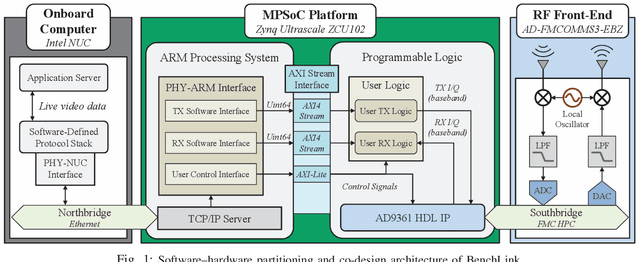
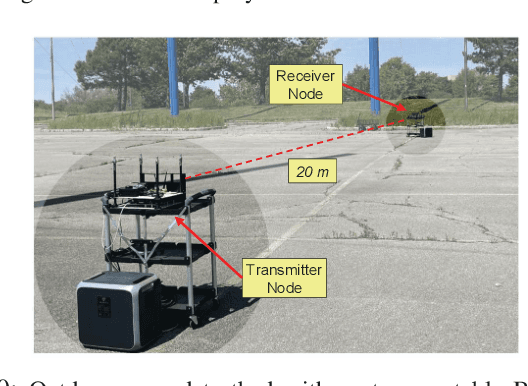
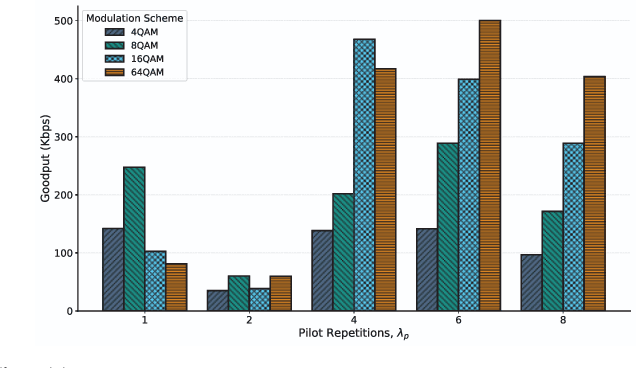
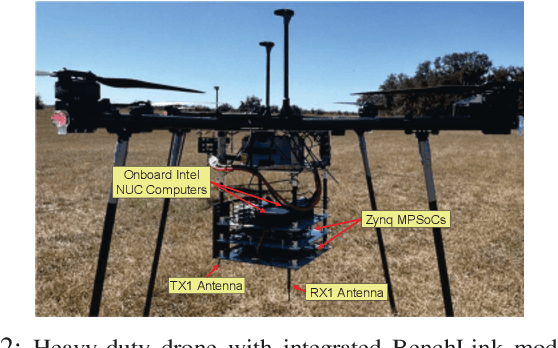
Accurate timing and synchronization, typically enabled by GPS, are essential for modern wireless communication systems. However, many emerging applications must operate in GPS-denied environments where signals are unreliable or disrupted, resulting in oscillator drift and carrier frequency impairments. To address these challenges, we present BenchLink, a System-on-Chip (SoC)-based benchmark for resilient communication links that functions without GPS and supports adaptive pilot density and modulation. Unlike traditional General Purpose Processor (GPP)-based software-defined radios (e.g. USRPs), the SoC-based design allows for more precise latency control. We implement and evaluate BenchLink on Zynq UltraScale+ MPSoCs, and demonstrate its effectiveness in both ground and aerial environments. A comprehensive dataset has also been collected under various conditions. We will make both the SoC-based link design and dataset available to the wireless community. BenchLink is expected to facilitate future research on data-driven link adaptation, resilient synchronization in GPS-denied scenarios, and emerging applications that require precise latency control, such as integrated radar sensing and communication.
Cloud-Based Federation Framework and Prototype for Open, Scalable, and Shared Access to NextG and IoT Testbeds
Aug 26, 2024
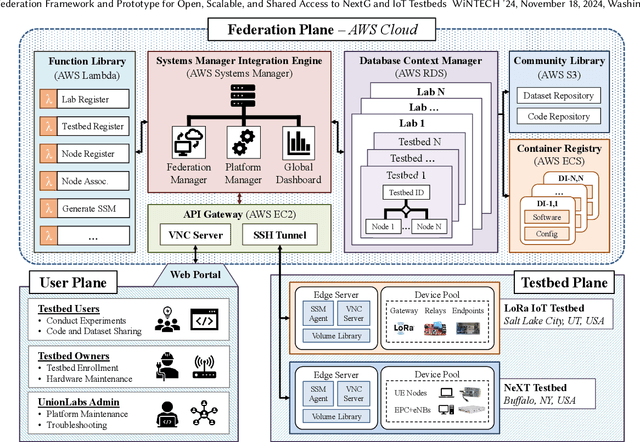
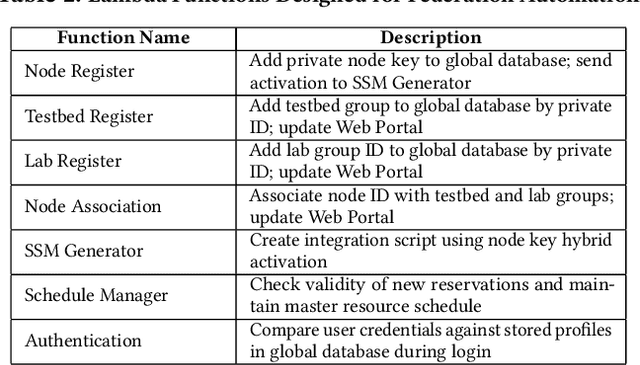
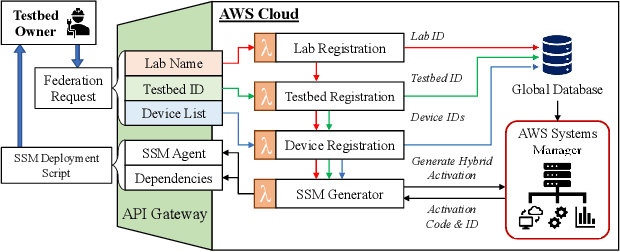
In this work, we present a new federation framework for UnionLabs, an innovative cloud-based resource-sharing infrastructure designed for next-generation (NextG) and Internet of Things (IoT) over-the-air (OTA) experiments. The framework aims to reduce the federation complexity for testbeds developers by automating tedious backend operations, thereby providing scalable federation and remote access to various wireless testbeds. We first describe the key components of the new federation framework, including the Systems Manager Integration Engine (SMIE), the Automated Script Generator (ASG), and the Database Context Manager (DCM). We then prototype and deploy the new Federation Plane on the Amazon Web Services (AWS) public cloud, demonstrating its effectiveness by federating two wireless testbeds: i) UB NeXT, a 5G-and-beyond (5G+) testbed at the University at Buffalo, and ii) UT IoT, an IoT testbed at the University of Utah. Through this work we aim to initiate a grassroots campaign to democratize access to wireless research testbeds with heterogeneous hardware resources and network environment, and accelerate the establishment of a mature, open experimental ecosystem for the wireless community. The API of the new Federation Plane will be released to the community after internal testing is completed.
On the Effects of Modeling on the Sim-to-Real Transfer Gap in Twinning the POWDER Platform
Aug 26, 2024Digital Twin (DT) technology is expected to play a pivotal role in NextG wireless systems. However, a key challenge remains in the evaluation of data-driven algorithms within DTs, particularly the transfer of learning from simulations to real-world environments. In this work, we investigate the sim-to-real gap in developing a digital twin for the NSF PAWR Platform, POWDER. We first develop a 3D model of the University of Utah campus, incorporating geographical measurements and all rooftop POWDER nodes. We then assess the accuracy of various path loss models used in training modeling and control policies, examining the impact of each model on sim-to-real link performance predictions. Finally, we discuss the lessons learned from model selection and simulation design, offering guidance for the implementation of DT-enabled wireless networks.