 Add to Chrome
 Add to Firefox
 Add to Edge
Taxonomy-aware deep learning for hierarchical marine species classification in underwater imagery
Jun 24, 2026
Automated classification of marine species from underwater imagery is essential for scalable ocean biodiversity monitoring and conservation policy. Existing approaches struggle with severe domain shift across collection platforms, fine-grained visual similarity between closely related species, and uneven annotation granularity, where many specimens can only be identified to genus or a coarser taxonomic rank. We present a taxonomy-aware deep learning framework that aligns both the training loss and the inference rule with the hierarchical structure of biological classification, combining a taxonomy-weighted loss, minimum-risk Bayesian inference, multi-scale feature encoding, and independent per-rank classification heads. Evaluated on the FathomNet 2025 dataset1 (79 marine classes across seven taxonomic ranks), the system achieves a mean taxonomic distance of 1.581, within 3% of the 1st-place solution (1.535), with the largest gains from metric-aligned inference and simple, decoupled components that generalize better than learned dependencies under distribution shift.
* 10 pages, 3 figures, 4 tables. Presented at SPIE Defense + Security 2026 (Machine Learning from Challenging Data conference), National Harbor, MD, April 2026

StormWave: An Open-Source Portable SDR Platform for Over-the-Air Resilience Evaluation of Terrestrial and Aerial Communications
May 05, 2026This paper presents \emph{StormWave}, an open-source, portable software-defined Radio Frequency (RF) interference generation and monitoring platform designed for realistic field-based evaluation of the resilience of wireless communication systems. StormWave enables seamless composition and runtime switching among a wide range of narrowband and wideband waveforms, while supporting multiple digital modulations, adaptive coding, and multi-radio orchestration with real-time spectrum visualization. We evaluate the effectiveness of StormWave through both outdoor ground and air-to-air (A2A) experiments. Ground experiments demonstrate clear waveform- and modulation-dependent interference effects under realistic propagation conditions, while A2A experiments reveal pronounced distance-dependent constellation distortion and access-symbol degradation under active interference. The StormWave source code will be released to the community, with the expectation that StormWave will be used as a flexible, extensible, and field-ready platform for systematically validating interference resilience of wireless systems under realistic operating conditions.
BenchLink: An SoC-Based Benchmark for Resilient Communication Links in GPS-Denied Environments
Dec 24, 2025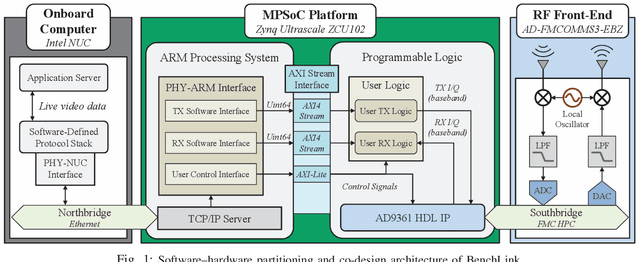
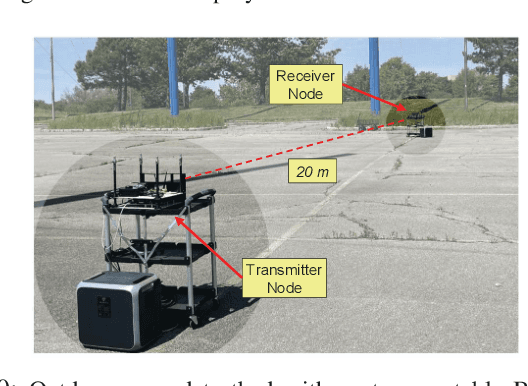
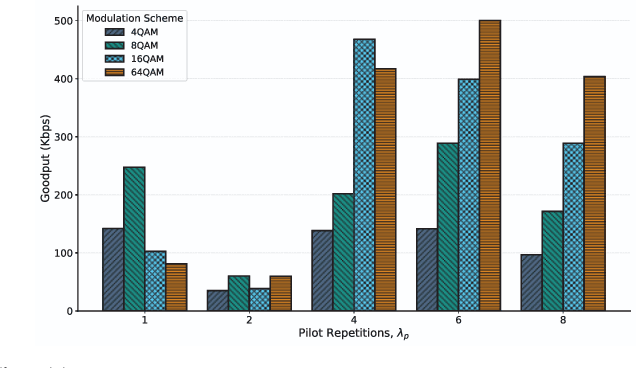
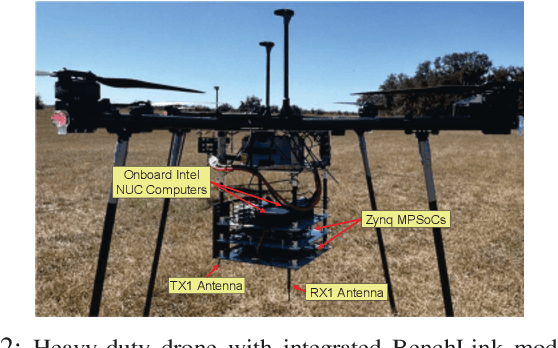
Accurate timing and synchronization, typically enabled by GPS, are essential for modern wireless communication systems. However, many emerging applications must operate in GPS-denied environments where signals are unreliable or disrupted, resulting in oscillator drift and carrier frequency impairments. To address these challenges, we present BenchLink, a System-on-Chip (SoC)-based benchmark for resilient communication links that functions without GPS and supports adaptive pilot density and modulation. Unlike traditional General Purpose Processor (GPP)-based software-defined radios (e.g. USRPs), the SoC-based design allows for more precise latency control. We implement and evaluate BenchLink on Zynq UltraScale+ MPSoCs, and demonstrate its effectiveness in both ground and aerial environments. A comprehensive dataset has also been collected under various conditions. We will make both the SoC-based link design and dataset available to the wireless community. BenchLink is expected to facilitate future research on data-driven link adaptation, resilient synchronization in GPS-denied scenarios, and emerging applications that require precise latency control, such as integrated radar sensing and communication.
Efficient L1-Norm Principal-Component Analysis via Bit Flipping
Oct 06, 2016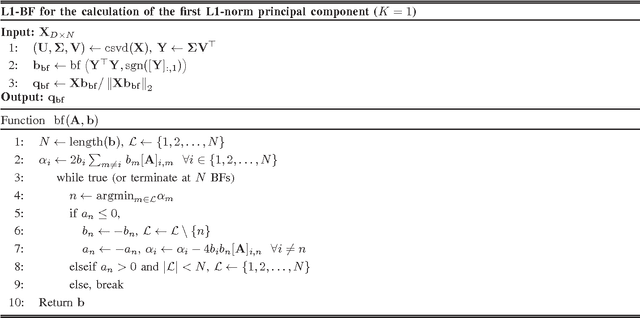
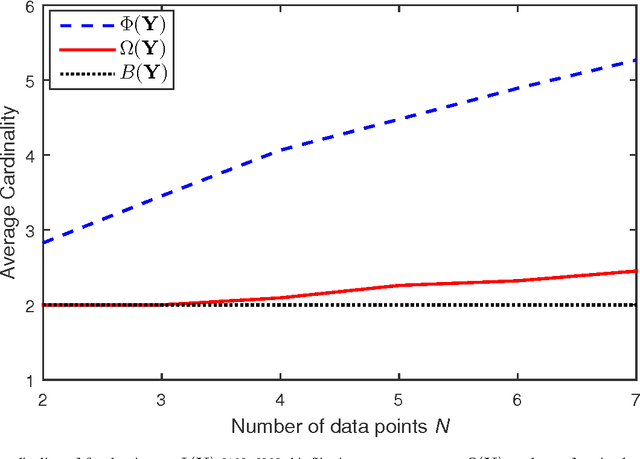
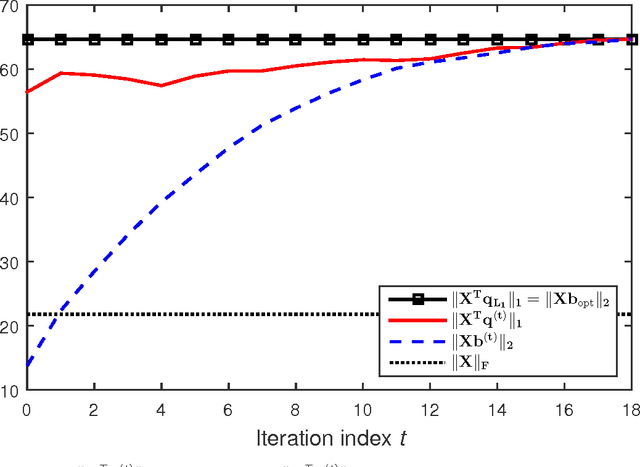
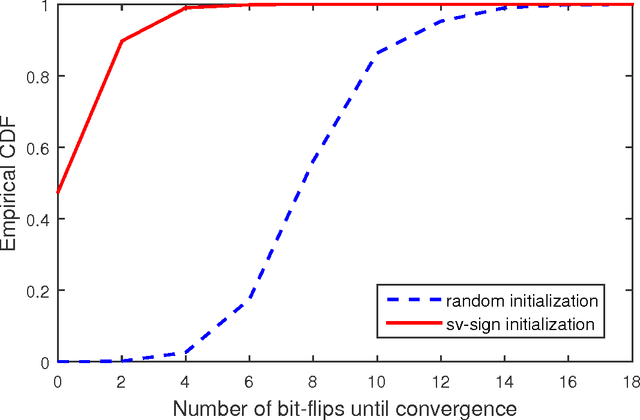
It was shown recently that the $K$ L1-norm principal components (L1-PCs) of a real-valued data matrix $\mathbf X \in \mathbb R^{D \times N}$ ($N$ data samples of $D$ dimensions) can be exactly calculated with cost $\mathcal{O}(2^{NK})$ or, when advantageous, $\mathcal{O}(N^{dK - K + 1})$ where $d=\mathrm{rank}(\mathbf X)$, $K<d$ [1],[2]. In applications where $\mathbf X$ is large (e.g., "big" data of large $N$ and/or "heavy" data of large $d$), these costs are prohibitive. In this work, we present a novel suboptimal algorithm for the calculation of the $K < d$ L1-PCs of $\mathbf X$ of cost $\mathcal O(ND \mathrm{min} \{ N,D\} + N^2(K^4 + dK^2) + dNK^3)$, which is comparable to that of standard (L2-norm) PC analysis. Our theoretical and experimental studies show that the proposed algorithm calculates the exact optimal L1-PCs with high frequency and achieves higher value in the L1-PC optimization metric than any known alternative algorithm of comparable computational cost. The superiority of the calculated L1-PCs over standard L2-PCs (singular vectors) in characterizing potentially faulty data/measurements is demonstrated with experiments on data dimensionality reduction and disease diagnosis from genomic data.
Some Options for L1-Subspace Signal Processing
Sep 04, 2013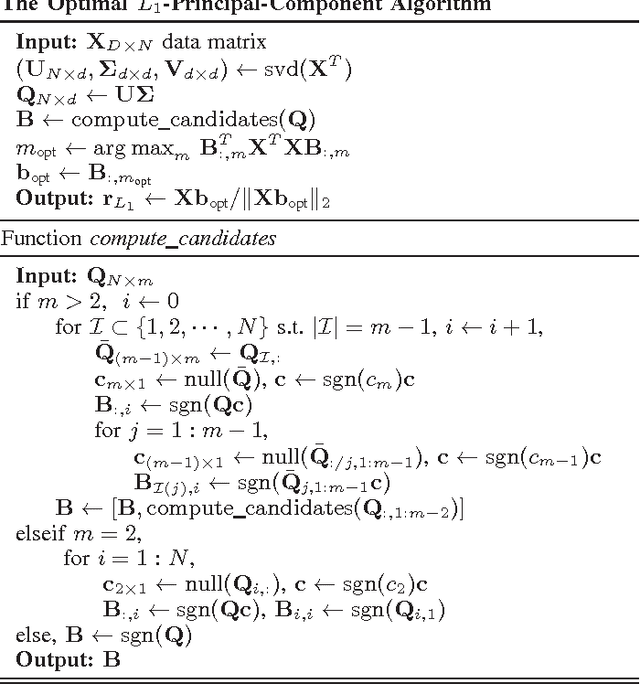
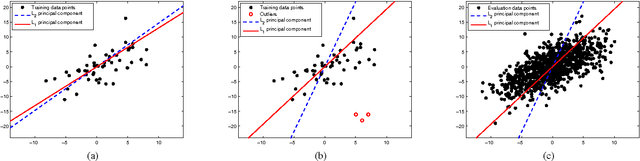
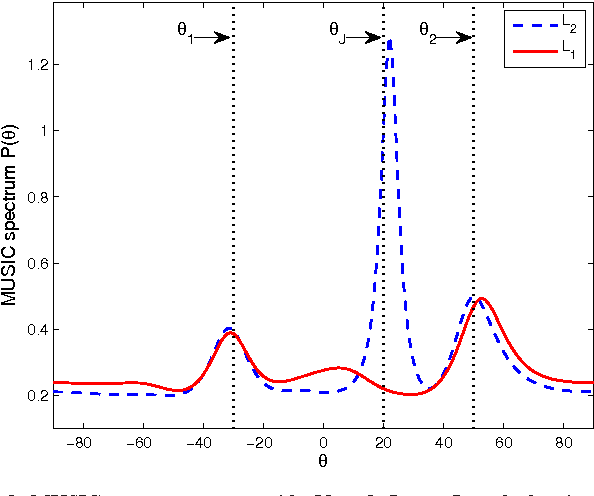
We describe ways to define and calculate $L_1$-norm signal subspaces which are less sensitive to outlying data than $L_2$-calculated subspaces. We focus on the computation of the $L_1$ maximum-projection principal component of a data matrix containing N signal samples of dimension D and conclude that the general problem is formally NP-hard in asymptotically large N, D. We prove, however, that the case of engineering interest of fixed dimension D and asymptotically large sample support N is not and we present an optimal algorithm of complexity $O(N^D)$. We generalize to multiple $L_1$-max-projection components and present an explicit optimal $L_1$ subspace calculation algorithm in the form of matrix nuclear-norm evaluations. We conclude with illustrations of $L_1$-subspace signal processing in the fields of data dimensionality reduction and direction-of-arrival estimation.