 Add to Chrome
 Add to Firefox
 Add to Edge
StormWave: An Open-Source Portable SDR Platform for Over-the-Air Resilience Evaluation of Terrestrial and Aerial Communications
May 05, 2026
This paper presents \emph{StormWave}, an open-source, portable software-defined Radio Frequency (RF) interference generation and monitoring platform designed for realistic field-based evaluation of the resilience of wireless communication systems. StormWave enables seamless composition and runtime switching among a wide range of narrowband and wideband waveforms, while supporting multiple digital modulations, adaptive coding, and multi-radio orchestration with real-time spectrum visualization. We evaluate the effectiveness of StormWave through both outdoor ground and air-to-air (A2A) experiments. Ground experiments demonstrate clear waveform- and modulation-dependent interference effects under realistic propagation conditions, while A2A experiments reveal pronounced distance-dependent constellation distortion and access-symbol degradation under active interference. The StormWave source code will be released to the community, with the expectation that StormWave will be used as a flexible, extensible, and field-ready platform for systematically validating interference resilience of wireless systems under realistic operating conditions.

BenchLink: An SoC-Based Benchmark for Resilient Communication Links in GPS-Denied Environments
Dec 24, 2025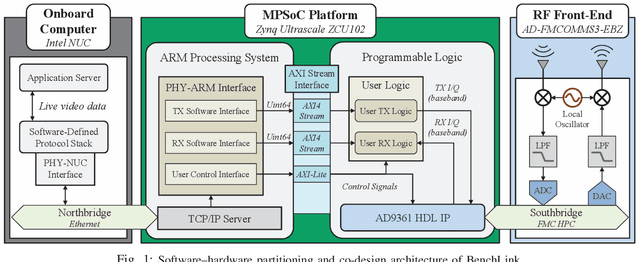
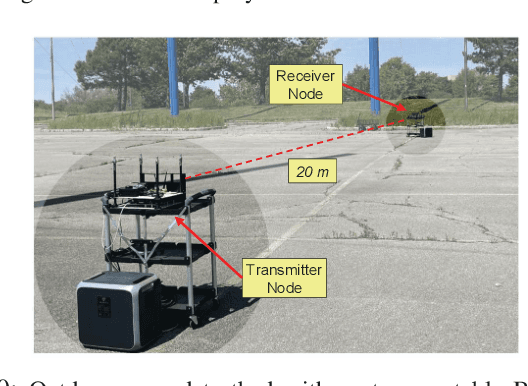
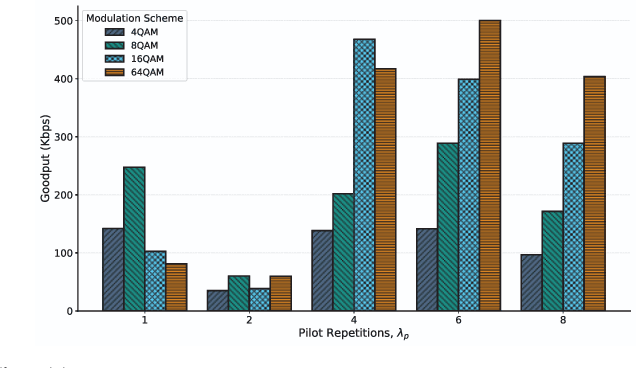
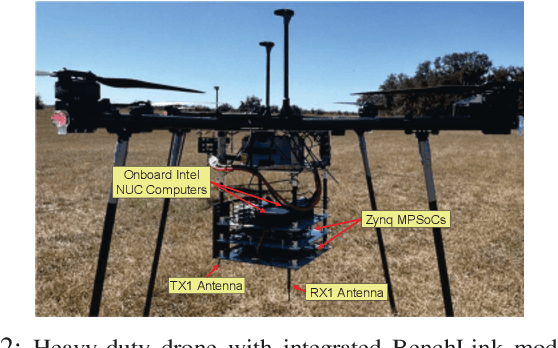
Accurate timing and synchronization, typically enabled by GPS, are essential for modern wireless communication systems. However, many emerging applications must operate in GPS-denied environments where signals are unreliable or disrupted, resulting in oscillator drift and carrier frequency impairments. To address these challenges, we present BenchLink, a System-on-Chip (SoC)-based benchmark for resilient communication links that functions without GPS and supports adaptive pilot density and modulation. Unlike traditional General Purpose Processor (GPP)-based software-defined radios (e.g. USRPs), the SoC-based design allows for more precise latency control. We implement and evaluate BenchLink on Zynq UltraScale+ MPSoCs, and demonstrate its effectiveness in both ground and aerial environments. A comprehensive dataset has also been collected under various conditions. We will make both the SoC-based link design and dataset available to the wireless community. BenchLink is expected to facilitate future research on data-driven link adaptation, resilient synchronization in GPS-denied scenarios, and emerging applications that require precise latency control, such as integrated radar sensing and communication.