 Add to Chrome
 Add to Firefox
 Add to Edge
Infinite Trace Objectives with Finite Trace Techniques: Translating LTL to LTLf+
Aug 03, 2026
Linear Temporal Logic (LTL) is one of the most widely adopted languages for specifying temporal extended objectives in AI, with applications ranging from reactive synthesis to stochastic planning in Markov decision processes and reinforcement learning. Traditionally, solving any of these problems requires translating the LTL specification to a nondeterministic automata on infinite words and then determinizing it, a step that is notoriously difficult in theory and in practice. Recent work has introduced LTLf+, which lifts the finite-trace logic LTLf to infinite traces. LTLf+ has the same expressive power as LTL, yet it retains most of the crucial advantages of its base logic LTLf. Most reasoning in LTLf+ rests on finite automata on finite words, for which we have not only a canonical minimal representation but also an efficient determinization procedure. In this work we present the first translation from LTL to LTLf+. We first normalize an LTL formula into the syntactic reactivity fragment of the Manna-Pnueli hierarchy, to create the general fragment-based shape of LTLf+. We then present linear translations for each individual component of that fragment. As a consequence of this translation, the expanding body of techniques developed for LTLf+ now becomes available to many AI problems currently formulated in LTL. We further show that this comes at no asymptotic cost, as the pipeline from LTL to automaton via LTLf+ remains doubly exponential.

SemML 2.0: Synthesizing Controllers for LTL
Apr 27, 2026Synthesizing a reactive system from specifications given in linear temporal logic (LTL) is a classical problem, finding its applications in safety-critical systems design. These systems are typically represented using either Mealy machines or AIGER circuits. We present the second version of SemML, which outperforms all state-of-the-art tools for finding either solution. Aside from implementing the classical automata-theoretic approach, our tool utilizes partial exploration and machine-learning guidance for obtaining solutions efficiently, and numerous heuristics and improvements of classic algorithms for extracting small representations of these solutions. We evaluate our tool against the existing state-of-the-art tools (in particular Strix, LtlSynt, and the previous version of SemML) on the dataset of the synthesis competition SYNTCOMP. We show that we solve significantly more instances and do so much faster than other tools, while maintaining state-of-the-art solution quality.
Semantically Labelled Automata for Multi-Task Reinforcement Learning with LTL Instructions
Feb 06, 2026We study multi-task reinforcement learning (RL), a setting in which an agent learns a single, universal policy capable of generalising to arbitrary, possibly unseen tasks. We consider tasks specified as linear temporal logic (LTL) formulae, which are commonly used in formal methods to specify properties of systems, and have recently been successfully adopted in RL. In this setting, we present a novel task embedding technique leveraging a new generation of semantic LTL-to-automata translations, originally developed for temporal synthesis. The resulting semantically labelled automata contain rich, structured information in each state that allow us to (i) compute the automaton efficiently on-the-fly, (ii) extract expressive task embeddings used to condition the policy, and (iii) naturally support full LTL. Experimental results in a variety of domains demonstrate that our approach achieves state-of-the-art performance and is able to scale to complex specifications where existing methods fail.
SemML: Enhancing Automata-Theoretic LTL Synthesis with Machine Learning
Jan 29, 2025
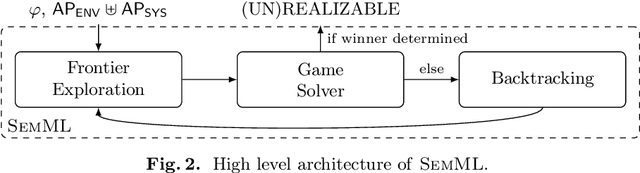

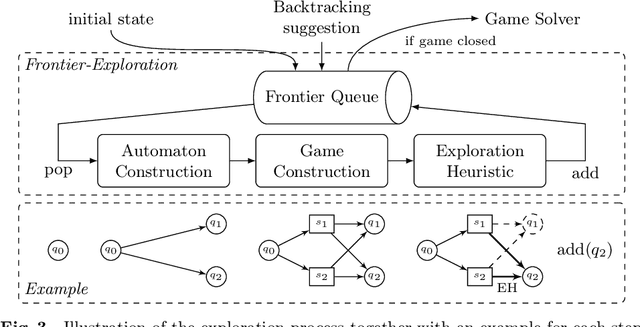
Synthesizing a reactive system from specifications given in linear temporal logic (LTL) is a classical problem, finding its applications in safety-critical systems design. We present our tool SemML, which won this year's LTL realizability tracks of SYNTCOMP, after years of domination by Strix. While both tools are based on the automata-theoretic approach, ours relies heavily on (i) Semantic labelling, additional information of logical nature, coming from recent LTL-to-automata translations and decorating the resulting parity game, and (ii) Machine Learning approaches turning this information into a guidance oracle for on-the-fly exploration of the parity game (whence the name SemML). Our tool fills the missing gaps of previous suggestions to use such an oracle and provides an efficeint implementation with additional algorithmic improvements. We evaluate SemML both on the entire set of SYNTCOMP as well as a synthetic data set, compare it to Strix, and analyze the advantages and limitations. As SemML solves more instances on SYNTCOMP and does so significantly faster on larger instances, this demonstrates for the first time that machine-learning-aided approaches can out-perform state-of-the-art tools in real LTL synthesis.
Guessing Winning Policies in LTL Synthesis by Semantic Learning
May 24, 2023We provide a learning-based technique for guessing a winning strategy in a parity game originating from an LTL synthesis problem. A cheaply obtained guess can be useful in several applications. Not only can the guessed strategy be applied as best-effort in cases where the game's huge size prohibits rigorous approaches, but it can also increase the scalability of rigorous LTL synthesis in several ways. Firstly, checking whether a guessed strategy is winning is easier than constructing one. Secondly, even if the guess is wrong in some places, it can be fixed by strategy iteration faster than constructing one from scratch. Thirdly, the guess can be used in on-the-fly approaches to prioritize exploration in the most fruitful directions. In contrast to previous works, we (i)~reflect the highly structured logical information in game's states, the so-called semantic labelling, coming from the recent LTL-to-automata translations, and (ii)~learn to reflect it properly by learning from previously solved games, bringing the solving process closer to human-like reasoning.