 Add to Chrome
 Add to Firefox
 Add to Edge
A 4D Representation for Training-Free Agentic Reasoning from Monocular Laparoscopic Video
Apr 01, 2026
Spatiotemporal reasoning is a fundamental capability for artificial intelligence (AI) in soft tissue surgery, paving the way for intelligent assistive systems and autonomous robotics. While 2D vision-language models show increasing promise at understanding surgical video, the spatial complexity of surgical scenes suggests that reasoning systems may benefit from explicit 4D representations. Here, we propose a framework for equipping surgical agents with spatiotemporal tools based on an explicit 4D representation, enabling AI systems to ground their natural language reasoning in both time and 3D space. Leveraging models for point tracking, depth, and segmentation, we develop a coherent 4D model with spatiotemporally consistent tool and tissue semantics. A Multimodal Large Language Model (MLLM) then acts as an agent on tools derived from the explicit 4D representation (e.g., trajectories) without any fine-tuning. We evaluate our method on a new dataset of 134 clinically relevant questions and find that the combination of a general purpose reasoning backbone and our 4D representation significantly improves spatiotemporal understanding and allows for 4D grounding. We demonstrate that spatiotemporal intelligence can be "assembled" from 2D MLLMs and 3D computer vision models without additional training. Code, data, and examples are available at https://tum-ai.github.io/surg4d/

Intraoperative Registration by Cross-Modal Inverse Neural Rendering
Sep 18, 2024We present in this paper a novel approach for 3D/2D intraoperative registration during neurosurgery via cross-modal inverse neural rendering. Our approach separates implicit neural representation into two components, handling anatomical structure preoperatively and appearance intraoperatively. This disentanglement is achieved by controlling a Neural Radiance Field's appearance with a multi-style hypernetwork. Once trained, the implicit neural representation serves as a differentiable rendering engine, which can be used to estimate the surgical camera pose by minimizing the dissimilarity between its rendered images and the target intraoperative image. We tested our method on retrospective patients' data from clinical cases, showing that our method outperforms state-of-the-art while meeting current clinical standards for registration. Code and additional resources can be found at https://maxfehrentz.github.io/style-ngp/.
Learning to Match 2D Keypoints Across Preoperative MR and Intraoperative Ultrasound
Sep 12, 2024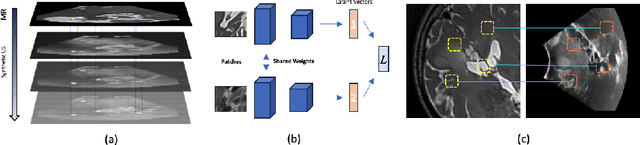
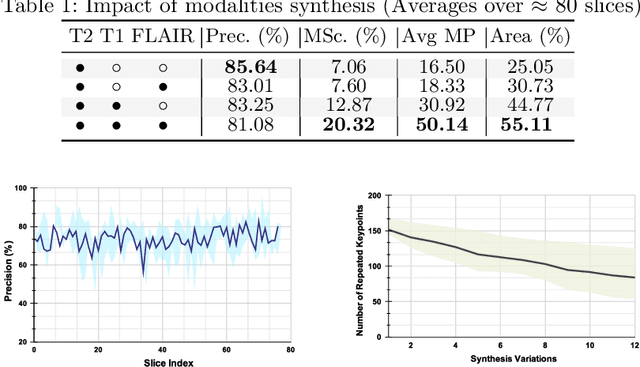
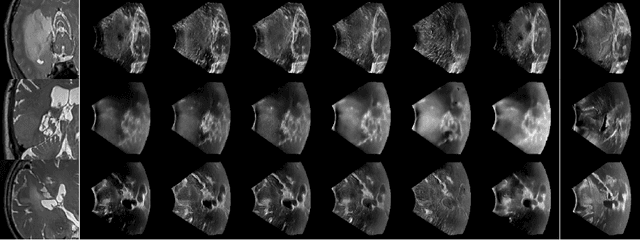
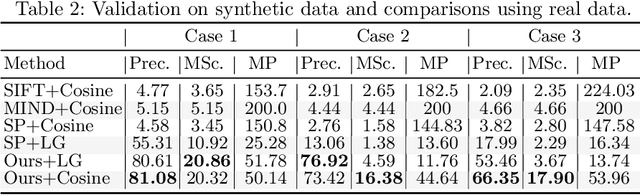
We propose in this paper a texture-invariant 2D keypoints descriptor specifically designed for matching preoperative Magnetic Resonance (MR) images with intraoperative Ultrasound (US) images. We introduce a matching-by-synthesis strategy, where intraoperative US images are synthesized from MR images accounting for multiple MR modalities and intraoperative US variability. We build our training set by enforcing keypoints localization over all images then train a patient-specific descriptor network that learns texture-invariant discriminant features in a supervised contrastive manner, leading to robust keypoints descriptors. Our experiments on real cases with ground truth show the effectiveness of the proposed approach, outperforming the state-of-the-art methods and achieving 80.35% matching precision on average.