 Add to Chrome
 Add to Firefox
 Add to Edge
A 4D Representation for Training-Free Agentic Reasoning from Monocular Laparoscopic Video
Apr 01, 2026
Spatiotemporal reasoning is a fundamental capability for artificial intelligence (AI) in soft tissue surgery, paving the way for intelligent assistive systems and autonomous robotics. While 2D vision-language models show increasing promise at understanding surgical video, the spatial complexity of surgical scenes suggests that reasoning systems may benefit from explicit 4D representations. Here, we propose a framework for equipping surgical agents with spatiotemporal tools based on an explicit 4D representation, enabling AI systems to ground their natural language reasoning in both time and 3D space. Leveraging models for point tracking, depth, and segmentation, we develop a coherent 4D model with spatiotemporally consistent tool and tissue semantics. A Multimodal Large Language Model (MLLM) then acts as an agent on tools derived from the explicit 4D representation (e.g., trajectories) without any fine-tuning. We evaluate our method on a new dataset of 134 clinically relevant questions and find that the combination of a general purpose reasoning backbone and our 4D representation significantly improves spatiotemporal understanding and allows for 4D grounding. We demonstrate that spatiotemporal intelligence can be "assembled" from 2D MLLMs and 3D computer vision models without additional training. Code, data, and examples are available at https://tum-ai.github.io/surg4d/

Diffeomorphic Obstacle Avoidance for Contractive Dynamical Systems via Implicit Representations
Apr 26, 2025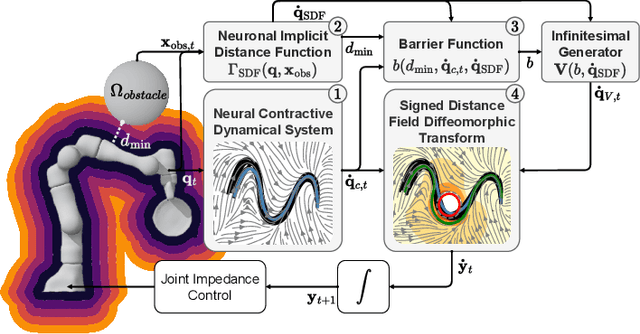
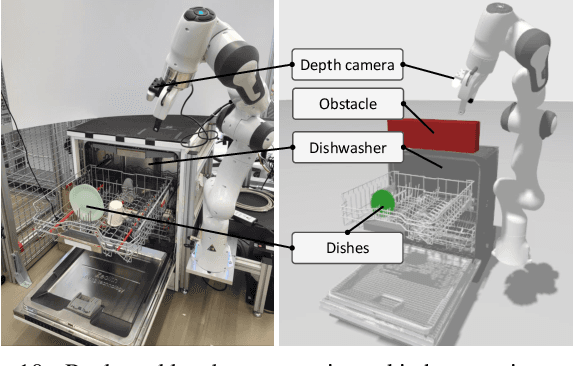
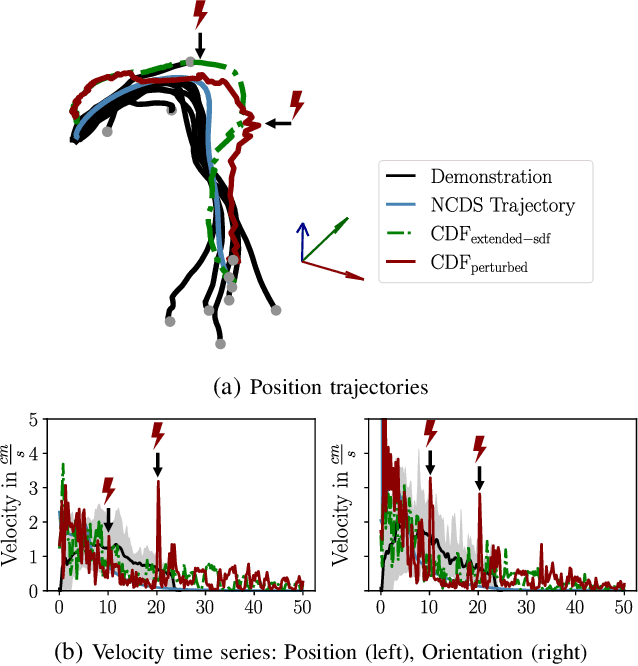
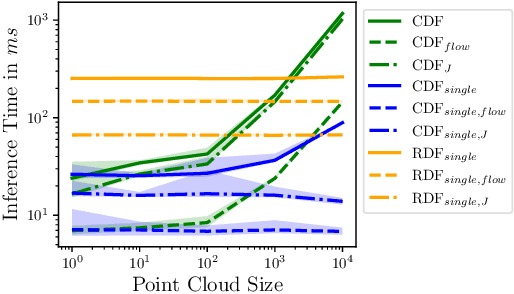
Ensuring safety and robustness of robot skills is becoming crucial as robots are required to perform increasingly complex and dynamic tasks. The former is essential when performing tasks in cluttered environments, while the latter is relevant to overcome unseen task situations. This paper addresses the challenge of ensuring both safety and robustness in dynamic robot skills learned from demonstrations. Specifically, we build on neural contractive dynamical systems to provide robust extrapolation of the learned skills, while designing a full-body obstacle avoidance strategy that preserves contraction stability via diffeomorphic transforms. This is particularly crucial in complex environments where implicit scene representations, such as Signed Distance Fields (SDFs), are necessary. To this end, our framework called Signed Distance Field Diffeomorphic Transform, leverages SDFs and flow-based diffeomorphisms to achieve contraction-preserving obstacle avoidance. We thoroughly evaluate our framework on synthetic datasets and several real-world robotic tasks in a kitchen environment. Our results show that our approach locally adapts the learned contractive vector field while staying close to the learned dynamics and without introducing highly-curved motion paths, thus outperforming several state-of-the-art methods.