 Add to Chrome
 Add to Firefox
 Add to Edge
TCG-AR: Real-Time Multi-View Augmented Reality for Trading Card Game Streaming
Jul 02, 2026
Trading card games are increasingly played and broadcast online, yet live streams remain mostly limited to flat top-down footage of the playing area. Augmenting such streams with virtual models of the played cards would improve the viewing experience, but most existing systems rely on instrumented playing surfaces and embedded chips, which are costly and impractical for casual players and large-scale events. In this work, we present TCG-AR, a novel real-time pipeline that augments trading card games using ordinary RGB cameras alone, without any physical markers or specialized hardware. Our pipeline detects, orients, and identifies the cards on the board, renders virtual content onto each card across all views, and can additionally compose a broadcaststyle view that summarizes the game state for spectators, streaming the augmented feeds to standard broadcasting software such as OBS. To train the detection, orientation, and identification models without manual labeling, we introduce an automatic procedure that generates annotated synthetic training data from a reference set of card images. Then, we evaluate several trained models on a new manually annotated dataset with real images, analyzing performance and runtime throughput that determine real-world usability. Overall, by relying only on commodity cameras and hardware, and by open-sourcing all code, models, and datasets, this work aims to serve as a reference for real-time trading card recognition and to make real-time augmented-reality streaming accessible to the broader community of players and streamers.

Recursive Block-Diagonal Coupling for Resource-Efficient Training of Vision Models
May 22, 2026Training high-capacity vision models from scratch requires substantial computational resources. To improve training efficiency of a wide target model, existing growth methods often assume the availability of narrower models, obscuring the true computational cost of the entire pipeline. We propose an efficient training protocol, RBDC, that builds wide models by coupling in a parameter-free block-diagonal way narrower, independently trained models in a recursive way. This allows a flexible allocation of the training budget available across all the models involved. Evaluated with vision transformers (DeiT) and convolutional networks (ResNet) on ImageNet, our RBDC training protocol shows a much better efficiency than models trained from scratch with the standard protocol, yielding 30% FLOPs reduction at similar test accuracies. It also achieves higher performances at same training FLOPs than training protocols from the model growth literature. Finally, we show that our models can serve as better backbones than their original counterparts for downstream object detection and instance segmentation tasks.
Multi-Stream Cellular Test-Time Adaptation of Real-Time Models Evolving in Dynamic Environments
Apr 27, 2024In the era of the Internet of Things (IoT), objects connect through a dynamic network, empowered by technologies like 5G, enabling real-time data sharing. However, smart objects, notably autonomous vehicles, face challenges in critical local computations due to limited resources. Lightweight AI models offer a solution but struggle with diverse data distributions. To address this limitation, we propose a novel Multi-Stream Cellular Test-Time Adaptation (MSC-TTA) setup where models adapt on the fly to a dynamic environment divided into cells. Then, we propose a real-time adaptive student-teacher method that leverages the multiple streams available in each cell to quickly adapt to changing data distributions. We validate our methodology in the context of autonomous vehicles navigating across cells defined based on location and weather conditions. To facilitate future benchmarking, we release a new multi-stream large-scale synthetic semantic segmentation dataset, called DADE, and show that our multi-stream approach outperforms a single-stream baseline. We believe that our work will open research opportunities in the IoT and 5G eras, offering solutions for real-time model adaptation.
Online Distillation with Continual Learning for Cyclic Domain Shifts
Apr 03, 2023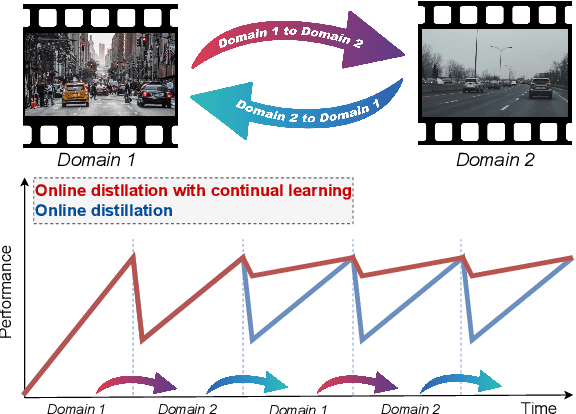
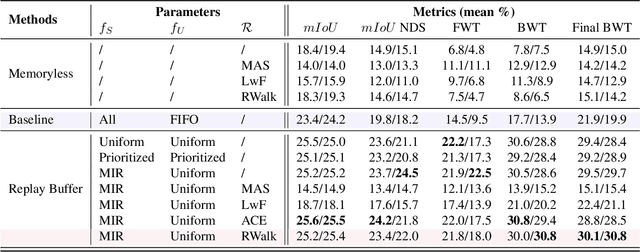
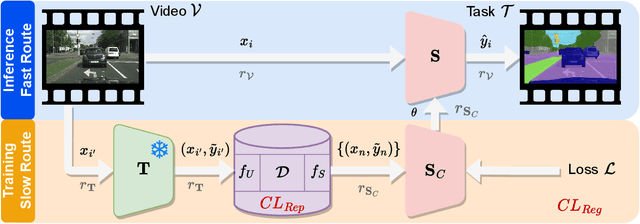
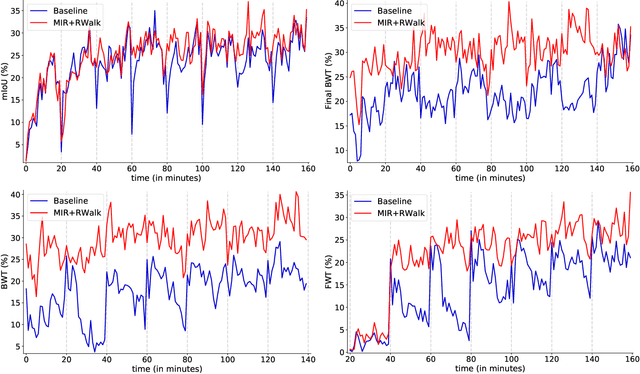
In recent years, online distillation has emerged as a powerful technique for adapting real-time deep neural networks on the fly using a slow, but accurate teacher model. However, a major challenge in online distillation is catastrophic forgetting when the domain shifts, which occurs when the student model is updated with data from the new domain and forgets previously learned knowledge. In this paper, we propose a solution to this issue by leveraging the power of continual learning methods to reduce the impact of domain shifts. Specifically, we integrate several state-of-the-art continual learning methods in the context of online distillation and demonstrate their effectiveness in reducing catastrophic forgetting. Furthermore, we provide a detailed analysis of our proposed solution in the case of cyclic domain shifts. Our experimental results demonstrate the efficacy of our approach in improving the robustness and accuracy of online distillation, with potential applications in domains such as video surveillance or autonomous driving. Overall, our work represents an important step forward in the field of online distillation and continual learning, with the potential to significantly impact real-world applications.