 Add to Chrome
 Add to Firefox
 Add to Edge
GTA: A Geometry-Aware Attention Mechanism for Multi-View Transformers
Oct 16, 2023
As transformers are equivariant to the permutation of input tokens, encoding the positional information of tokens is necessary for many tasks. However, since existing positional encoding schemes have been initially designed for NLP tasks, their suitability for vision tasks, which typically exhibit different structural properties in their data, is questionable. We argue that existing positional encoding schemes are suboptimal for 3D vision tasks, as they do not respect their underlying 3D geometric structure. Based on this hypothesis, we propose a geometry-aware attention mechanism that encodes the geometric structure of tokens as relative transformation determined by the geometric relationship between queries and key-value pairs. By evaluating on multiple novel view synthesis (NVS) datasets in the sparse wide-baseline multi-view setting, we show that our attention, called Geometric Transform Attention (GTA), improves learning efficiency and performance of state-of-the-art transformer-based NVS models without any additional learned parameters and only minor computational overhead.

Flow Factorized Representation Learning
Sep 22, 2023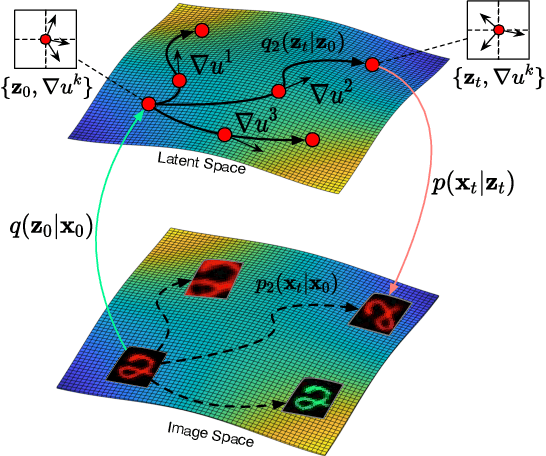
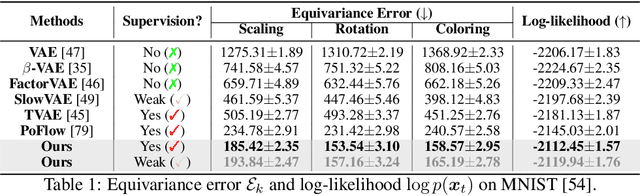
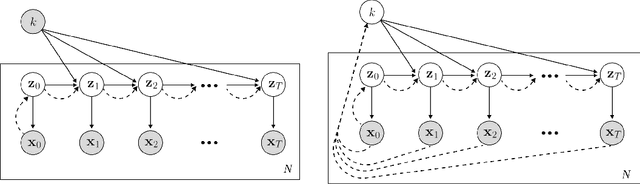
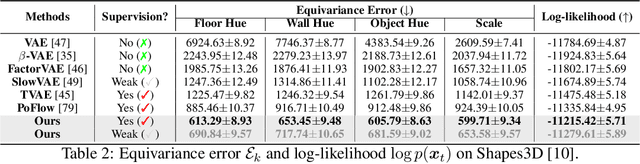
A prominent goal of representation learning research is to achieve representations which are factorized in a useful manner with respect to the ground truth factors of variation. The fields of disentangled and equivariant representation learning have approached this ideal from a range of complimentary perspectives; however, to date, most approaches have proven to either be ill-specified or insufficiently flexible to effectively separate all realistic factors of interest in a learned latent space. In this work, we propose an alternative viewpoint on such structured representation learning which we call Flow Factorized Representation Learning, and demonstrate it to learn both more efficient and more usefully structured representations than existing frameworks. Specifically, we introduce a generative model which specifies a distinct set of latent probability paths that define different input transformations. Each latent flow is generated by the gradient field of a learned potential following dynamic optimal transport. Our novel setup brings new understandings to both \textit{disentanglement} and \textit{equivariance}. We show that our model achieves higher likelihoods on standard representation learning benchmarks while simultaneously being closer to approximately equivariant models. Furthermore, we demonstrate that the transformations learned by our model are flexibly composable and can also extrapolate to new data, implying a degree of robustness and generalizability approaching the ultimate goal of usefully factorized representation learning.
Learning Objective-Specific Active Learning Strategies with Attentive Neural Processes
Sep 11, 2023

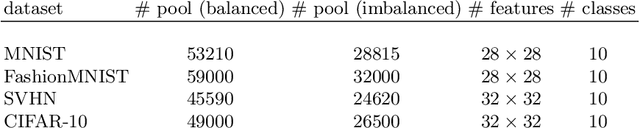

Pool-based active learning (AL) is a promising technology for increasing data-efficiency of machine learning models. However, surveys show that performance of recent AL methods is very sensitive to the choice of dataset and training setting, making them unsuitable for general application. In order to tackle this problem, the field Learning Active Learning (LAL) suggests to learn the active learning strategy itself, allowing it to adapt to the given setting. In this work, we propose a novel LAL method for classification that exploits symmetry and independence properties of the active learning problem with an Attentive Conditional Neural Process model. Our approach is based on learning from a myopic oracle, which gives our model the ability to adapt to non-standard objectives, such as those that do not equally weight the error on all data points. We experimentally verify that our Neural Process model outperforms a variety of baselines in these settings. Finally, our experiments show that our model exhibits a tendency towards improved stability to changing datasets. However, performance is sensitive to choice of classifier and more work is necessary to reduce the performance the gap with the myopic oracle and to improve scalability. We present our work as a proof-of-concept for LAL on nonstandard objectives and hope our analysis and modelling considerations inspire future LAL work.
Traveling Waves Encode the Recent Past and Enhance Sequence Learning
Sep 03, 2023Traveling waves of neural activity have been observed throughout the brain at a diversity of regions and scales; however, their precise computational role is still debated. One physically grounded hypothesis suggests that the cortical sheet may act like a wave-field capable of storing a short-term memory of sequential stimuli through induced waves traveling across the cortical surface. To date, however, the computational implications of this idea have remained hypothetical due to the lack of a simple recurrent neural network architecture capable of exhibiting such waves. In this work, we introduce a model to fill this gap, which we denote the Wave-RNN (wRNN), and demonstrate how both connectivity constraints and initialization play a crucial role in the emergence of wave-like dynamics. We then empirically show how such an architecture indeed efficiently encodes the recent past through a suite of synthetic memory tasks where wRNNs learn faster and perform significantly better than wave-free counterparts. Finally, we explore the implications of this memory storage system on more complex sequence modeling tasks such as sequential image classification and find that wave-based models not only again outperform comparable wave-free RNNs while using significantly fewer parameters, but additionally perform comparably to more complex gated architectures such as LSTMs and GRUs. We conclude with a discussion of the implications of these results for both neuroscience and machine learning.
Efficient Neural PDE-Solvers using Quantization Aware Training
Aug 14, 2023In the past years, the application of neural networks as an alternative to classical numerical methods to solve Partial Differential Equations has emerged as a potential paradigm shift in this century-old mathematical field. However, in terms of practical applicability, computational cost remains a substantial bottleneck. Classical approaches try to mitigate this challenge by limiting the spatial resolution on which the PDEs are defined. For neural PDE solvers, we can do better: Here, we investigate the potential of state-of-the-art quantization methods on reducing computational costs. We show that quantizing the network weights and activations can successfully lower the computational cost of inference while maintaining performance. Our results on four standard PDE datasets and three network architectures show that quantization-aware training works across settings and three orders of FLOPs magnitudes. Finally, we empirically demonstrate that Pareto-optimality of computational cost vs performance is almost always achieved only by incorporating quantization.
Wasserstein Quantum Monte Carlo: A Novel Approach for Solving the Quantum Many-Body Schrödinger Equation
Jul 17, 2023Solving the quantum many-body Schr\"odinger equation is a fundamental and challenging problem in the fields of quantum physics, quantum chemistry, and material sciences. One of the common computational approaches to this problem is Quantum Variational Monte Carlo (QVMC), in which ground-state solutions are obtained by minimizing the energy of the system within a restricted family of parameterized wave functions. Deep learning methods partially address the limitations of traditional QVMC by representing a rich family of wave functions in terms of neural networks. However, the optimization objective in QVMC remains notoriously hard to minimize and requires second-order optimization methods such as natural gradient. In this paper, we first reformulate energy functional minimization in the space of Born distributions corresponding to particle-permutation (anti-)symmetric wave functions, rather than the space of wave functions. We then interpret QVMC as the Fisher-Rao gradient flow in this distributional space, followed by a projection step onto the variational manifold. This perspective provides us with a principled framework to derive new QMC algorithms, by endowing the distributional space with better metrics, and following the projected gradient flow induced by those metrics. More specifically, we propose "Wasserstein Quantum Monte Carlo" (WQMC), which uses the gradient flow induced by the Wasserstein metric, rather than Fisher-Rao metric, and corresponds to transporting the probability mass, rather than teleporting it. We demonstrate empirically that the dynamics of WQMC results in faster convergence to the ground state of molecular systems.
Rotating Features for Object Discovery
Jun 01, 2023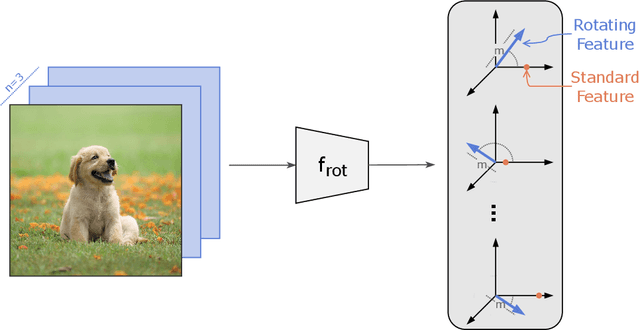
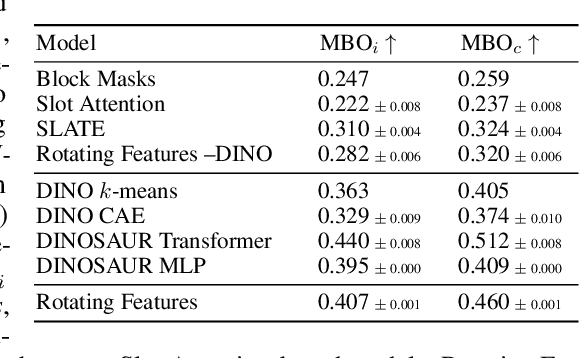
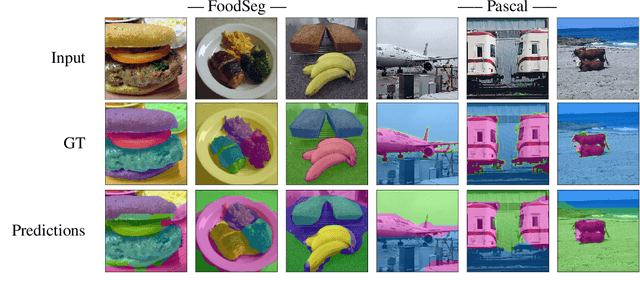
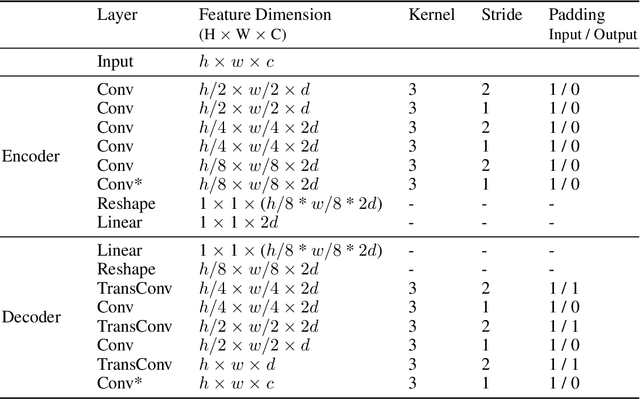
The binding problem in human cognition, concerning how the brain represents and connects objects within a fixed network of neural connections, remains a subject of intense debate. Most machine learning efforts addressing this issue in an unsupervised setting have focused on slot-based methods, which may be limiting due to their discrete nature and difficulty to express uncertainty. Recently, the Complex AutoEncoder was proposed as an alternative that learns continuous and distributed object-centric representations. However, it is only applicable to simple toy data. In this paper, we present Rotating Features, a generalization of complex-valued features to higher dimensions, and a new evaluation procedure for extracting objects from distributed representations. Additionally, we show the applicability of our approach to pre-trained features. Together, these advancements enable us to scale distributed object-centric representations from simple toy to real-world data. We believe this work advances a new paradigm for addressing the binding problem in machine learning and has the potential to inspire further innovation in the field.
Latent Traversals in Generative Models as Potential Flows
Apr 25, 2023Despite the significant recent progress in deep generative models, the underlying structure of their latent spaces is still poorly understood, thereby making the task of performing semantically meaningful latent traversals an open research challenge. Most prior work has aimed to solve this challenge by modeling latent structures linearly, and finding corresponding linear directions which result in `disentangled' generations. In this work, we instead propose to model latent structures with a learned dynamic potential landscape, thereby performing latent traversals as the flow of samples down the landscape's gradient. Inspired by physics, optimal transport, and neuroscience, these potential landscapes are learned as physically realistic partial differential equations, thereby allowing them to flexibly vary over both space and time. To achieve disentanglement, multiple potentials are learned simultaneously, and are constrained by a classifier to be distinct and semantically self-consistent. Experimentally, we demonstrate that our method achieves both more qualitatively and quantitatively disentangled trajectories than state-of-the-art baselines. Further, we demonstrate that our method can be integrated as a regularization term during training, thereby acting as an inductive bias towards the learning of structured representations, ultimately improving model likelihood on similarly structured data.
The END: An Equivariant Neural Decoder for Quantum Error Correction
Apr 14, 2023Quantum error correction is a critical component for scaling up quantum computing. Given a quantum code, an optimal decoder maps the measured code violations to the most likely error that occurred, but its cost scales exponentially with the system size. Neural network decoders are an appealing solution since they can learn from data an efficient approximation to such a mapping and can automatically adapt to the noise distribution. In this work, we introduce a data efficient neural decoder that exploits the symmetries of the problem. We characterize the symmetries of the optimal decoder for the toric code and propose a novel equivariant architecture that achieves state of the art accuracy compared to previous neural decoders.
Geometric Clifford Algebra Networks
Feb 13, 2023We propose Geometric Clifford Algebra Networks (GCANs) that are based on symmetry group transformations using geometric (Clifford) algebras. GCANs are particularly well-suited for representing and manipulating geometric transformations, often found in dynamical systems. We first review the quintessence of modern (plane-based) geometric algebra, which builds on isometries encoded as elements of the $\mathrm{Pin}(p,q,r)$ group. We then propose the concept of group action layers, which linearly combine object transformations using pre-specified group actions. Together with a new activation and normalization scheme, these layers serve as adjustable geometric templates that can be refined via gradient descent. Theoretical advantages are strongly reflected in the modeling of three-dimensional rigid body transformations as well as large-scale fluid dynamics simulations, showing significantly improved performance over traditional methods.