 Add to Chrome
 Add to Firefox
 Add to Edge
Simultaneous State Estimation and Online Model Learning in a Soft Robotic System
Feb 15, 2026
Operating complex real-world systems, such as soft robots, can benefit from precise predictive control schemes that require accurate state and model knowledge. This knowledge is typically not available in practical settings and must be inferred from noisy measurements. In particular, it is challenging to simultaneously estimate unknown states and learn a model online from sequentially arriving measurements. In this paper, we show how a recently proposed gray-box system identification tool enables the estimation of a soft robot's current pose while at the same time learning a bending stiffness model. For estimation and learning, we rely solely on a nominal constant-curvature robot model and measurements of the robot's base reactions (e.g., base forces). The estimation scheme -- relying on a marginalized particle filter -- allows us to conveniently interface nominal constant-curvature equations with a Gaussian Process (GP) bending stiffness model to be learned. This, in contrast to estimation via a random walk over stiffness values, enables prediction of bending stiffness and improves overall model quality. We demonstrate, using real-world soft-robot data, that the method learns a bending stiffness model online while accurately estimating the robot's pose. Notably, reduced multi-step forward-prediction errors indicate that the learned bending-stiffness GP improves overall model quality.

Adaptive Model-Predictive Control of a Soft Continuum Robot Using a Physics-Informed Neural Network Based on Cosserat Rod Theory
Aug 18, 2025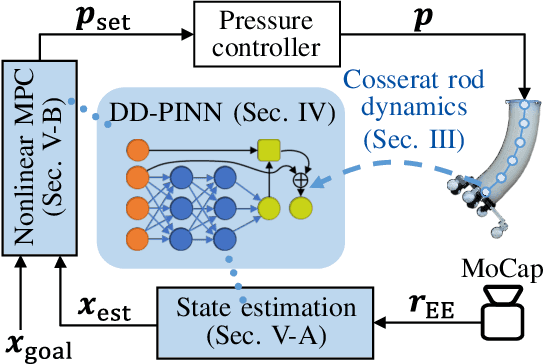
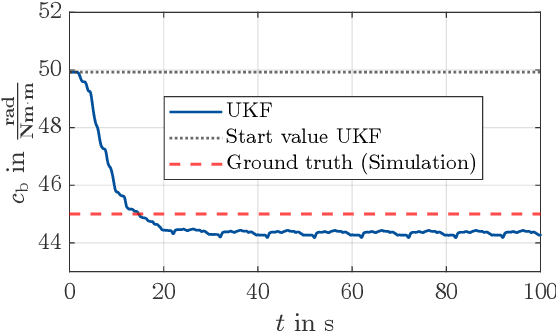
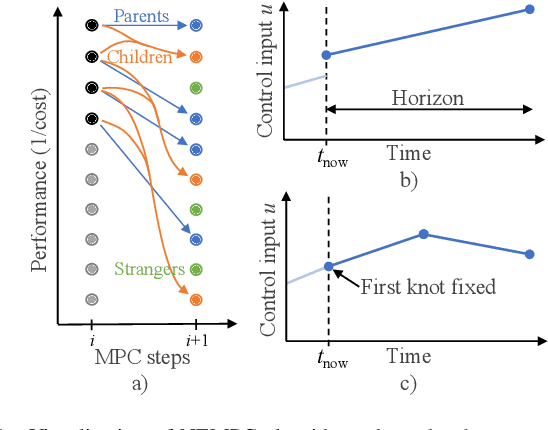
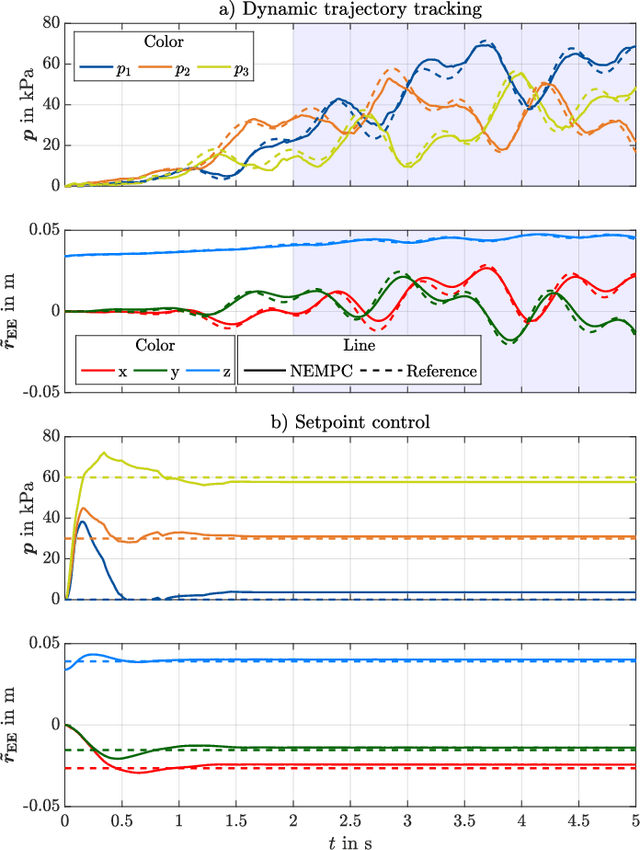
Dynamic control of soft continuum robots (SCRs) holds great potential for expanding their applications, but remains a challenging problem due to the high computational demands of accurate dynamic models. While data-driven approaches like Koopman-operator-based methods have been proposed, they typically lack adaptability and cannot capture the full robot shape, limiting their applicability. This work introduces a real-time-capable nonlinear model-predictive control (MPC) framework for SCRs based on a domain-decoupled physics-informed neural network (DD-PINN) with adaptable bending stiffness. The DD-PINN serves as a surrogate for the dynamic Cosserat rod model with a speed-up factor of 44000. It is also used within an unscented Kalman filter for estimating the model states and bending compliance from end-effector position measurements. We implement a nonlinear evolutionary MPC running at 70 Hz on the GPU. In simulation, it demonstrates accurate tracking of dynamic trajectories and setpoint control with end-effector position errors below 3 mm (2.3% of the actuator's length). In real-world experiments, the controller achieves similar accuracy and accelerations up to 3.55 m/s2.
Toward Dynamic Control of Tendon-Driven Continuum Robots using Clarke Transform
Mar 26, 2025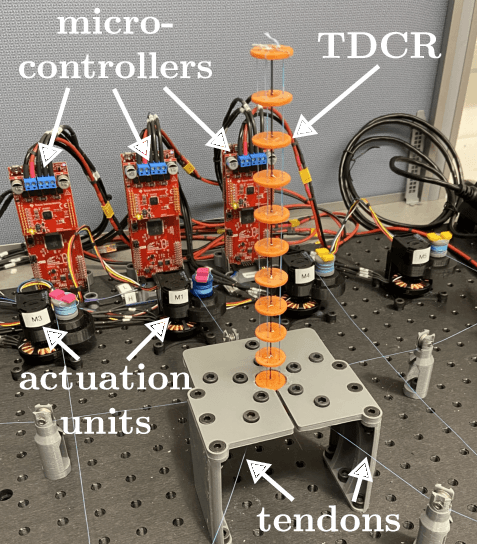
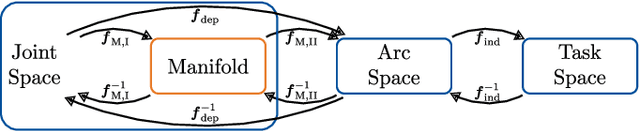
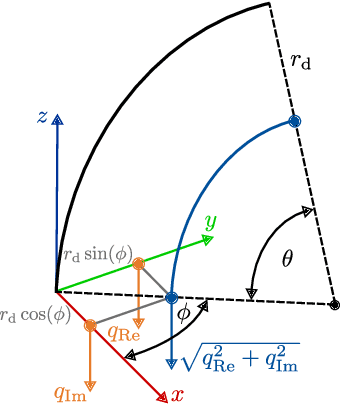
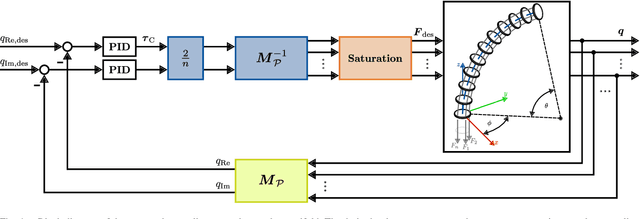
In this paper, we propose a dynamic model and control framework for tendon-driven continuum robots with multiple segments and an arbitrary number of tendons per segment. Our approach leverages the Clarke transform, the Euler-Lagrange formalism, and the piecewise constant curvature assumption to formulate a dynamic model on a two-dimensional manifold embedded in the joint space that inherently satisfies tendon constraints. We present linear controllers that operate directly on this manifold, along with practical methods for preventing negative tendon forces without compromising control fidelity. We validate these approaches in simulation and on a physical prototype with one segment and five tendons, demonstrating accurate dynamic behavior and robust trajectory tracking under real-time conditions.
Domain-decoupled Physics-informed Neural Networks with Closed-form Gradients for Fast Model Learning of Dynamical Systems
Aug 27, 2024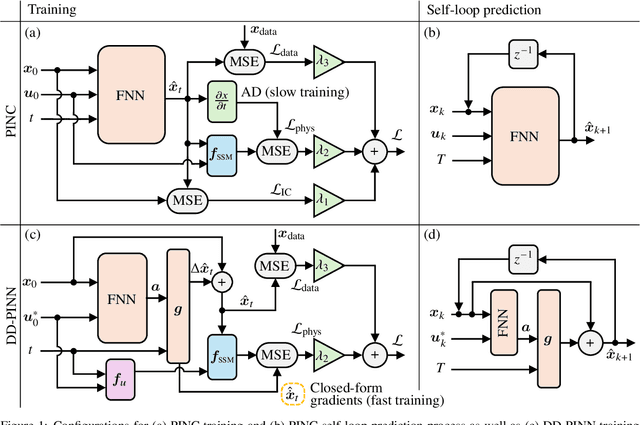
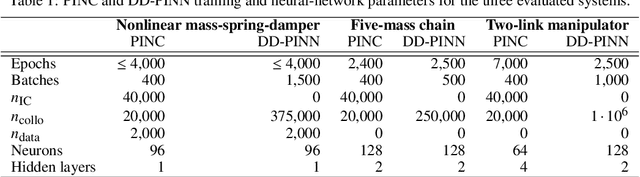
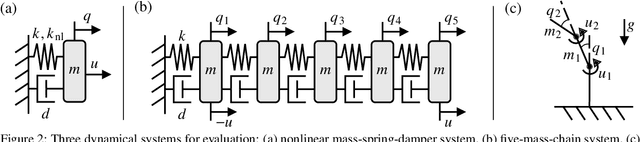
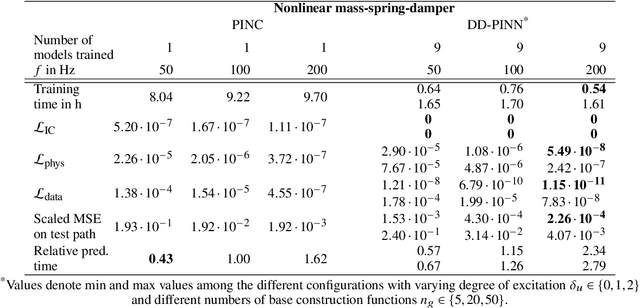
Physics-informed neural networks (PINNs) are trained using physical equations and can also incorporate unmodeled effects by learning from data. PINNs for control (PINCs) of dynamical systems are gaining interest due to their prediction speed compared to classical numerical integration methods for nonlinear state-space models, making them suitable for real-time control applications. We introduce the domain-decoupled physics-informed neural network (DD-PINN) to address current limitations of PINC in handling large and complex nonlinear dynamic systems. The time domain is decoupled from the feed-forward neural network to construct an Ansatz function, allowing for calculation of gradients in closed form. This approach significantly reduces training times, especially for large dynamical systems, compared to PINC, which relies on graph-based automatic differentiation. Additionally, the DD-PINN inherently fulfills the initial condition and supports higher-order excitation inputs, simplifying the training process and enabling improved prediction accuracy. Validation on three systems - a nonlinear mass-spring-damper, a five-mass-chain, and a two-link robot - demonstrates that the DD-PINN achieves significantly shorter training times. In cases where the PINC's prediction diverges, the DD-PINN's prediction remains stable and accurate due to higher physics loss reduction or use of a higher-order excitation input. The DD-PINN allows for fast and accurate learning of large dynamical systems previously out of reach for the PINC.