 Add to Chrome
 Add to Firefox
 Add to Edge
Accurate Open-Loop Control of a Soft Continuum Robot Through Visually Learned Latent Representations
Mar 20, 2026
This work addresses open-loop control of a soft continuum robot (SCR) from video-learned latent dynamics. Visual Oscillator Networks (VONs) from previous work are used, that provide mechanistically interpretable 2D oscillator latents through an attention broadcast decoder (ABCD). Open-loop, single-shooting optimal control is performed in latent space to track image-specified waypoints without camera feedback. An interactive SCR live simulator enables design of static, dynamic, and extrapolated targets and maps them to model-specific latent waypoints. On a two-segment pneumatic SCR, Koopman, MLP, and oscillator dynamics, each with and without ABCD, are evaluated on setpoint and dynamic trajectories. ABCD-based models consistently reduce image-space tracking error. The VON and ABCD-based Koopman models attains the lowest MSEs. Using an ablation study, we demonstrate that several architecture choices and training settings contribute to the open-loop control performance. Simulation stress tests further confirm static holding, stable extrapolated equilibria, and plausible relaxation to the rest state. To the best of our knowledge, this is the first demonstration that interpretable, video-learned latent dynamics enable reliable long-horizon open-loop control of an SCR.

Adaptive Model-Predictive Control of a Soft Continuum Robot Using a Physics-Informed Neural Network Based on Cosserat Rod Theory
Aug 18, 2025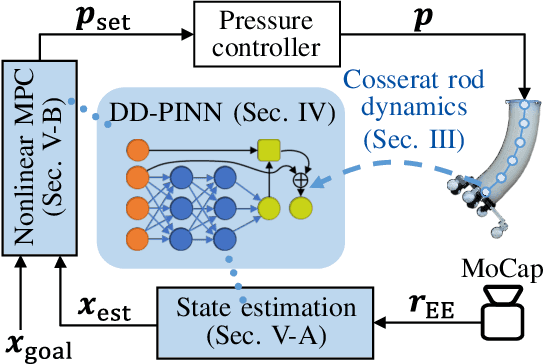
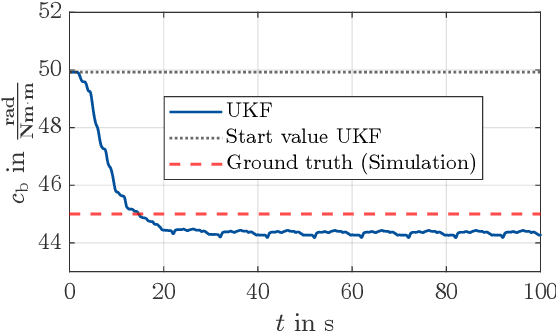
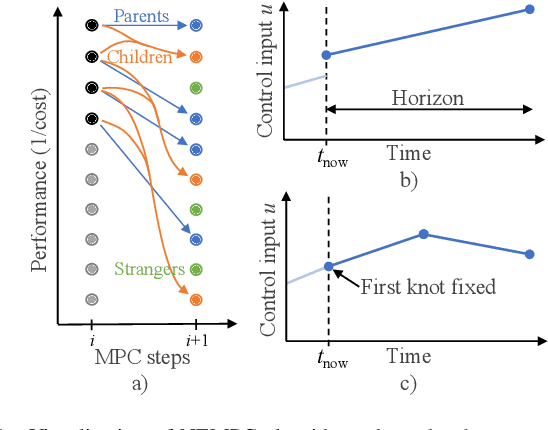
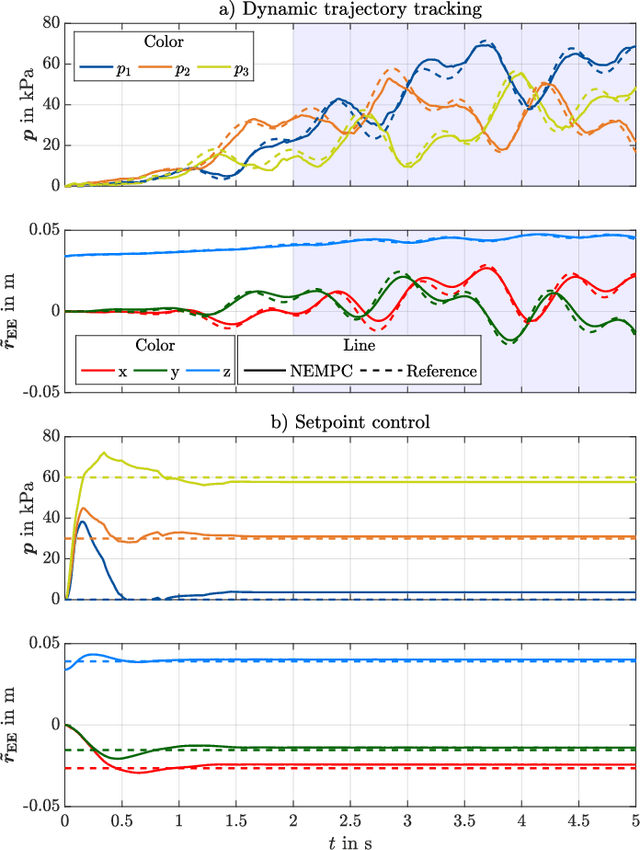
Dynamic control of soft continuum robots (SCRs) holds great potential for expanding their applications, but remains a challenging problem due to the high computational demands of accurate dynamic models. While data-driven approaches like Koopman-operator-based methods have been proposed, they typically lack adaptability and cannot capture the full robot shape, limiting their applicability. This work introduces a real-time-capable nonlinear model-predictive control (MPC) framework for SCRs based on a domain-decoupled physics-informed neural network (DD-PINN) with adaptable bending stiffness. The DD-PINN serves as a surrogate for the dynamic Cosserat rod model with a speed-up factor of 44000. It is also used within an unscented Kalman filter for estimating the model states and bending compliance from end-effector position measurements. We implement a nonlinear evolutionary MPC running at 70 Hz on the GPU. In simulation, it demonstrates accurate tracking of dynamic trajectories and setpoint control with end-effector position errors below 3 mm (2.3% of the actuator's length). In real-world experiments, the controller achieves similar accuracy and accelerations up to 3.55 m/s2.