 Add to Chrome
 Add to Firefox
 Add to Edge
CIRCLE: A Framework for Evaluating AI from a Real-World Lens
Mar 03, 2026
This paper proposes CIRCLE, a six-stage, lifecycle-based framework to bridge the reality gap between model-centric performance metrics and AI's materialized outcomes in deployment. While existing frameworks like MLOps focus on system stability and benchmarks measure abstract capabilities, decision-makers outside the AI stack lack systematic evidence about the behavior of AI technologies under real-world user variability and constraints. CIRCLE operationalizes the Validation phase of TEVV (Test, Evaluation, Verification, and Validation) by formalizing the translation of stakeholder concerns outside the stack into measurable signals. Unlike participatory design, which often remains localized, or algorithmic audits, which are often retrospective, CIRCLE provides a structured, prospective protocol for linking context-sensitive qualitative insights to scalable quantitative metrics. By integrating methods such as field testing, red teaming, and longitudinal studies into a coordinated pipeline, CIRCLE produces systematic knowledge: evidence that is comparable across sites yet sensitive to local context. This can enable governance based on materialized downstream effects rather than theoretical capabilities.

Reality Check: A New Evaluation Ecosystem Is Necessary to Understand AI's Real World Effects
May 24, 2025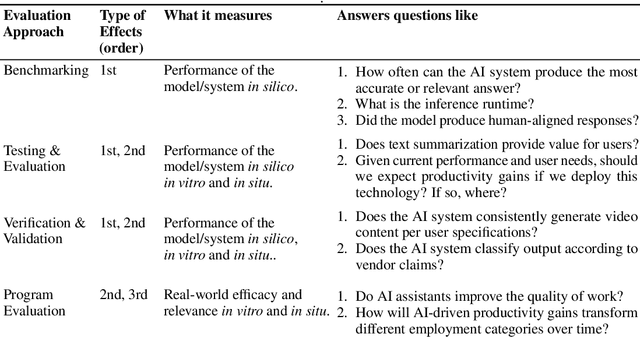
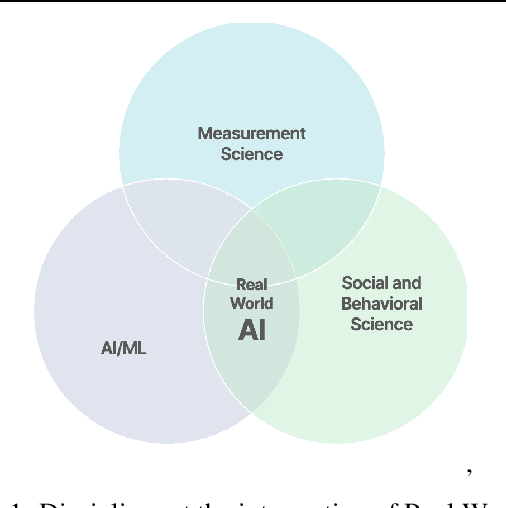
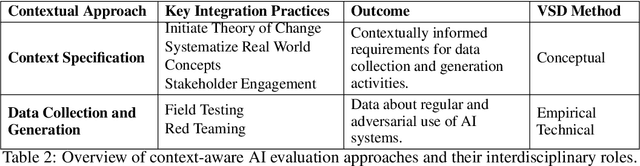
Conventional AI evaluation approaches concentrated within the AI stack exhibit systemic limitations for exploring, navigating and resolving the human and societal factors that play out in real world deployment such as in education, finance, healthcare, and employment sectors. AI capability evaluations can capture detail about first-order effects, such as whether immediate system outputs are accurate, or contain toxic, biased or stereotypical content, but AI's second-order effects, i.e. any long-term outcomes and consequences that may result from AI use in the real world, have become a significant area of interest as the technology becomes embedded in our daily lives. These secondary effects can include shifts in user behavior, societal, cultural and economic ramifications, workforce transformations, and long-term downstream impacts that may result from a broad and growing set of risks. This position paper argues that measuring the indirect and secondary effects of AI will require expansion beyond static, single-turn approaches conducted in silico to include testing paradigms that can capture what actually materializes when people use AI technology in context. Specifically, we describe the need for data and methods that can facilitate contextual awareness and enable downstream interpretation and decision making about AI's secondary effects, and recommend requirements for a new ecosystem.