 Add to Chrome
 Add to Firefox
 Add to Edge
Challenges in Evaluating Explanation Methods for Static and Evolving Data
Aug 06, 2026
This paper addresses the limitations of Explainable Artificial Intelligence (XAI) with respect to insufficient evaluation. They are illustrated through the DetoxAI image recognition system for bias detection and concept unlearning. Then, an example of a human-grounded evaluation of methods for explaining image classification is presented. The paper further explores methods for adapting explanations to evolving data streams with concept drift. Experiences with adapting counterfactuals for this problem are discussed. Finally it is related to the challenges of tracking the co-evolution of data, models, and explanations.\footnote{This paper has been accepted for a publication in J.Nalepa (ed) Explainable AI in Space. Proceedings of EASi 2026 Workshop at IJCAI-ECAI 2026 Bremen, Springer CCIS vol 3107 (2016).}

Alike Parts: A Feature-Informed Approach to Local and Global Prototype Explanations
May 20, 2026Prototype-based explanations offer an intuitive, example-based approach to support the interpretability of machine learning black box classifiers but often lack feature-level granularity. We introduce a framework that integrates feature importance at two levels to address this gap. First, for local explanations, we propose \textit{alike parts}: a method that uses feature importance scores to highlight the most relevant, shared feature subsets between a classified instance and its nearest prototype, guiding user attention. Second, we augment the global prototype selection objective function with a feature importance term to actively promote diversity in the feature attributions of the selected prototypes. Experiments on six benchmark datasets show that this augmented selection process maintains or, in some cases, increases the prediction fidelity of the surrogate model, suggesting that feature diversity does not compromise model fidelity.
PREF-XAI: Preference-Based Personalized Rule Explanations of Black-Box Machine Learning Models
Apr 21, 2026Explainable artificial intelligence (XAI) has predominantly focused on generating model-centric explanations that approximate the behavior of black-box models. However, such explanations often overlook a fundamental aspect of interpretability: different users require different explanations depending on their goals, preferences, and cognitive constraints. Although recent work has explored user-centric and personalized explanations, most existing approaches rely on heuristic adaptations or implicit user modeling, lacking a principled framework for representing and learning individual preferences. In this paper, we consider Preference-Based Explainable Artificial Intelligence (PREF-XAI), a novel perspective that reframes explanation as a preference-driven decision problem. Within PREF-XAI, explanations are not treated as fixed outputs, but as alternatives to be evaluated and selected according to user-specific criteria. In the PREF-XAI perspective, here we propose a methodology that combines rule-based explanations with formal preference learning. User preferences are elicited through a ranking of a small set of candidate explanations and modeled via an additive utility function inferred using robust ordinal regression. Experimental results on real-world datasets show that PREF-XAI can accurately reconstruct user preferences from limited feedback, identify highly relevant explanations, and discover novel explanatory rules not initially considered by the user. Beyond the proposed methodology, this work establishes a connection between XAI and preference learning, opening new directions for interactive and adaptive explanation systems.
A Probabilistic Consensus-Driven Approach for Robust Counterfactual Explanations
Apr 19, 2026Counterfactual explanations (CFEs) are essential for interpreting black-box models, yet they often become invalid when models are slightly changed. Existing methods for generating robust CFEs are often limited to specific types of models, require costly tuning, or inflexible robustness controls. We propose a novel approach that jointly models the data distribution and the space of plausible model decisions to ensure robustness to model changes. Using a probabilistic consensus over a model ensemble, we train a conditional normalizing flow that captures the data density under varying levels of classifier agreement. At inference time, a single interpretable parameter controls the robustness level; it specifies the minimum fraction of models that should agree on the target class without retraining the generative model. Our method effectively pushes CFEs toward regions that are both plausible and stable across model changes. Experimental results demonstrate that our approach achieves superior empirical robustness while also maintaining good performance across other evaluation measures.
Towards Differentiating Between Failures and Domain Shifts in Industrial Data Streams
Mar 09, 2026Anomaly and failure detection methods are crucial in identifying deviations from normal system operational conditions, which allows for actions to be taken in advance, usually preventing more serious damages. Long-lasting deviations indicate failures, while sudden, isolated changes in the data indicate anomalies. However, in many practical applications, changes in the data do not always represent abnormal system states. Such changes may be recognized incorrectly as failures, while being a normal evolution of the system, e.g. referring to characteristics of starting the processing of a new product, i.e. realizing a domain shift. Therefore, distinguishing between failures and such ''healthy'' changes in data distribution is critical to ensure the practical robustness of the system. In this paper, we propose a method that not only detects changes in the data distribution and anomalies but also allows us to distinguish between failures and normal domain shifts inherent to a given process. The proposed method consists of a modified Page-Hinkley changepoint detector for identification of the domain shift and possible failures and supervised domain-adaptation-based algorithms for fast, online anomaly detection. These two are coupled with an explainable artificial intelligence (XAI) component that aims at helping the human operator to finally differentiate between domain shifts and failures. The method is illustrated by an experiment on a data stream from the steel factory.
An interpretable prototype parts-based neural network for medical tabular data
Mar 05, 2026The ability to interpret machine learning model decisions is critical in such domains as healthcare, where trust in model predictions is as important as their accuracy. Inspired by the development of prototype parts-based deep neural networks in computer vision, we propose a new model for tabular data, specifically tailored to medical records, that requires discretization of diagnostic result norms. Unlike the original vision models that rely on the spatial structure, our method employs trainable patching over features describing a patient, to learn meaningful prototypical parts from structured data. These parts are represented as binary or discretized feature subsets. This allows the model to express prototypes in human-readable terms, enabling alignment with clinical language and case-based reasoning. Our proposed neural network is inherently interpretable and offers interpretable concept-based predictions by comparing the patient's description to learned prototypes in the latent space of the network. In experiments, we demonstrate that the model achieves classification performance competitive to widely used baseline models on medical benchmark datasets, while also offering transparency, bridging the gap between predictive performance and interpretability in clinical decision support.
Explaining Concept Drift through the Evolution of Group Counterfactuals
Sep 11, 2025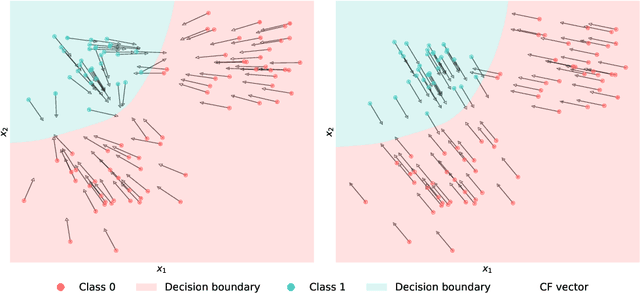
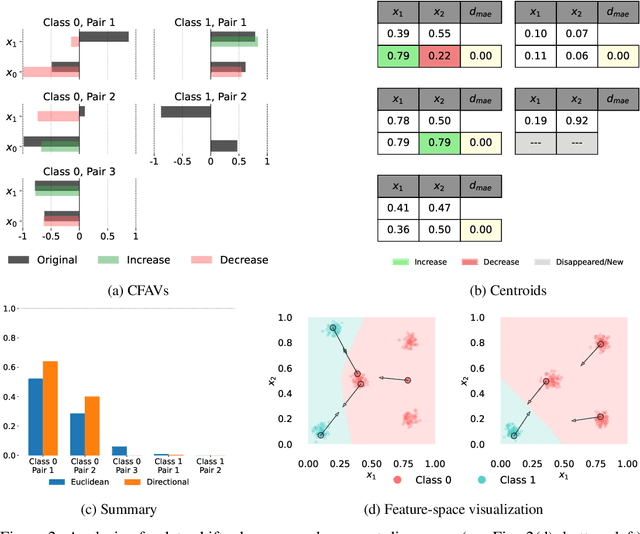
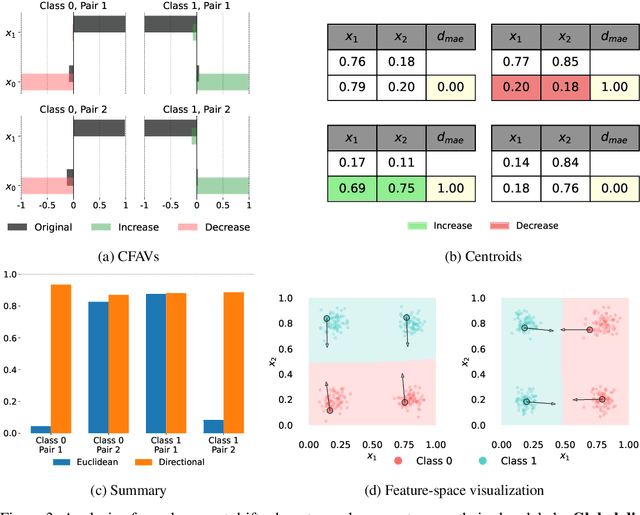
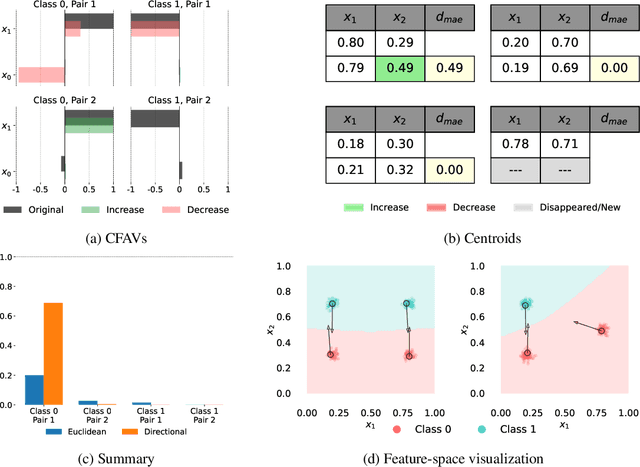
Machine learning models in dynamic environments often suffer from concept drift, where changes in the data distribution degrade performance. While detecting this drift is a well-studied topic, explaining how and why the model's decision-making logic changes still remains a significant challenge. In this paper, we introduce a novel methodology to explain concept drift by analyzing the temporal evolution of group-based counterfactual explanations (GCEs). Our approach tracks shifts in the GCEs' cluster centroids and their associated counterfactual action vectors before and after a drift. These evolving GCEs act as an interpretable proxy, revealing structural changes in the model's decision boundary and its underlying rationale. We operationalize this analysis within a three-layer framework that synergistically combines insights from the data layer (distributional shifts), the model layer (prediction disagreement), and our proposed explanation layer. We show that such holistic view allows for a more comprehensive diagnosis of drift, making it possible to distinguish between different root causes, such as a spatial data shift versus a re-labeling of concepts.
This part looks alike this: identifying important parts of explained instances and prototypes
May 08, 2025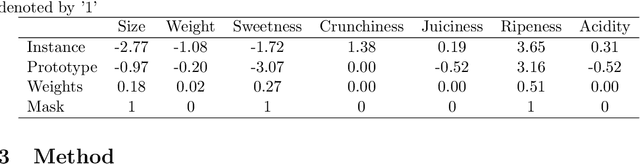
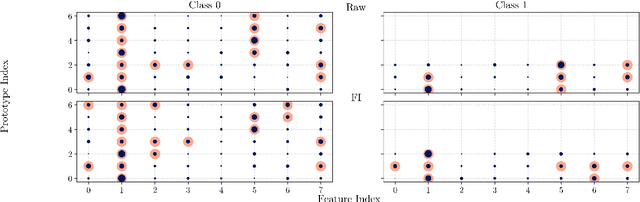
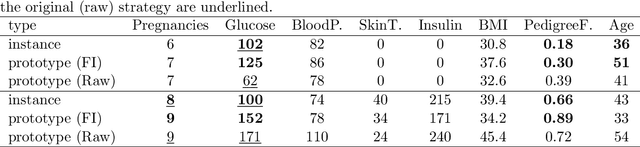
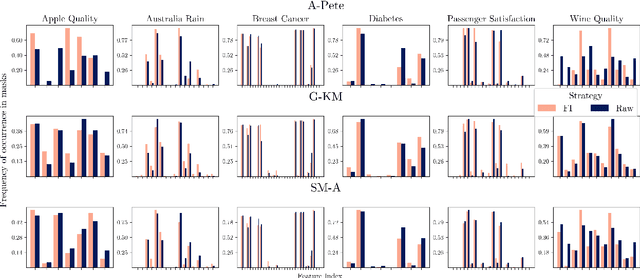
Although prototype-based explanations provide a human-understandable way of representing model predictions they often fail to direct user attention to the most relevant features. We propose a novel approach to identify the most informative features within prototypes, termed alike parts. Using feature importance scores derived from an agnostic explanation method, it emphasizes the most relevant overlapping features between an instance and its nearest prototype. Furthermore, the feature importance score is incorporated into the objective function of the prototype selection algorithms to promote global prototypes diversity. Through experiments on six benchmark datasets, we demonstrate that the proposed approach improves user comprehension while maintaining or even increasing predictive accuracy.
DetoxAI: a Python Toolkit for Debiasing Deep Learning Models in Computer Vision
May 02, 2025While machine learning fairness has made significant progress in recent years, most existing solutions focus on tabular data and are poorly suited for vision-based classification tasks, which rely heavily on deep learning. To bridge this gap, we introduce DetoxAI, an open-source Python library for improving fairness in deep learning vision classifiers through post-hoc debiasing. DetoxAI implements state-of-the-art debiasing algorithms, fairness metrics, and visualization tools. It supports debiasing via interventions in internal representations and includes attribution-based visualization tools and quantitative algorithmic fairness metrics to show how bias is mitigated. This paper presents the motivation, design, and use cases of DetoxAI, demonstrating its tangible value to engineers and researchers.
Properties of fairness measures in the context of varying class imbalance and protected group ratios
Nov 13, 2024


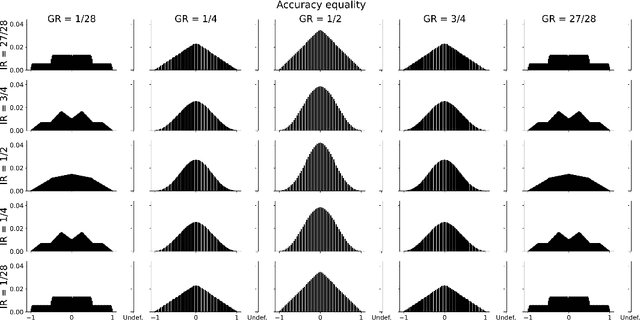
Society is increasingly relying on predictive models in fields like criminal justice, credit risk management, or hiring. To prevent such automated systems from discriminating against people belonging to certain groups, fairness measures have become a crucial component in socially relevant applications of machine learning. However, existing fairness measures have been designed to assess the bias between predictions for protected groups without considering the imbalance in the classes of the target variable. Current research on the potential effect of class imbalance on fairness focuses on practical applications rather than dataset-independent measure properties. In this paper, we study the general properties of fairness measures for changing class and protected group proportions. For this purpose, we analyze the probability mass functions of six of the most popular group fairness measures. We also measure how the probability of achieving perfect fairness changes for varying class imbalance ratios. Moreover, we relate the dataset-independent properties of fairness measures described in this paper to classifier fairness in real-life tasks. Our results show that measures such as Equal Opportunity and Positive Predictive Parity are more sensitive to changes in class imbalance than Accuracy Equality. These findings can help guide researchers and practitioners in choosing the most appropriate fairness measures for their classification problems.