 Add to Chrome
 Add to Firefox
 Add to Edge
From Global to Local: Efficient Regional Weather Downscaling with Global Weather Foundation Model
Jul 03, 2026
Accurate regional weather prediction requires resolving fine-scale structure while remaining consistent with global dynamics. Traditional limited area models rely on computationally expensive simulations, while many learning-based approaches frame the problem as super-resolution, overlooking statistical and physical mismatches across scales. We propose a foundation-model-driven downscaling framework that learns regional refinements of global forecasts by augmenting a pretrained weather model backbone with lightweight, multi-scale prediction heads operating directly in its latent space. Despite being trained on substantially coarser inputs, the pretrained backbone supports regional adaptation at resolutions corresponding to a two-order-of-magnitude increase in grid-cell resolution, without the need for retraining. The proposed approach uses regional numerical simulations as training targets and is evaluated not only against gridded datasets but also against ground-based weather station observations, enabling analysis of systematic biases between global reanalysis, regional simulations, and in-situ weather station observations. Our experiments show improved accuracy in comparison to NWP on most of the metrics at the fraction of computational cost. Moreover, we observe that building on a latent space of globally pre-trained weather foundation model offers better downscaling capabilities than the standard image-based super-resolution approaches.

SRS-Stories: Vocabulary-constrained multilingual story generation for language learning
Dec 20, 2025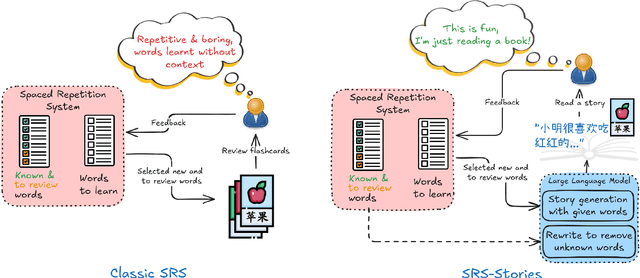
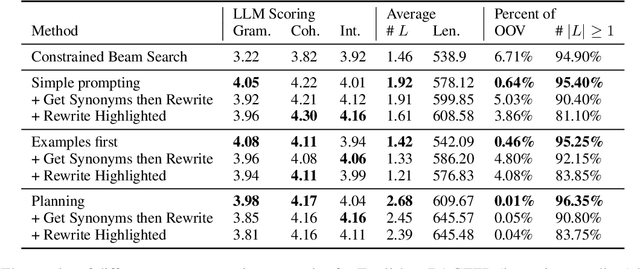
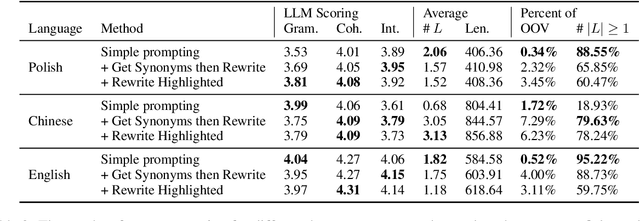
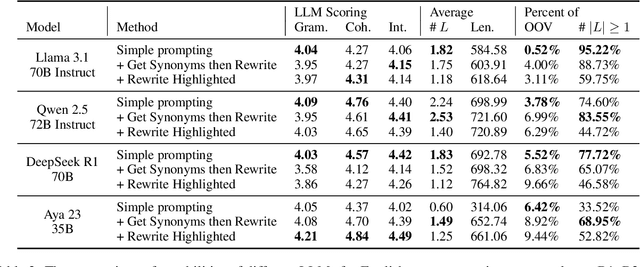
In this paper, we use large language models to generate personalized stories for language learners, using only the vocabulary they know. The generated texts are specifically written to teach the user new vocabulary by simply reading stories where it appears in context, while at the same time seamlessly reviewing recently learned vocabulary. The generated stories are enjoyable to read and the vocabulary reviewing/learning is optimized by a Spaced Repetition System. The experiments are conducted in three languages: English, Chinese and Polish, evaluating three story generation methods and three strategies for enforcing lexical constraints. The results show that the generated stories are more grammatical, coherent, and provide better examples of word usage than texts generated by the standard constrained beam search approach