 Add to Chrome
 Add to Firefox
 Add to Edge
Resilient AI Supercomputer Networking using MRC and SRv6
May 05, 2026
Tail latency dominates the performance of synchronous pretraining jobs when running at very large scales. We describe a three-pronged approach: (1) a new RDMA-based transport protocol, MRC, sprays across many paths and actively load-balances between them, eliminating the issue of flow collisions (2) the use of multi-plane Clos topologies to get the benefits of high switch radix and redundancy, allowing training clusters well over 100K GPUs to be built as two-tier topologies while increasing physical redundancy, and (3) the use of static source-routing using SRv6 to allow MRC the freedom to bypass failures by itself. We describe our experiences running MRC and static SRv6 routing in production in OpenAI and Microsoft's largest training clusters, where it has been used to train the latest frontier models. We demonstrate how MRC allows AI training jobs to ride out many network failures that previously would have interrupted training.

Scaling Distributed Machine Learning with In-Network Aggregation
Feb 22, 2019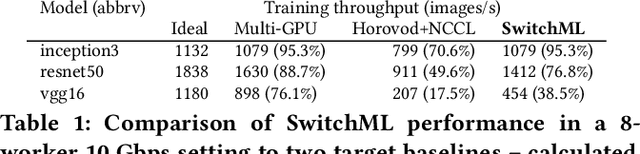
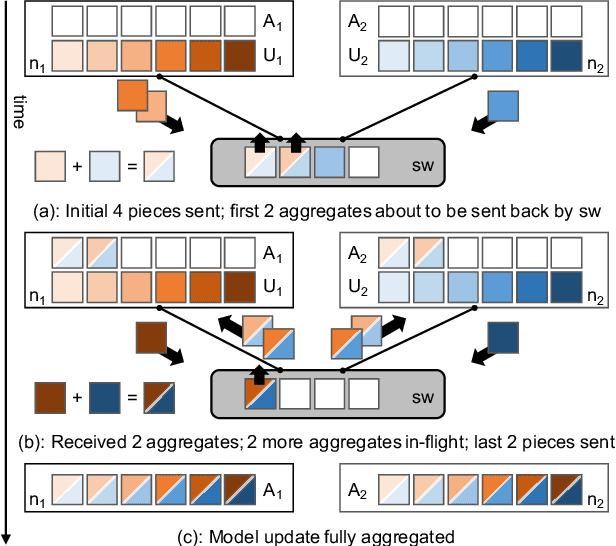
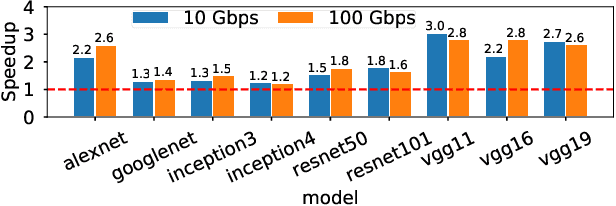
Training complex machine learning models in parallel is an increasingly important workload. We accelerate distributed parallel training by designing a communication primitive that uses a programmable switch dataplane to execute a key step of the training process. Our approach, SwitchML, reduces the volume of exchanged data by aggregating the model updates from multiple workers in the network. We co-design the switch processing with the end-host protocols and ML frameworks to provide a robust, efficient solution that speeds up training by up to 300%, and at least by 20% for a number of real-world benchmark models.