 Add to Chrome
 Add to Firefox
 Add to Edge
The Unified Autonomy Stack: Toward a Blueprint for Generalizable Robot Autonomy
May 12, 2026
We introduce and open-source the Unified Autonomy Stack, a system-level solution that enables resilient autonomy across diverse aerial and ground robot morphologies. The architecture centers on three synergistic modules -- multi-modal perception, multi-behavior planning, and multi-layered safe navigation -- that together deliver comprehensive mission autonomy. The stack fuses data from LiDAR, radar, vision, and inertial sensing, enabling (a) robust localization and mapping through factor graph-based fusion, (b) semantic scene understanding, (c) motion and informative path planning through sampling-based techniques adaptive across spatial scales, as well as (d) multi-layered safe navigation both through planning on the online reconstructed map and deep learning-driven exteroceptive policies alongside last-resort safety filters using control barrier functions. The resulting behaviors include safe GNSS-denied navigation into unknown and perceptually-degraded regions, exploration of complex environments, object discovery, and efficient inspection planning. The stack has been field-tested and validated on both aerial (rotorcraft) and ground (legged) robots operating in a host of demanding environments, including self-similar and smoke-filled settings, with complex geometries and high obstacle clutter. These tests demonstrate resilient performance in challenging conditions. To facilitate ease of adoption, we open-source the implementation alongside supporting documentation, validation, and evaluation datasets https://github.com/ntnu-arl/unified_autonomy_stack. A video giving the overview of the paper and the field experiments is available at https://youtu.be/l8Su8OXsM-E.

DigiForest: Digital Analytics and Robotics for Sustainable Forestry
Apr 16, 2026Covering one third of Earth's land surface, forests are vital to global biodiversity, climate regulation, and human well-being. In Europe, forests and woodlands reach approximately 40% of land area, and the forestry sector is central to achieving the EU's climate neutrality and biodiversity goals; these emphasize sustainable forest management, increased use of long-lived wood products, and resilient forest ecosystems. To meet these goals and properly address their inherent challenges, current practices require further innovation. This chapter introduces DigiForest, a novel, large-scale precision forestry approach leveraging digital technologies and autonomous robotics. DigiForest is structured around four main components: (1) autonomous, heterogeneous mobile robots (aerial, legged, and marsupial) for tree-level data collection; (2) automated extraction of tree traits to build forest inventories; (3) a Decision Support System (DSS) for forecasting forest growth and supporting decision-making; and (4) low-impact selective logging using purpose-built autonomous harvesters. These technologies have been extensively validated in real-world conditions in several locations, including forests in Finland, the UK, and Switzerland.
Embedded Safe Reactive Navigation for Multirotors Systems using Control Barrier Functions
Apr 22, 2025Aiming to promote the wide adoption of safety filters for autonomous aerial robots, this paper presents a safe control architecture designed for seamless integration into widely used open-source autopilots. Departing from methods that require consistent localization and mapping, we formalize the obstacle avoidance problem as a composite control barrier function constructed only from the online onboard range measurements. The proposed framework acts as a safety filter, modifying the acceleration references derived by the nominal position/velocity control loops, and is integrated into the PX4 autopilot stack. Experimental studies using a small multirotor aerial robot demonstrate the effectiveness and performance of the solution within dynamic maneuvering and unknown environments.
Safe Quadrotor Navigation using Composite Control Barrier Functions
Feb 06, 2025This paper introduces a safety filter to ensure collision avoidance for multirotor aerial robots. The proposed formalism leverages a single Composite Control Barrier Function from all position constraints acting on a third-order nonlinear representation of the robot's dynamics. We analyze the recursive feasibility of the safety filter under the composite constraint and demonstrate that the infeasible set is negligible. The proposed method allows computational scalability against thousands of constraints and, thus, complex scenes with numerous obstacles. We experimentally demonstrate its ability to guarantee the safety of a quadrotor with an onboard LiDAR, operating in both indoor and outdoor cluttered environments against both naive and adversarial nominal policies.
Neural Control Barrier Functions for Safe Navigation
Jul 29, 2024Autonomous robot navigation can be particularly demanding, especially when the surrounding environment is not known and safety of the robot is crucial. This work relates to the synthesis of Control Barrier Functions (CBFs) through data for safe navigation in unknown environments. A novel methodology to jointly learn CBFs and corresponding safe controllers, in simulation, inspired by the State Dependent Riccati Equation (SDRE) is proposed. The CBF is used to obtain admissible commands from any nominal, possibly unsafe controller. An approach to apply the CBF inside a safety filter without the need for a consistent map or position estimate is developed. Subsequently, the resulting reactive safety filter is deployed on a multirotor platform integrating a LiDAR sensor both in simulation and real-world experiments.
N-MPC for Deep Neural Network-Based Collision Avoidance exploiting Depth Images
Feb 20, 2024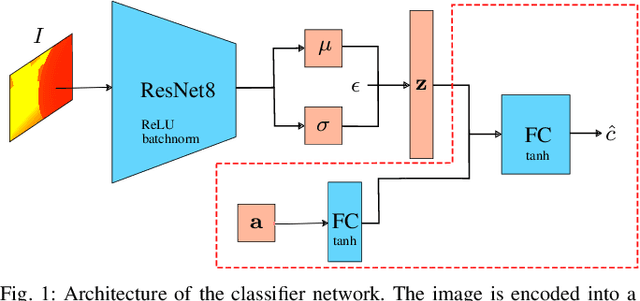
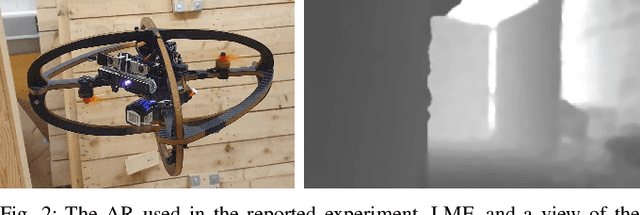


This paper introduces a Nonlinear Model Predictive Control (N-MPC) framework exploiting a Deep Neural Network for processing onboard-captured depth images for collision avoidance in trajectory-tracking tasks with UAVs. The network is trained on simulated depth images to output a collision score for queried 3D points within the sensor field of view. Then, this network is translated into an algebraic symbolic equation and included in the N-MPC, explicitly constraining predicted positions to be collision-free throughout the receding horizon. The N-MPC achieves real time control of a UAV with a control frequency of 100Hz. The proposed framework is validated through statistical analysis of the collision classifier network, as well as Gazebo simulations and real experiments to assess the resulting capabilities of the N-MPC to effectively avoid collisions in cluttered environments. The associated code is released open-source along with the training images.