 Add to Chrome
 Add to Firefox
 Add to Edge
Neural Tracking of Sustained Attention, Attention Switching, and Natural Conversation in Audiovisual Environments using Mobile EEG
Jan 21, 2026
Everyday communication is dynamic and multisensory, often involving shifting attention, overlapping speech and visual cues. Yet, most neural attention tracking studies are still limited to highly controlled lab settings, using clean, often audio-only stimuli and requiring sustained attention to a single talker. This work addresses that gap by introducing a novel dataset from 24 normal-hearing participants. We used a mobile electroencephalography (EEG) system (44 scalp electrodes and 20 cEEGrid electrodes) in an audiovisual (AV) paradigm with three conditions: sustained attention to a single talker in a two-talker environment, attention switching between two talkers, and unscripted two-talker conversations with a competing single talker. Analysis included temporal response functions (TRFs) modeling, optimal lag analysis, selective attention classification with decision windows ranging from 1.1s to 35s, and comparisons of TRFs for attention to AV conversations versus side audio-only talkers. Key findings show significant differences in the attention-related P2-peak between attended and ignored speech across conditions for scalp EEG. No significant change in performance between switching and sustained attention suggests robustness for attention switches. Optimal lag analysis revealed narrower peak for conversation compared to single-talker AV stimuli, reflecting the additional complexity of multi-talker processing. Classification of selective attention was consistently above chance (55-70% accuracy) for scalp EEG, while cEEGrid data yielded lower correlations, highlighting the need for further methodological improvements. These results demonstrate that mobile EEG can reliably track selective attention in dynamic, multisensory listening scenarios and provide guidance for designing future AV paradigms and real-world attention tracking applications.

On the Relationship Between Iterated Statistical Linearization and Quasi-Newton Methods
Sep 14, 2023This letter investigates relationships between iterated filtering algorithms based on statistical linearization, such as the iterated unscented Kalman filter (IUKF), and filtering algorithms based on quasi-Newton (QN) methods, such as the QN iterated extended Kalman filter (QN-IEKF). Firstly, it is shown that the IUKF and the iterated posterior linearization filter (IPLF) can be viewed as QN algorithms, by finding a Hessian correction in the QN-IEKF such that the IPLF iterate updates are identical to that of the QN-IEKF. Secondly, it is shown that the IPLF/IUKF update can be rewritten such that it is approximately identical to the QN-IEKF, albeit for an additional correction term. This enables a richer understanding of the properties of iterated filtering algorithms based on statistical linearization.
Predicting EEG Responses to Attended Speech via Deep Neural Networks for Speech
Feb 27, 2023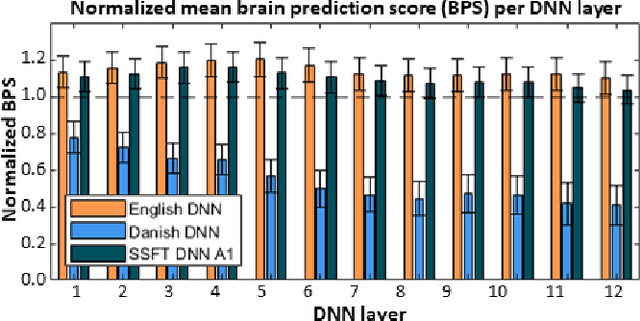
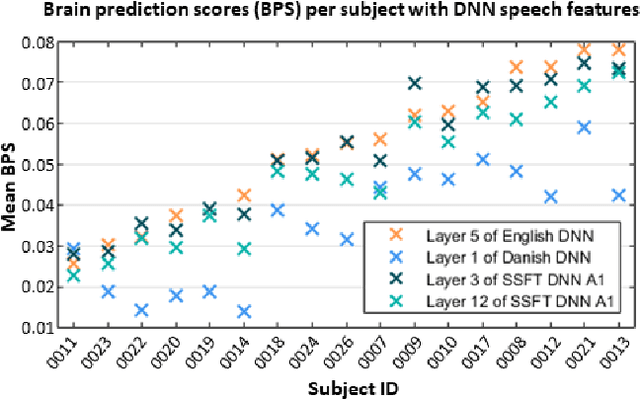
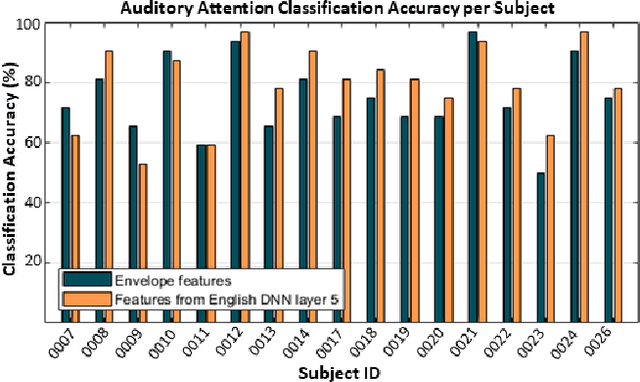
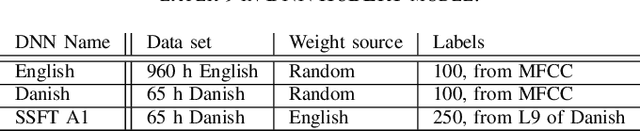
Attending to the speech stream of interest in multi-talker environments can be a challenging task, particularly for listeners with hearing impairment. Research suggests that neural responses assessed with electroencephalography (EEG) are modulated by listener`s auditory attention, revealing selective neural tracking (NT) of the attended speech. NT methods mostly rely on hand-engineered acoustic and linguistic speech features to predict the neural response. Only recently, deep neural network (DNN) models without specific linguistic information have been used to extract speech features for NT, demonstrating that speech features in hierarchical DNN layers can predict neural responses throughout the auditory pathway. In this study, we go one step further to investigate the suitability of similar DNN models for speech to predict neural responses to competing speech observed in EEG. We recorded EEG data using a 64-channel acquisition system from 17 listeners with normal hearing instructed to attend to one of two competing talkers. Our data revealed that EEG responses are significantly better predicted by DNN-extracted speech features than by hand-engineered acoustic features. Furthermore, analysis of hierarchical DNN layers showed that early layers yielded the highest predictions. Moreover, we found a significant increase in auditory attention classification accuracies with the use of DNN-extracted speech features over the use of hand-engineered acoustic features. These findings open a new avenue for development of new NT measures to evaluate and further advance hearing technology.